Almenara Castle
Almenara Castle stands as a significant example of a hill castle in Spain, with origins tracing back to the 10th century during the Muslim rule. This fortress occupies a commanding position on a steep hill overlooking the town of Almenara, strategically placed to control vital routes between the Mediterranean coast and inland territories. Its name, derived from the Arabic term "Al-manara," meaning "beacon" or "signal tower," reflects its primary function as a frontier watchpoint between the Taifa kingdoms of Valencia and Tortosa.
Historical origins and early significance
The site of Almenara Castle reveals a deep historical layering, with archaeological evidence indicating earlier Roman and Iberian settlements on the hill’s northern slope. The castle itself was constructed by Muslim builders during the late Taifa period in the 10th century, utilizing and expanding upon these earlier foundations. This period was marked by political fragmentation in the Iberian Peninsula, with numerous Muslim principalities vying for control, making the castle’s location crucial for military oversight and territorial defense.
Written records first mention the castle in the 11th century, but its strategic importance was well established by then. The fortress served as a vital military and signaling point, overseeing important coastal and inland routes, including those leading toward Aragón. Its role extended beyond defense, as it was also a center of administration and local governance under Muslim rule.
Christian conquest and medieval prominence
Following the Reconquista, King James I of Aragón incorporated Almenara Castle into his expanding Christian kingdom in 1238. The fortress is referenced in his chronicle, the Llibre dels fets, underscoring its continued military and strategic relevance. The castle’s inclusion in medieval Spanish literature, notably the epic poem Cantar de Mío Cid, highlights its cultural as well as military significance during the Middle Ages.
Under Christian control, the castle continued to serve as a defensive stronghold and administrative center. Its fortifications were adapted to meet evolving military technologies and threats, although the core structure retained much of its original Muslim architectural character.
Architectural features and layout
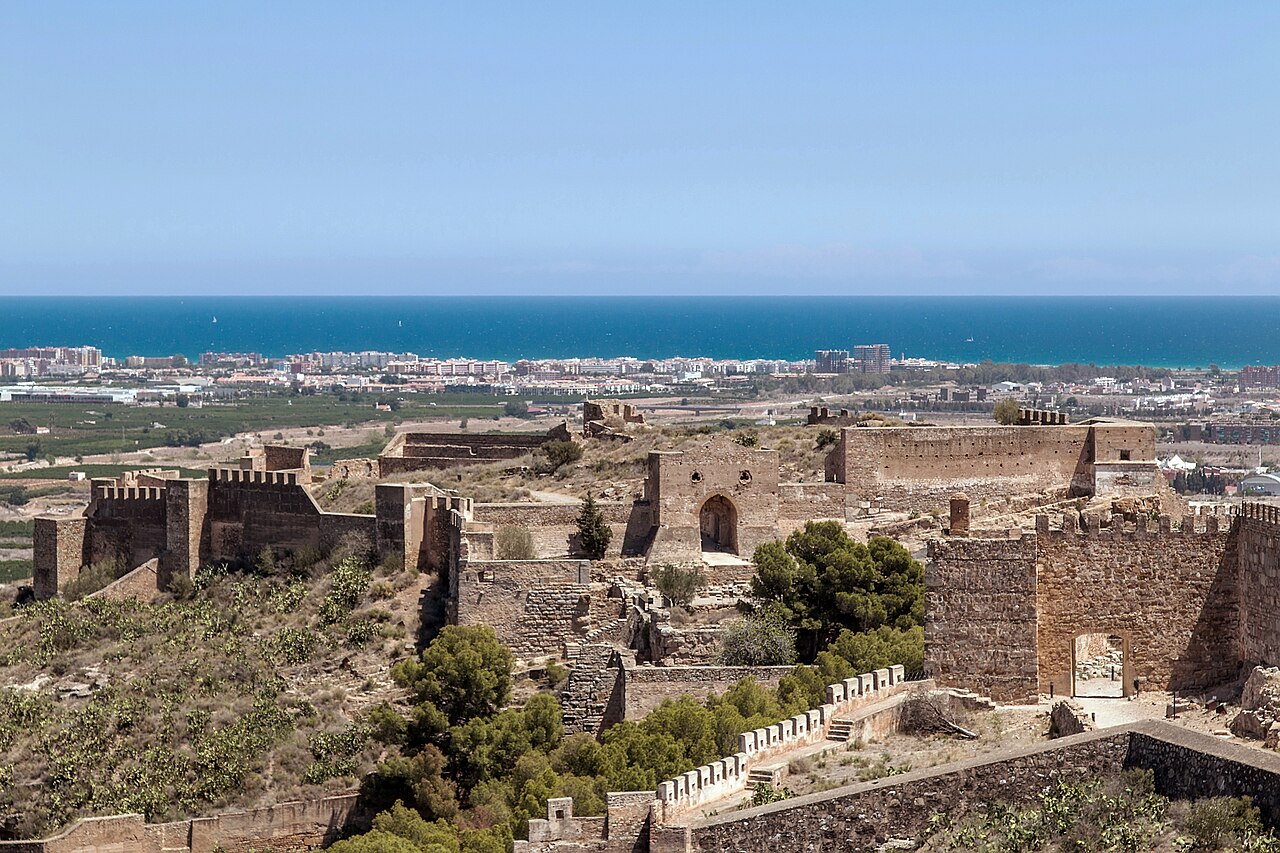
Almenara Castle exhibits a complex and irregular layout shaped by the natural contours of the hill, extending from east to west. The fortress comprises three main enclosed areas, with the main fortress occupying the highest platform of approximately 4,000 square meters. While largely in ruins today, this central section remains the focal point of the site.
Below the main fortress lies the albacar, a fortified courtyard that provided an additional defensive layer protecting the main keep. Within this enclosure, visitors can still see the remains of a cistern (aljibe), which collected and stored water essential for the castle’s inhabitants during sieges. Historical records also confirm the presence of a mosque within the albacar, reflecting the religious practices maintained during the Muslim period.
Isolated towers and signaling points
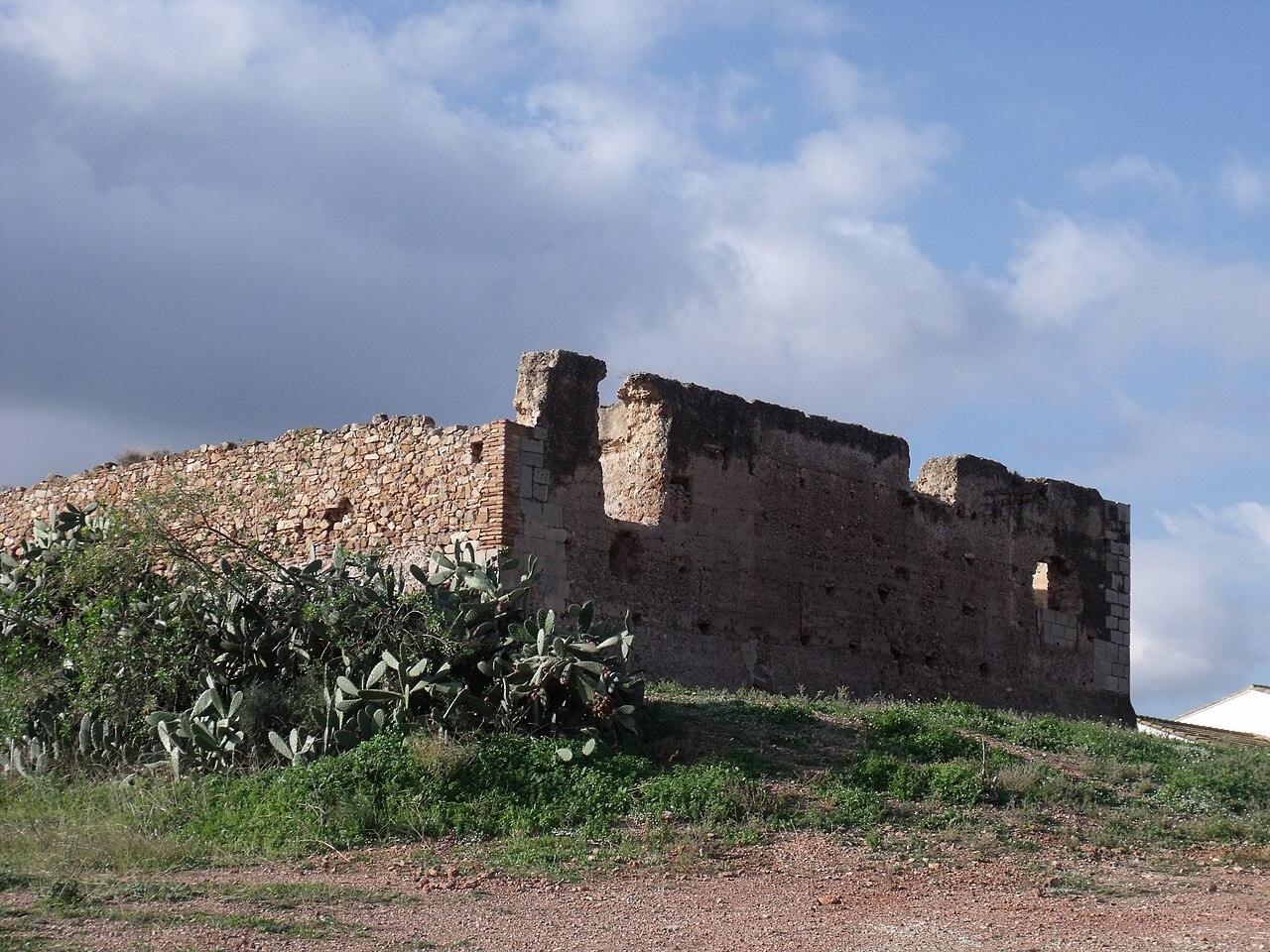
At the eastern and western ends of the hill stand two isolated towers known as Bivalcadim and Bergamuza (also called L’Agüeleta). These towers have survived better than many other structures and served as lookout points or signaling stations, consistent with the castle’s role as a beacon. The Bergamuza tower was notably rebuilt in the 19th century using stone from a demolished Dominican convent, repurposed as a communications post rather than a defensive structure.
Defensive walls and terrain adaptation
Parts of the castle’s enclosure walls remain, particularly to the northeast, where they follow the hill’s uneven terrain with staggered defenses and substantial retaining walls supporting the upper platform. The southern side of the site contains remnants of additional buildings, now in ruins, illustrating the castle’s layered construction phases and adaptation to the natural landscape.
Later use and preservation
Though the castle’s military importance waned over the centuries, its elevated position continued to be valued for communication purposes, as demonstrated by the 19th-century reconstruction of the Bergamuza tower. Today, Almenara Castle is an archaeological site of historical and cultural significance, offering visitors a glimpse into the layered history of Muslim and Christian presence in eastern Spain.
Despite the ruinous condition of much of the fortress, the surviving structures—including the cistern, towers, and walls—provide valuable insight into medieval military architecture and the strategic use of landscape in castle construction. The castle remains a prominent landmark in the region, symbolizing the complex historical interactions between different cultures and powers on the Iberian Peninsula.
Visiting Almenara Castle
Visitors to Almenara Castle can explore the ruins and appreciate the commanding views over the town and surrounding countryside. The visible cistern and surviving towers offer tangible connections to the castle’s past functions. The site’s irregular layout and hillside setting provide an engaging experience for those interested in medieval fortifications and Spanish history.
The castle’s location in the town of Almenara makes it accessible for tourists exploring the broader region of eastern Spain, which is rich in historical sites from Roman, Muslim, and Christian periods. While the castle is largely in ruins, its historical significance and architectural remnants make it a noteworthy destination for cultural heritage enthusiasts.
Frequently asked questions (FAQ)
- When was Almenara Castle originally built?
- Almenara Castle was originally constructed in the 10th century by Muslim builders during the late Taifa period.
- What is the significance of the castle's name?
- The name "Almenara" derives from the Arabic "Al-manara," meaning "beacon" or "signal tower," reflecting its role as a frontier watchpoint.
- Can visitors see the original cistern at the castle?
- Yes, the cistern (aljibe) within the albacar courtyard is still visible and demonstrates the castle's water storage system.
- What are the notable surviving structures at Almenara Castle?
- The two isolated towers, Bivalcadim and Bergamuza, along with the enclosure walls and cistern, are among the best-preserved features.
- Is Almenara Castle mentioned in historical literature?
- Yes, it appears in King James I's chronicle, the Llibre dels fets, and the medieval epic poem Cantar de Mío Cid.
Information
Loading map...
Visitor reviews
No reviews yet. Been here? Write the first review and help other travelers!
Write the first reviewVisited this castle? Share your experience
Your review helps other travelers and adds first-hand knowledge to our encyclopedia.