Sagunto Castle
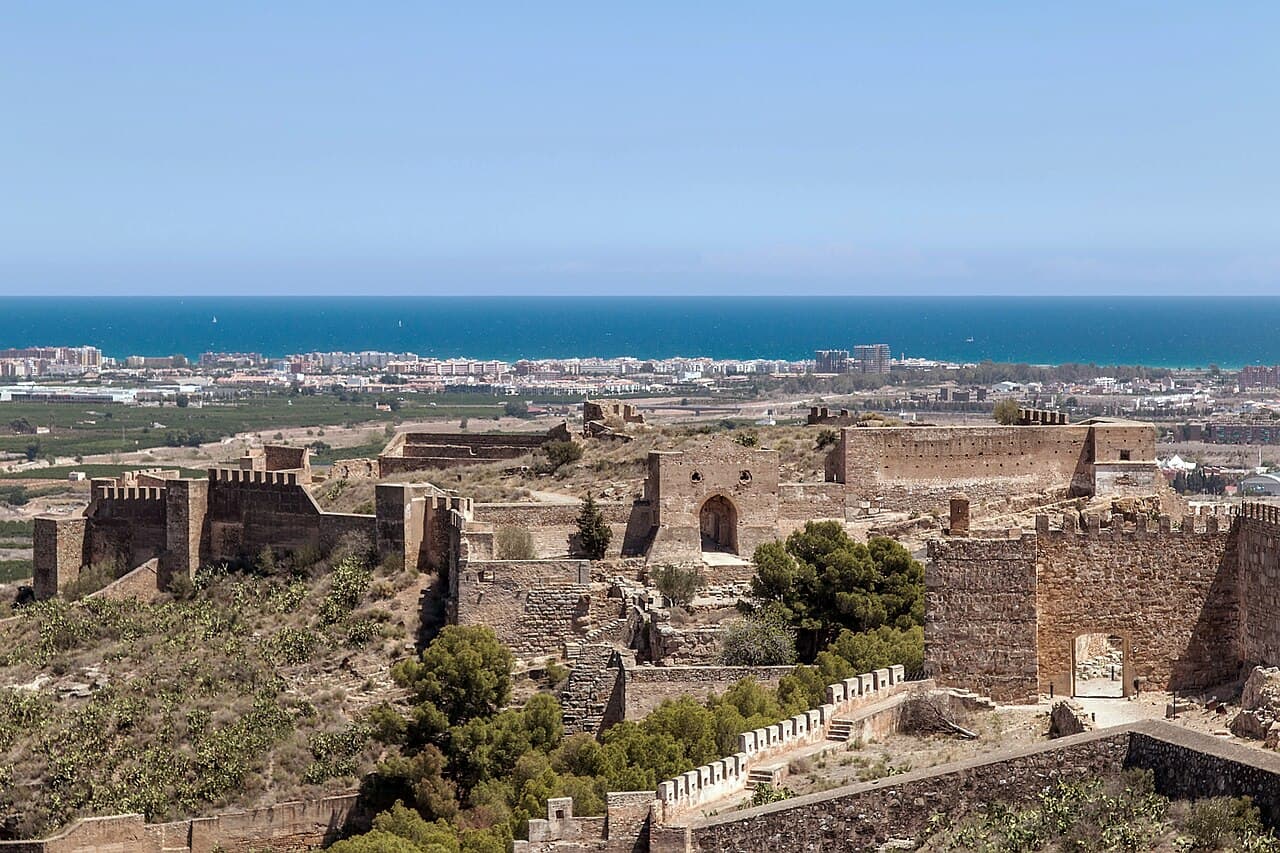
Sagunto Castle is a prominent hilltop fortress overlooking the town of Sagunto near Valencia, Spain. Its history spans over two millennia, encompassing significant Iberian, Roman, Islamic, and medieval remains. The castle's strategic location atop a flat-topped hill rising 172 meters above sea level provided commanding views of the Mediterranean coast and the surrounding landscape, making it a crucial military and administrative center throughout its long history.
The ancient origins and Roman development
The site of Sagunto Castle was originally settled by the Iberians, who called it Arse. This early settlement dates back to the early 1st millennium BC. The extensive Iberian defensive walls on the eastern side of the castle, dating from the early 4th century BC, are among the oldest surviving fortifications on the site. These walls enclosed a territory larger than the current castle footprint, highlighting the area's importance in prehistoric times.
The settlement gained wider historical significance during the Second Punic War when the Carthaginian general Hannibal attacked Sagunto in 219 BC. This assault triggered the war between Rome and Carthage. The Romans recaptured the city in 214 BC, renaming it Saguntum or Saguntinum and elevating it to the status of a Roman municipium.
Between approximately 175 and 100 BC, the Romans undertook major construction projects on the hilltop, including the building of a temple (capitolium) and a large water cistern. These structures later became part of an imperial forum established in the 1st century AD. The forum, measuring roughly 60 by 36.5 meters, was the city's civic heart. Adjacent to it, the basilica served as a large rectangular hall for public and judicial functions, while rows of tabernae (shops) lined the eastern edge of the forum, indicating a bustling urban center. A complex building near the forum's northeast is thought to have been the curia or a temple dedicated to Augustus, reflecting the administrative and religious significance of the site.
Further Roman cultural life is evidenced by the remains of a Roman theatre on the northwestern slope, about 50 meters below the forum. This theatre highlights the city's role as a center of entertainment and social gathering during Roman times.
Islamic period fortifications and medieval history
Following the decline of Roman authority, Sagunto fell under Islamic control during the early medieval period. The castle was known as Murbĩtar or Morvedre during this time. The Islamic rulers constructed most of the outer walls and the Albacar section, a fortified enclosure within the castle complex. These fortifications were designed to defend the regions of Catalonia and Valencia from external threats.
The castle's defensive system was further enhanced with a curtain wall descending from the hilltop to connect with the town's outer fortifications. The construction techniques used during this period included layers of adobe (sun-dried mud bricks) mixed with small stones packed between large masonry blocks, demonstrating a blend of building traditions.
El Cid, the famed Castilian nobleman and military leader, occupied Sagunto Castle from 1098 to 1102, a period marked by conflict between Christian and Muslim forces in the Iberian Peninsula. The castle was eventually incorporated into the Kingdom of Valencia by King Jaume I in 1238 during the Christian Reconquista.
Despite Christian political control, the local population remained largely Muslim for some time. By 1328, a Jewish community had also developed near the castle, evidenced by the establishment of a Jewish cemetery close to the walls. This coexistence of cultures reflects the complex social fabric of medieval Sagunto.
In the 14th century, King Peter IV of Aragon undertook significant efforts to reinforce the castle's fortifications. However, the fortress remained contested; in 1363, it was captured by King Peter of Castile after a siege, illustrating the turbulent political landscape of medieval Spain.
Renaissance and early modern military adaptations
In 1562, King Philip II commissioned the military engineer Juan Bautista Antonelli to upgrade Sagunto Castle's defenses. Antonelli's work divided the fortress into seven distinct plazas, each serving specific military functions to improve the castle's defensive coordination. These plazas include the Plaza de Armas, Plaza de Almenara, Plaza de San Fernando, and the smaller Plaza del Refectorio, which features vaulted arcades that once served as dining halls.
The castle's fortifications were adapted to accommodate evolving military technology, including artillery, which necessitated stronger walls and bastions. The division into plazas allowed for better troop deployment and defense management during sieges.
During the War of Spanish Succession in the early 18th century, Sagunto Castle briefly changed hands between the Archduke of Austria and King Philip V of Spain. The castle's strategic importance persisted through this conflict, reflecting its continued military relevance.
Napoleonic era and 19th-century military significance
In 1811, during the Peninsular War, French forces under General Suchet laid siege to Sagunto Castle. Although initially defended by Brigadier Andriani, the fortress ultimately fell to the French. After their victory, the French repaired and strengthened the castle's defenses, incorporating contemporary military engineering techniques.
The castle's walls and bastions visible today include modifications from this period, demonstrating adaptations to the demands of 19th-century warfare. The layered construction reflects centuries of military evolution, from Iberian stone walls to Napoleonic bastions.
Archaeological excavations and preservation
Interest in Sagunto Castle's archaeological heritage began in the early 20th century. In 1932, Manuel González Simancas conducted detailed excavations focusing on the Roman foundations, uncovering significant remains of the forum, basilica, temple, and cistern.
Further excavations in 1975 and 1992 revealed additional Roman and medieval structures, enhancing understanding of the site's multi-period occupation. The discovery of the Roman tower on the northern flank, dating to the early 2nd century BC, provided insight into the castle's defensive evolution, as it was later incorporated into medieval and Napoleonic fortifications.
Today, Sagunto Castle is protected as a National Monument since 1931. The visible ruins primarily reflect the Muslim citadel with later Christian and French modifications. The castle remains a significant cultural and historical landmark, illustrating the complex layers of Spanish history through its architecture and archaeological remains.
Frequently asked questions (FAQ)
- How do I get to Sagunto Castle from Valencia?
- Sagunto Castle is accessible by train and bus from Valencia. The train ride takes about 30 minutes, and the castle is a short walk from Sagunto town center.
- What is the best time of year to visit Sagunto Castle?
- The best time to visit Sagunto Castle is during spring and autumn when the weather is mild and suitable for exploring the extensive ruins comfortably.
- Is Sagunto Castle wheelchair accessible?
- Due to its hilltop location and uneven terrain, Sagunto Castle has limited wheelchair accessibility. Visitors with mobility issues should check with the visitor center for assistance options.
- What are the main historical periods represented at Sagunto Castle?
- Sagunto Castle features remains from the Iberian, Roman, Islamic, medieval Christian, and Napoleonic periods, illustrating its long and varied history.
- Can I explore the Roman ruins within Sagunto Castle?
- Yes, visitors can explore the well-preserved Roman forum, basilica, temple foundations, and theatre remains within the castle grounds.
- Are guided tours available at Sagunto Castle?
- Guided tours are available and recommended to fully appreciate the complex history and architectural features of Sagunto Castle.
- What are the opening hours and ticket prices for Sagunto Castle?
- Sagunto Castle is open daily from 10:00 to 18:00. Tickets cost €5 for adults and €3 for children.
Photo gallery

Information
Opening hours
10:00-18:00, daily
Ticket prices
€5 adult, €3 child
Current owner
Municipality of Sagunto
Loading map...
Visitor reviews
No reviews yet. Been here? Write the first review and help other travelers!
Write the first reviewVisited this castle? Share your experience
Your review helps other travelers and adds first-hand knowledge to our encyclopedia.