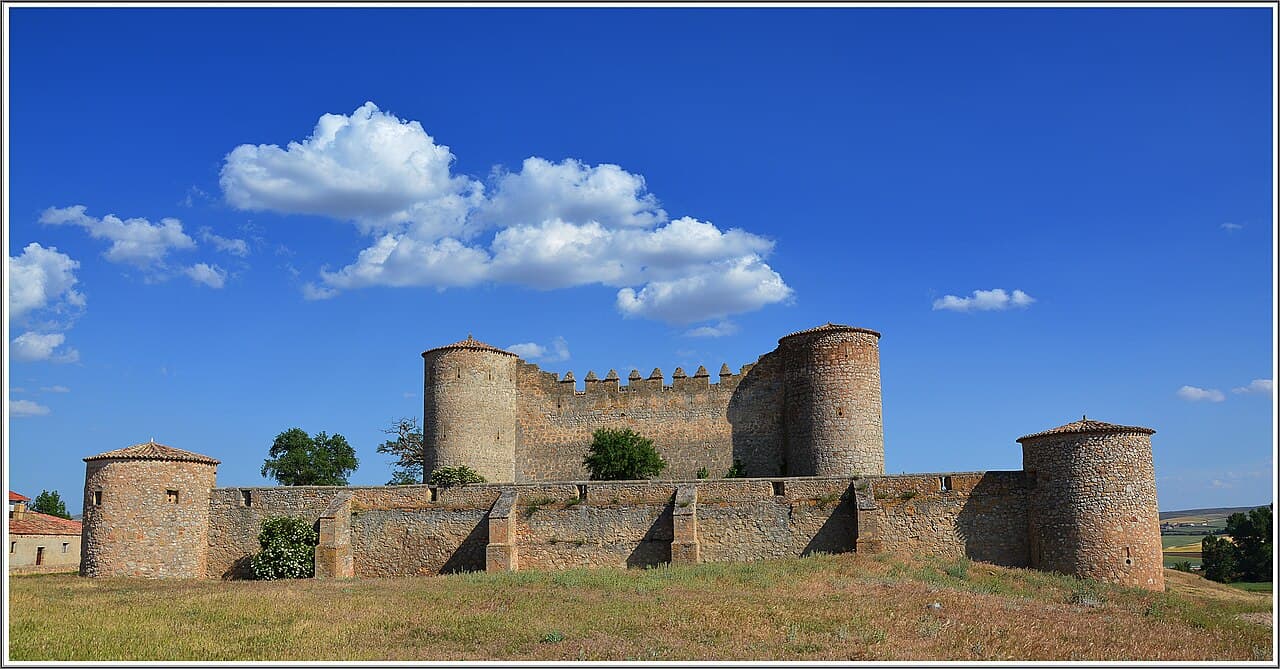
Almenar Castle
Almenar castle stands as a remarkable example of late medieval military architecture nestled in the town of Almenar de Soria, Spain. Constructed primarily in the 15th century atop the remains of an earlier fortification, the castle offers a tangible narrative of centuries of strategic, residential, and cultural evolution. Its layered history is etched into its robust walls, towers, and courtyards, making it a significant monument in the province of Soria.
The castle’s origins trace back to a 10th-century Muslim tower around which a small settlement developed. This early fortification laid the groundwork for the castle’s later expansion during the 13th and 14th centuries, with substantial enhancements occurring in the 15th and 16th centuries. The site’s strategic position on a narrow ridge provided commanding views of the surrounding landscape, an essential feature for defense and control.
Architectural evolution and defensive features
The castle’s design reflects the military needs and residential functions of its time. The double-wall enclosure is a defining characteristic, with an inner bailey housing the keep and a weapon courtyard, while the outer defensive walls encompass a moat and a drawbridge. These features exemplify the typical defensive strategies of hill castles in the late medieval period.
The inner bailey is fortified with crenellated walls and punctuated by circular towers, which provided defenders with multiple vantage points and angles of fire. The tower of homage, dating from the earliest phase of construction, stands as a testament to the castle’s military origins, commanding the ridge with its imposing presence.
In the 16th century, remodeling of the towers altered their form and appearance, reflecting evolving defensive techniques and architectural tastes. The addition of galleries and staircases within the inner courtyard indicates a shift towards accommodating social and residential functions alongside military use.
Historical significance and noble ownership
The castle originally belonged to prominent noble families such as the Bravo de Laguna, Saravias, and Ríos, whose coats of arms remain visible on the castle walls. These families played key roles in the region’s history, and their association with the castle underscores its importance as a noble residence and military stronghold.
Throughout its history, Almenar castle served as a royal residence during the reigns of Carlos II and Felipe V, highlighting its stature within the Spanish monarchy’s network of estates. The castle’s strategic and residential value made it a significant site for governance and control in the area.
Cultural connections and literary heritage
Beyond its military and noble functions, the castle holds a special place in Spanish cultural history. It was the birthplace of Leonor Izquierdo on June 12, 1894, the wife and muse of the famed poet Antonio Machado. This personal connection is commemorated by a plaque at the castle entrance, linking the site to Spain’s literary heritage.
The castle also inspired the Romantic writer Gustavo Adolfo Bécquer, who set two of his famous leyendas (legends) within its walls. This association with Romantic literature enhances the castle’s cultural significance and attracts literary enthusiasts to the site.
Preservation and modern use
Today, Almenar castle is recognized as one of the best-preserved fortifications in the Soria province. Its durable construction and ongoing maintenance have allowed many original features to survive, providing valuable insights into medieval military architecture and noble residences.
In the 20th century, the castle served as barracks for the Guardia Civil, maintaining its military function until around 1940. It was declared a protected cultural monument (Bien de Interés Cultural) in 1949, and later included in Spain’s national list of historical heritage sites in 1986.
More recently, the castle has been used as a filming location for the television series El Cid, demonstrating its continuing relevance as a cultural and historical landmark. Visitors today can explore its well-preserved walls, towers, and courtyards, experiencing a site that embodies centuries of Spanish history and architectural evolution.
Exploring almenar castle
Visitors to Almenar castle can appreciate its strategic hilltop location, which offers panoramic views of the surrounding landscape. The double defensive walls and moat with drawbridge remain key features that illustrate medieval fortification techniques.
The inner bailey invites exploration of the castle’s residential and military spaces, including the keep and weapon courtyard. The presence of noble coats of arms and commemorative plaques enriches the visitor experience by connecting the architecture to the families and individuals who shaped its history.
While some areas have undergone remodeling, the castle’s overall layout and many original features are intact, making it a valuable destination for those interested in medieval architecture, Spanish history, and literary heritage.
Frequently asked questions (FAQ)
- How do I get to Almenar Castle?
- Almenar Castle is located in Almenar de Soria, Spain. You can reach it by car via the N-234 road. Public transportation options are limited, so driving or taking a taxi from nearby towns is recommended.
- What is the historical significance of Almenar Castle?
- Almenar Castle dates back to the 12th century and played a crucial role in the defense against the Moors during the Reconquista. Its historical significance lies in its strategic position and its preservation of medieval architectural styles, reflecting the rich history of the region.
- When was Almenar Castle built?
- Construction of Almenar Castle began in the late 11th century, with significant renovations occurring in the following centuries. The castle has undergone various restorations to maintain its structure and historical integrity, making it a fascinating site for visitors interested in medieval architecture.
- Can I take guided tours of Almenar Castle?
- Yes, guided tours are available at Almenar Castle, providing visitors with in-depth information about its history and architecture. These tours typically include access to key areas of the castle and are a great way to enhance your understanding of its significance.
- Is it possible to visit Almenar Castle year-round?
- Almenar Castle is generally open to visitors year-round, but it's advisable to check local listings for any seasonal hours or special events. During the off-peak season, visitor numbers may be lower, allowing for a more intimate experience.
- What are the opening hours for Almenar Castle?
- Almenar Castle typically opens to visitors from 10 AM to 6 PM, but hours may vary depending on the season. It's best to confirm the current opening hours on their official website or contact local tourism offices before your visit.
- What are the ticket prices for visiting Almenar Castle?
- Admission prices for Almenar Castle are quite reasonable, typically ranging from €3 to €5 per person, with discounts available for students and seniors. Children under a certain age may enter for free, making it an affordable option for families.
- When is the best time to visit Almenar Castle?
- The best time to visit Almenar Castle is during the spring and early fall when the weather is mild and the landscape is beautiful. These seasons offer a pleasant climate for exploring the castle and surrounding areas without the summer crowds.
- Are there any nearby attractions to visit?
- Yes, nearby attractions include the scenic landscapes of the Sierra de Urbión and the picturesque village of Almenar de Soria itself. Visitors can also explore other historical sites in the Soria province, enhancing their cultural experience in the region.
Photo gallery

Information
Loading map...
Visitor reviews
No reviews yet. Been here? Write the first review and help other travelers!
Write the first reviewVisited this castle? Share your experience
Your review helps other travelers and adds first-hand knowledge to our encyclopedia.



