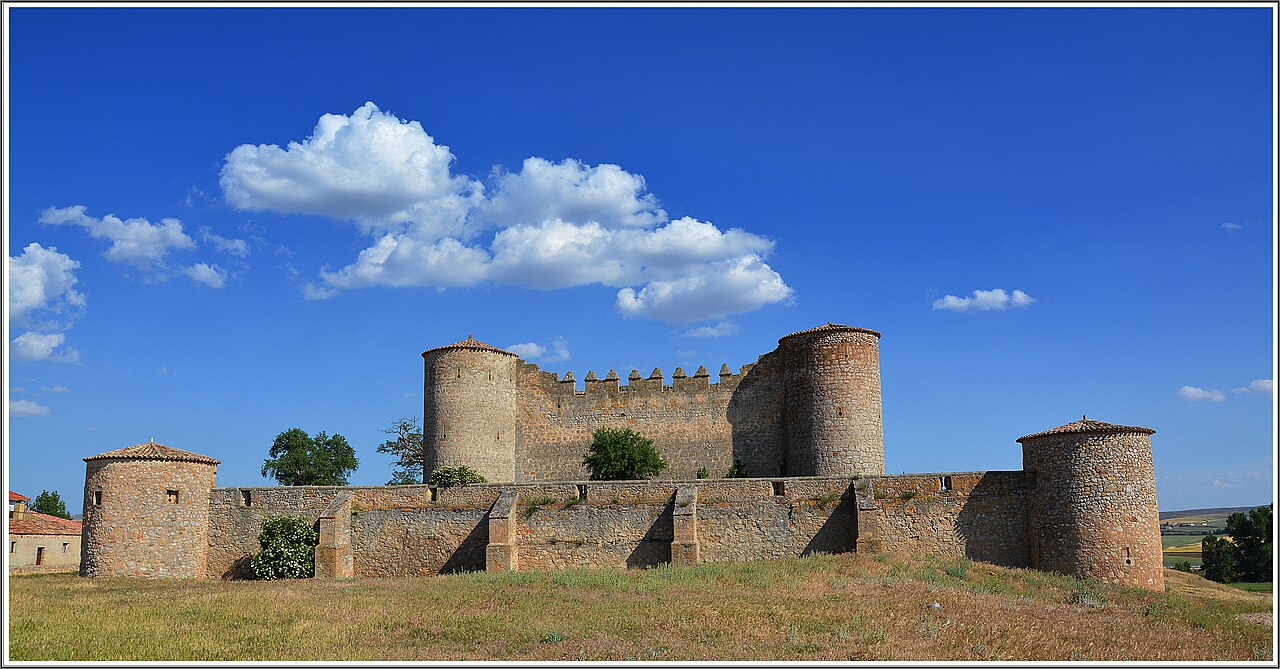
Ciria Castle
Ciria Castle stands as a significant medieval fortress located in the town of Ciria, Spain, embodying centuries of frontier defense and noble heritage. Constructed during the 9th century AD in the early medieval period, this hill castle was strategically positioned to guard the vital passage between the ancient cities of Bilbilis and Numancia during the era of Muslim rule in the Iberian Peninsula. Its location on a prominent hill provided commanding views of the surrounding landscape, essential for monitoring troop movements and controlling regional trade routes.
Historical significance and political context
The castle's history is deeply intertwined with the turbulent border disputes between the medieval kingdoms of Castile and Aragon. Initially built by Muslim forces to secure territorial control, Ciria Castle later became a focal point in the shifting allegiances and military confrontations that characterized the Christian reconquest and consolidation of power in northern Spain.
In 1395, the fortress and its adjacent town were granted by King Enrique "el Doliente" to Juan Hurtado de Mendoza, despite opposition from neighboring Ágreda. This transfer highlighted the contested nature of the region during a period marked by frequent skirmishes and political maneuvering.
The early 15th century saw the castle change hands amid ongoing conflict. In 1430, Aragonese forces seized Ciria and the nearby castle of Borobia. However, the 1437 peace treaty signed in Naples between Aragón, Castilla, and Navarra restored control of Ciria to Castile. This treaty exemplifies the complex diplomatic efforts to stabilize the region after decades of warfare.
Further cementing its noble status, in 1443, Ciria was included in the dowry of Doña Aldara, niece of the Castilian Constable Álvaro de Luna, upon her marriage to Don Carlos de Arellano, son of the lord of Los Cameros. This alliance illustrates the castle's role not only as a military asset but also as a valuable hereditary estate within aristocratic networks.
In the 18th century, the site achieved formal noble recognition with the establishment of the title Marqués de Ciria in 1771, granted to Don José Pedro de Luna. The title and estate passed through prominent lineages, including the Viscount of Eza and the current Count of Ripalda, underscoring Ciria's enduring importance in Spain's aristocratic hierarchy.
Architectural features and construction techniques
Ciria Castle occupies a compact hilltop footprint with a roughly rectangular plan measuring about ten meters long and one meter wide. Its defensive walls were built using the sillarejo technique, characterized by the use of irregularly shaped limestone blocks fitted together without extensive shaping. This method reflects the practical and resource-efficient masonry practices of the period.
The walls are composed of two main parallel faces filled internally with smaller limestone fragments, forming a robust core. The exterior was coated with a lime-based mortar mixed with small quartzite stones, serving both as a protective plaster and a weather-resistant finish. This layer smoothed the rough stone surface and enhanced the durability of the fortifications against the elements.
The surviving sections of the walls feature approximately thirty battlements, including several with distinctive diamond-shaped tops. These battlements provided defensive positions for archers and served as a deterrent to attackers. Interspersed among them are about ten arrow slits (saeteras), narrow vertical openings that allowed defenders to shoot while minimizing exposure.
One of the castle's notable preserved elements is its original access gate, which controlled entry into the enclosed courtyard. The interior remains are uneven and fragmented, indicating partial collapse and long-term degradation. The absence of a central keep or flanking towers is consistent with historical records, suggesting that Ciria was primarily a fortified outpost rather than a large noble residence.
Strategic role and military function
Throughout its active use, Ciria Castle served as a military outpost guarding a crucial route between Bilbilis and Numancia. Its location on a hill allowed for early warning of enemy movements and provided a defensible position against incursions. The castle's fortifications reflect its role in frontier defense during the Moorish era and later Christian reconquest.
During the border conflicts between Castile and Aragon, Ciria was a contested site due to its strategic importance. The castle's capture and recapture in the 15th century illustrate the ongoing struggle for regional dominance. Its fortifications were designed to withstand sieges and provide a stronghold for garrisoned troops.
Cultural heritage and current status
Today, Ciria Castle stands as a partially preserved ruin, offering valuable insights into medieval military architecture and the complex history of the Castile-Aragon borderlands. Its hilltop location and surviving walls with battlements and arrow slits provide a tangible connection to the past.
The castle's remains are an important cultural landmark within the Ceuta region of Spain, attracting historians, archaeologists, and visitors interested in medieval fortifications and Spanish noble history. Preservation efforts focus on maintaining the structural integrity of the surviving walls and enhancing public access to this historic site.
While the castle no longer functions as a military stronghold, its legacy endures through its architectural features and the noble titles associated with its estate. Ciria Castle exemplifies the evolution of frontier castles from Muslim fortifications to Christian noble estates, reflecting broader historical trends in medieval Spain.
Architectural comparison and regional context
Ciria Castle's modest size and construction techniques are typical of early medieval hill castles in the Iberian Peninsula, where fortifications were often adapted to local materials and strategic needs. Unlike larger concentric castles or those with imposing keeps, Ciria's design emphasizes practical defense and control of key routes rather than grand residential features.
This contrasts with nearby fortresses such as Borobia, which featured more extensive fortifications and played complementary roles in the border defense system. Together, these castles formed a network of strongholds that shaped the political landscape of medieval Spain.
Visiting information and accessibility
Visitors to Ciria Castle can explore the ruins situated on the hill overlooking the town of Ciria. The site offers panoramic views of the surrounding countryside and an opportunity to appreciate medieval military architecture firsthand. Due to the castle's ruinous state, visitors should exercise caution when navigating uneven terrain and fragmented walls.
While there are no formal visitor facilities or guided tours, the castle is accessible year-round. Its remote location and historical significance make it a rewarding destination for enthusiasts of Spanish medieval history and architecture.
Frequently asked questions (FAQ)
- When was Ciria Castle built and what was its original purpose?
- Ciria Castle was built in the 9th century AD during the early medieval period. It was originally constructed to protect the passage between the ancient cities of Bilbilis and Numancia during the Moorish era.
- What role did Ciria Castle play in the conflicts between Castile and Aragon?
- Ciria Castle was a strategic fortress involved in border disputes between the kingdoms of Castile and Aragon. It changed hands multiple times in the 15th century, reflecting the ongoing struggle for regional control.
- What are the notable architectural features of Ciria Castle?
- The castle features irregular limestone walls built using the sillarejo technique, with battlements including diamond-shaped tops and arrow slits for defense. It retains an original access gate and has a rectangular footprint.
- Is Ciria Castle accessible to visitors today?
- Yes, Ciria Castle is accessible year-round. Visitors can explore the hilltop ruins and enjoy panoramic views, though the site is in a partially preserved state with uneven terrain requiring caution.
- How does Ciria Castle compare to other castles in the region?
- Ciria Castle is smaller and simpler compared to larger fortresses like Borobia. Its design focuses on practical defense rather than grand residential features, typical of early medieval hill castles in the Iberian Peninsula.
Information
Loading map...
Visitor reviews
No reviews yet. Been here? Write the first review and help other travelers!
Write the first reviewVisited this castle? Share your experience
Your review helps other travelers and adds first-hand knowledge to our encyclopedia.