Alloa Tower
Alloa Tower stands as a remarkable example of a medieval Scottish tower house, located in the town of Alloa, Scotland. Constructed originally in the early 14th century, this imposing structure played a vital role in local defense and governance due to its strategic position near the north shore of the Firth of Forth. The tower's proximity to the ferry crossing on the River Forth made it a key stronghold controlling access and movement in the region.
The earliest phase of Alloa Tower dates to around the early 1300s, when it was built as a fortified residence, part of a broader network of coastal defenses. Over the following centuries, the tower was expanded and enhanced to reflect its growing importance. By the mid-14th century, the structure had been raised to three storeys and included a great hall, a significant addition that emphasized its dual role as both a defensive fortress and a noble residence. Further vertical expansion in the 15th century increased the tower to four or five storeys, solidifying its status as a dominant feature in the landscape.
Architectural features and construction details
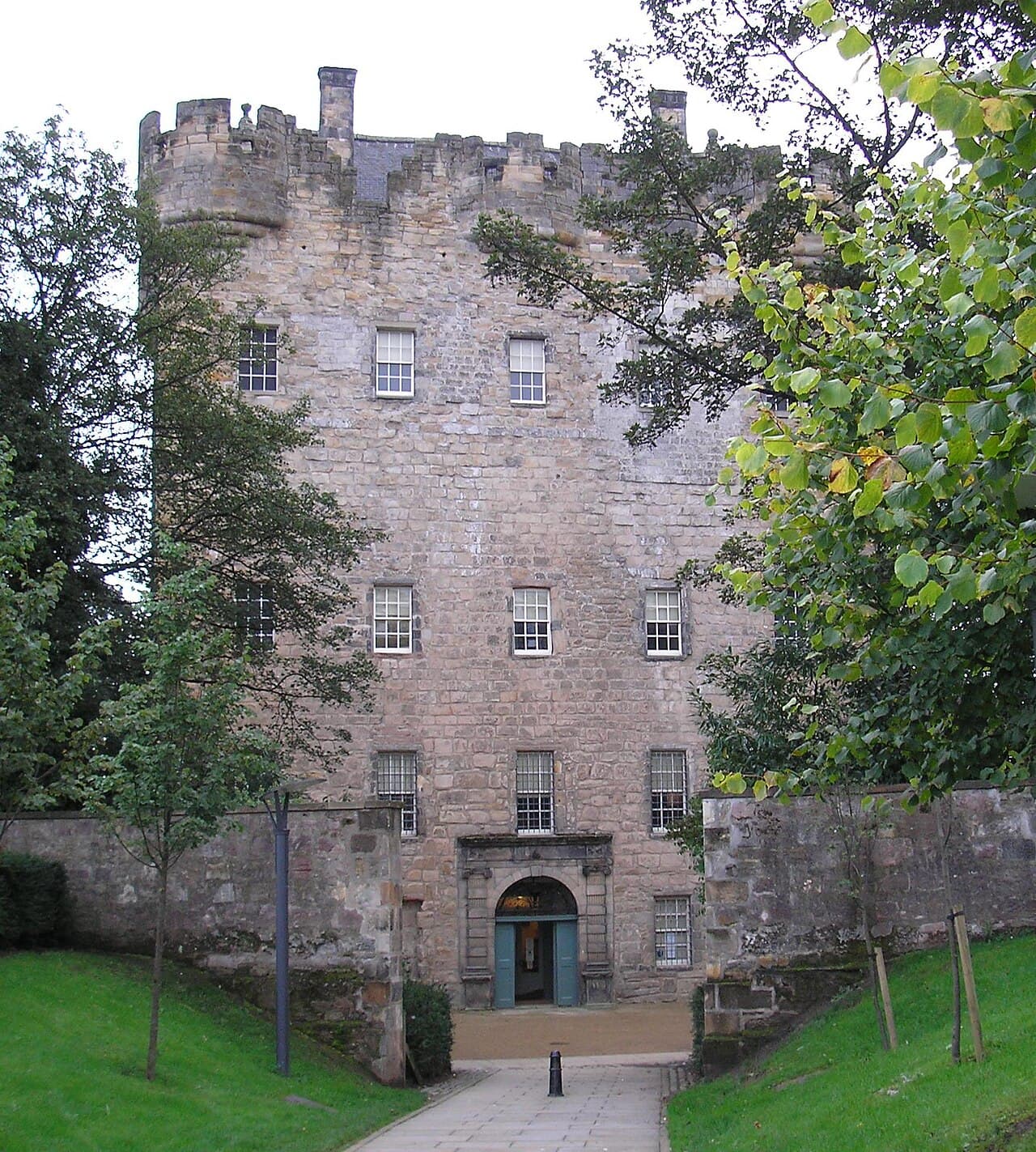
The tower measures approximately 68 feet (21 meters) in height, excluding the attic, and covers a footprint of about 62.5 by 39.5 feet (19.1 by 12.0 meters). Built using coursed rubble stone, the walls are notably thick, providing formidable defensive strength typical of medieval tower houses. Several original medieval features have survived the centuries, including a timber roof and battlements, which offer valuable insight into the defensive architecture of the period.
Internally, the cellar was used at times as a pit prison, demonstrating the tower's role in maintaining law and order. The original entrance was located on the first floor, a common defensive feature designed to restrict access and make the tower harder to assault. Ground-level access was introduced later, likely in the late 16th century, reflecting evolving needs and security considerations.
Throughout its history, the tower underwent several modifications, including re-fenestration to update or enlarge windows, adapting the structure to changing tastes and functional requirements. During the 18th century, when the tower became part of the larger Alloa House mansion, it was connected to the main house by additions such as an Italian-style grand staircase, which no longer survives but once contributed to the estate's grandeur.
Historical significance and royal connections
Alloa Tower served as the ancestral home of the Erskine family, who later became the Earls of Mar. Its royal connections are notable, with Mary, Queen of Scots staying at the tower multiple times during the 1560s, including visits shortly after the birth of her son, Prince James, in 1566. The tower also hosted James VI in 1579, underscoring its importance as a noble residence and political center.
The tower was the site of significant social and cultural events, such as the 1592 wedding festivities of John Erskine, Earl of Mar, and Marie Stewart, which included a masque performed by Anne of Denmark. These events highlight the tower's role as a hub of aristocratic life and celebration.
However, the tower's history also reflects darker chapters, including its involvement in the witch trials of the late 16th and early 17th centuries. John Erskine, the second Earl of Mar, participated in trials held in 1596 and again in 1613–1614. The area experienced further witch-hunts in 1658, illustrating the turbulent religious and social climate of the era.
Later developments and preservation
In 1710, John Erskine, the 6th Earl of Mar, incorporated the ancient tower into a larger mansion known as Alloa House, using the tower as an annexe. Unfortunately, the mansion suffered a major fire in 1800 and was subsequently rebuilt between 1834 and 1838. After 1868, the mansion was demolished, leaving Alloa Tower to stand alone once again.
Recognized for its historical and architectural significance, Alloa Tower was designated a scheduled monument in 1960. Today, it is managed by the National Trust for Scotland and has undergone restoration to reflect its appearance around 1712, during the era of the 6th Earl of Mar. The tower is protected as a Category A listed building, ensuring its preservation for future generations.
The tower in the landscape and visitor experience
Situated in the southern part of Alloa, the tower commands a strategic position overlooking the approach to the ferry crossing on the River Forth. This location not only provided practical defense but also symbolized the power and status of its owners.
Visitors to Alloa Tower can appreciate its robust medieval construction, original defensive features, and the layers of history embedded in its walls. The tower's preservation allows a tangible connection to Scotland's medieval past and the noble families who shaped its history.
Frequently asked questions (FAQ)
- How do I visit Alloa Tower?
- Alloa Tower is managed by the National Trust for Scotland and is open to visitors during specific hours. It is advisable to check the official website for current opening times and any visitor requirements before planning your trip.
- What is the historical significance of Alloa Tower?
- Alloa Tower is a prominent medieval Scottish tower house with royal connections, including visits by Mary, Queen of Scots, and James VI. It served as the ancestral home of the Erskine family, Earls of Mar, and played a role in local defense and social events.
- Can I see original medieval features at Alloa Tower?
- Yes, several original medieval architectural features survive at Alloa Tower, including the timber roof, battlements, and the cellar that was once used as a pit prison. These elements provide insight into the defensive and residential functions of the tower.
- Is Alloa Tower accessible for visitors with mobility issues?
- Due to its medieval construction and historic preservation, Alloa Tower has limited accessibility for visitors with mobility issues. Visitors are advised to contact the National Trust for Scotland for detailed accessibility information and assistance.
- When was Alloa Tower built?
- Alloa Tower was originally constructed in the early 14th century, with significant expansions in the 14th and 15th centuries that shaped its current form.
Photo gallery

Photo by AllyD at English Wikipedia•Public domain
Information
Sources & official resources
Verify the information above using these authoritative references.
Loading map...
Visitor reviews
No reviews yet. Been here? Write the first review and help other travelers!
Write the first reviewVisited this castle? Share your experience
Your review helps other travelers and adds first-hand knowledge to our encyclopedia.