Puerta del Puente
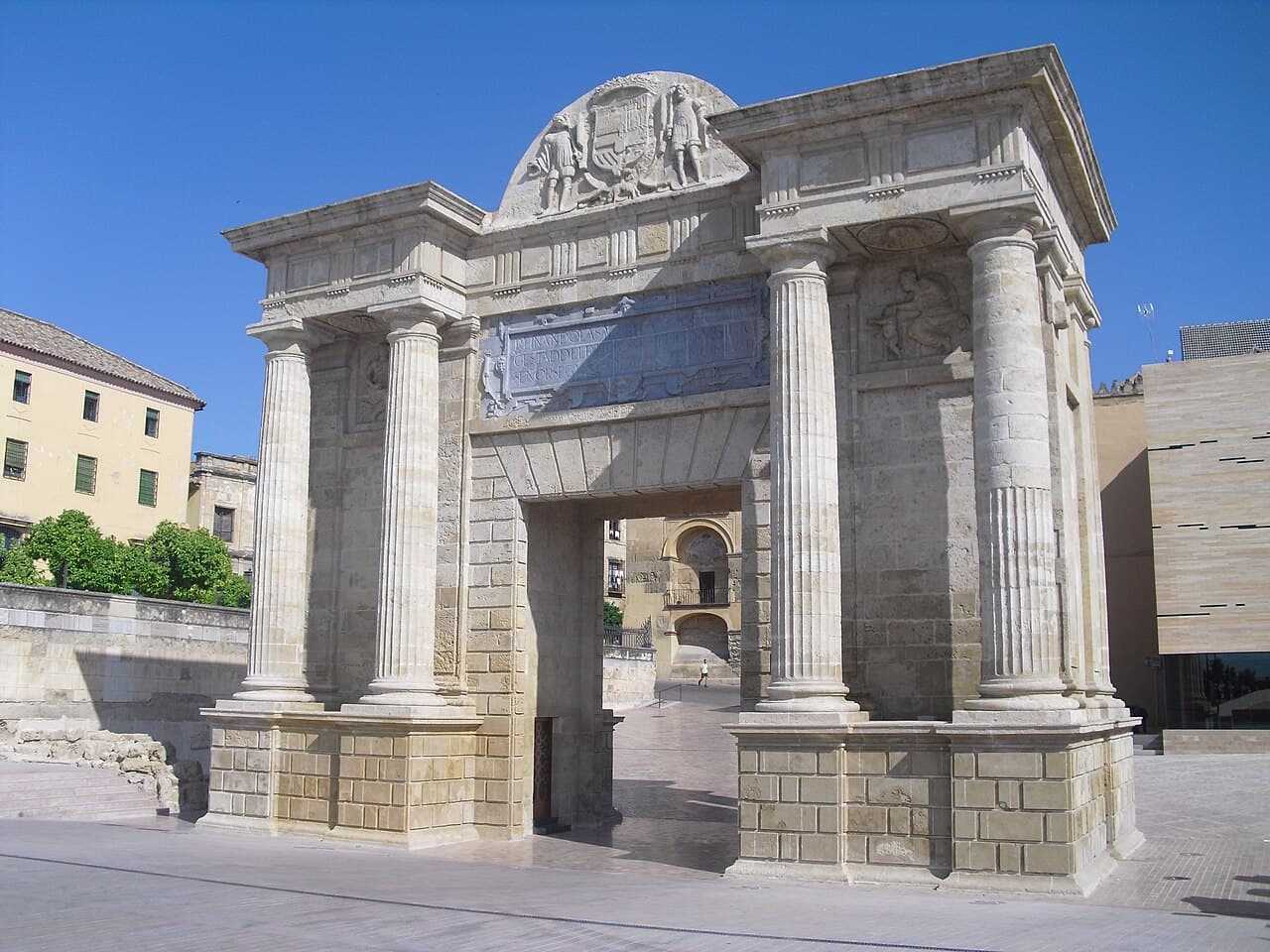
The Puerta del Puente ("Gate of the Bridge") is a notable Renaissance gate located in Córdoba, Andalusia, Spain. Constructed in the 16th century, this gate was built to commemorate a visit by King Philip II and stands on the historic site of earlier Roman gates. It served as a crucial link between the city and the Roman bridge crossing the Guadalquivir River, as well as the ancient Via Augusta, an important Roman road.
Historical significance and location
The Puerta del Puente occupies a strategic position at the entrance to Córdoba from the south, marking the transition from the Roman bridge into the city. Its location on the site of former Roman gates highlights the continuity of urban defense and ceremonial architecture in Córdoba from antiquity through the Renaissance. The gate's construction in the 16th century reflects the city's importance during the reign of Philip II and the Spanish Renaissance's architectural trends.
Architectural features and design
This gate exemplifies Renaissance architectural principles, characterized by symmetry, proportion, and classical elements. The structure is built primarily of stone, featuring a central archway flanked by pilasters and topped with decorative cornices and classical motifs. Its design integrates both defensive and ornamental functions, typical of city gates of the period that served as both fortifications and ceremonial entrances.
The gate's facade includes sculptural details and inscriptions commemorating King Philip II's visit, emphasizing its role as a monument celebrating royal authority and civic pride. The gate's robust construction also aligns with the characteristics of a bastioned fortress, designed to withstand potential attacks while projecting power.
Cultural heritage and preservation
Since 1931, the Puerta del Puente has been protected as a Bien de Interés Cultural under the monument category, recognizing its historical and architectural value. It forms part of a trio of significant landmarks alongside the Roman bridge and the Calahorra tower, all contributing to Córdoba's rich heritage.
The gate is also included within the boundaries of the historic centre of Córdoba, which was designated a UNESCO World Heritage Site in 1984. This status underscores the gate's importance not only to local history but also to global cultural heritage.
The gate in the context of córdoba's urban fabric
The Puerta del Puente functions as a symbolic and physical gateway connecting Córdoba's historic center with the river and beyond. It anchors the southern approach to the city, guiding visitors from the Roman bridge into the heart of Córdoba's medieval and Renaissance urban landscape.
Its presence complements other monumental structures in the city, illustrating the layers of history visible in Córdoba's architecture—from Roman through Islamic to Christian periods. The gate's Renaissance style adds to this architectural diversity, showcasing the city's evolution and the influence of Spanish Renaissance design.
Visiting the puerta del puente
Today, the Puerta del Puente is accessible to visitors exploring Córdoba's historic center. It stands as a prominent landmark near the Guadalquivir River, offering insights into the city's layered history and architectural heritage. While the gate itself does not function as a castle or fortress open for interior tours, its external form and location provide valuable context for understanding Córdoba's defensive and ceremonial urban elements.
Visitors often combine a visit to the Puerta del Puente with nearby attractions such as the Roman bridge, the Calahorra tower, and the Mezquita-Catedral, enriching their experience of Córdoba's rich cultural landscape.
Frequently asked questions (FAQ)
- What is the historical significance of Puerta del Puente?
- Puerta del Puente is a monumental archway in Córdoba, Spain, built in the 16th century to serve as the main entrance to the city. It symbolizes the connection between the historic center and the surrounding areas, showcasing the Renaissance architectural style and the cultural heritage of Córdoba.
- When was Puerta del Puente constructed?
- The construction of Puerta del Puente began in 1570 and was completed in 1574. It was designed by the architect Alonso de Vasquez and represents an important period in the city's architectural development.
- Can I visit Puerta del Puente?
- Yes, visitors are welcome to explore Puerta del Puente. The site is accessible year-round, allowing tourists to enjoy the impressive architecture and take photographs in this historic location.
- What are the opening hours for Puerta del Puente?
- Puerta del Puente is open to the public at all times, making it easy for visitors to stop by whenever they wish. There are no specific opening hours, but it is best to visit during daylight for optimal viewing and photography.
- Is it possible to access Puerta del Puente by public transportation?
- Yes, Puerta del Puente is easily accessible via public transportation in Córdoba. Buses frequently run from various parts of the city, and the nearby pedestrian areas make it convenient for visitors.
- What is the best time to visit Puerta del Puente?
- The best time to visit Puerta del Puente is during the spring and fall months when the weather is mild and pleasant. These seasons provide an ideal atmosphere for exploring the area without the heat of summer.
- Are there any nearby attractions to visit along with Puerta del Puente?
- Yes, nearby attractions include the Alcázar de los Reyes Cristianos and the historic Mosque-Cathedral of Córdoba. Both sites are within walking distance and offer a deeper insight into the rich history and culture of the city.
- What are the ticket prices for visiting Puerta del Puente?
- There are no ticket prices to visit Puerta del Puente as it is a public monument. Visitors can freely enjoy the site without any entrance fees, making it an accessible attraction for everyone.
Photo gallery

Information
Loading map...
Visitor reviews
No reviews yet. Been here? Write the first review and help other travelers!
Write the first reviewVisited this castle? Share your experience
Your review helps other travelers and adds first-hand knowledge to our encyclopedia.