Alcázar de los Condestables de Castilla
The Alcázar de los Condestables de Castilla stands as a remarkable example of 14th-century Castilian fortress-palace architecture located in Medina de Pomar, Spain. This historic castle, now home to the Museo Histórico de las Merindades, embodies the medieval political and social landscape of Castile during the late Middle Ages. Constructed primarily as a noble residence with defensive capabilities, the Alcázar reflects the dual purpose common to many castles of the era, combining military strength with the comforts befitting the aristocracy.
Historical background and noble origins
The origins of the Alcázar trace back to circa 1370, when Don Pedro Fernández de Velasco, a prominent nobleman and Camarero Mayor under King Henry II of Castile, initiated its construction. Don Pedro's loyalty during the civil wars against King Pedro I, known as "the Cruel," earned him the city of Medina de Pomar and the privilege to build this fortress-palace. This strategic gift underscored the importance of the site both militarily and politically.
The castle's completion is documented in a foundation deed dated 1433, involving Don Pedro's eldest son, Don Juan Fernández de Velasco. This document also references modifications related to the nearby Hospital de la Misericordia, confirming the castle's established role within the urban fabric of Medina de Pomar by the early 15th century.
Over the centuries, the fortress became popularly known as "Las Torres" due to its distinctive square towers. It remained under the control of the Velasco family, one of Castile's most influential noble houses, until the late 19th century. In 1896, the Dukes of Frías, successors to the Velasco title, transferred usufruct rights to the local municipality, and later full ownership passed to the town council, ensuring its preservation as a cultural landmark.
Recognized for its historical and cultural significance, the Alcázar was declared a Bien de Interés Cultural in 1931 during the Second Spanish Republic. Since then, it has housed the Museo Histórico de las Merindades, serving as a vital institution for regional heritage and history.
Architectural features and layout
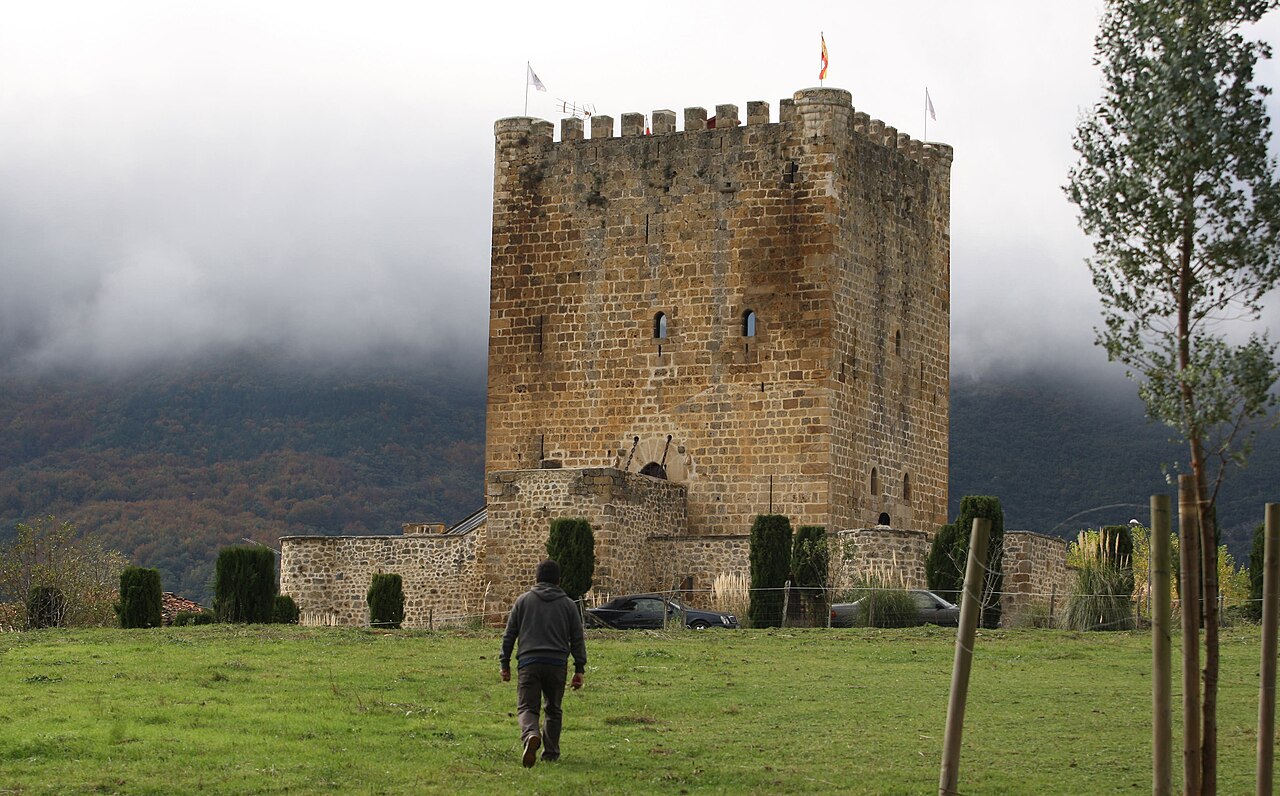
The Alcázar de los Condestables de Castilla is a compact yet formidable hill castle characterized by its two substantial square towers of differing heights, connected by a narrower, lower central body. Positioned at the highest point in Medina de Pomar, the castle's location provided strategic defensive advantages and commanding views over the surrounding landscape.
The construction primarily utilized stone masonry, typical of 14th-century Castilian fortifications, emphasizing both defense and noble habitation. The castle's layout reflects a careful integration of military and residential functions, with clear distinctions between the roles of its towers.
The great hall and interior elements
Within the central section lies a large great hall, accessed via an elegant spiral staircase that prominently features the carved Velasco family coat of arms. This staircase and the integrated chimney within the wall highlight the blend of functionality and noble aesthetics. Although much of the original decorative elements have been lost, remnants of a Mudejar-style frieze remain, showcasing a unique blend of Christian and Islamic artistic motifs. This painted gypsum band included medallions connected by lobed designs and displayed Velasco heraldry, while a lower band inscribed in Gothic characters contained Latin texts, likely biblical verses and the Lord's Prayer, intertwining spiritual devotion with familial identity.
Distinctive towers and their roles
The southern tower, known as the noble hall, retains more elaborate decoration, including friezes adorned with Arabic inscriptions in African and Kufic scripts. These inscriptions repeat the phrase "Mater Dei miserere mei" ("Mother of God, have mercy on me") and include corner medallions with praises affirming divine victory and guardianship, such as "He is not victorious except Allah, He is the best, the guardian." This tower served as a venue for important gatherings, meetings, and summer courses, and later housed the municipal archive.
In contrast, the northern tower is devoid of decorative elements, reflecting its utilitarian purpose as accommodation for armed guards and servants responsible for the castle's defense. This functional division between the two towers underscores the castle's dual role as a residence and fortress.
Structural adaptations and preservation
The original roofing of the castle featured wooden terraces, consistent with medieval construction techniques. Subsequent renovations introduced a double-pitched roof atop the central body and pyramidal roofs crowning the towers, enhancing both protection and aesthetic appeal.
Beneath the castle floors lies an extensive well that historically secured the water supply during sieges, although this feature has since been sealed. These architectural elements demonstrate the castle's adaptation over centuries to meet both defensive needs and domestic comforts.
Today, the Alcázar de los Condestables de Castilla stands as a well-preserved monument, reflecting the rich heritage of Castilian nobility and medieval military architecture. Its current function as a museum allows visitors to explore not only the castle's physical structure but also the broader historical narrative of the Merindades region.
Cultural significance and visitor experience
The castle's designation as a Bien de Interés Cultural highlights its importance as a cultural and historical treasure of Spain. Visitors to the Museo Histórico de las Merindades can experience a comprehensive journey through the region's history, enriched by the castle's authentic medieval ambiance.
The blend of architectural styles, historical inscriptions, and preserved defensive features offers a unique insight into the life of Castilian nobility and the complex socio-political environment of medieval Spain. The castle's location in Medina de Pomar also provides opportunities to explore the town's historic center and surrounding landscapes.
Frequently asked questions (FAQ)
- What are the visiting hours for the Alcázar de los Condestables de Castilla?
- The Alcázar de los Condestables de Castilla is generally open to visitors from 10:00 to 18:00, Tuesday through Sunday. It is advisable to check ahead for any seasonal changes or special closures.
- How do I get to the Alcázar de los Condestables de Castilla?
- The castle is located in the town of Medina de Pomar in the Castile and León region of Spain. It is accessible by car and public transport, with local buses and taxis available from nearby cities.
- What is the historical significance of the Alcázar de los Condestables de Castilla?
- This castle was built in the late 14th century by Don Pedro Fernández de Velasco, a key nobleman in Castile, serving both as a defensive fortress and noble residence. It reflects the political and military history of medieval Castile.
- Can I see original architectural features at the castle?
- Yes, visitors can observe the stone masonry, the spiral staircase with the Velasco coat of arms, remnants of Mudejar decorative friezes, and Arabic inscriptions in the southern tower, all original to the castle's medieval construction.
- Is the castle suitable for visitors with mobility issues?
- Due to its medieval structure, some areas of the castle may be challenging for visitors with mobility issues, particularly the spiral staircases and uneven floors. However, efforts have been made to improve accessibility where possible.
Information
Sources & official resources
Verify the information above using these authoritative references.
Loading map...
Visitor reviews
No reviews yet. Been here? Write the first review and help other travelers!
Write the first reviewVisited this castle? Share your experience
Your review helps other travelers and adds first-hand knowledge to our encyclopedia.