Alcázar de Colón
The Alcázar de Colón, also known as the Columbus Alcazar, stands as a significant monument in the history of the Americas as the first fortified European palace built in the New World. Situated in the heart of the Ciudad Colonial of Santo Domingo, the capital of the Dominican Republic, this palace is an integral part of the UNESCO World Heritage Site that preserves the early colonial history of the Americas.
Constructed between 1511 and 1514, the Alcázar de Colón was commissioned by Diego Columbus, the eldest son of the famed explorer Christopher Columbus. This palace served as the residence and administrative center for Diego, who was appointed the Viceroy of the Indies by the Spanish Crown. The building reflects the architectural transition of the period, predominantly exhibiting Gothic elements blended with Renaissance influences, a style typical of early 16th-century Spain but adapted to the Caribbean environment.
Architectural features and design
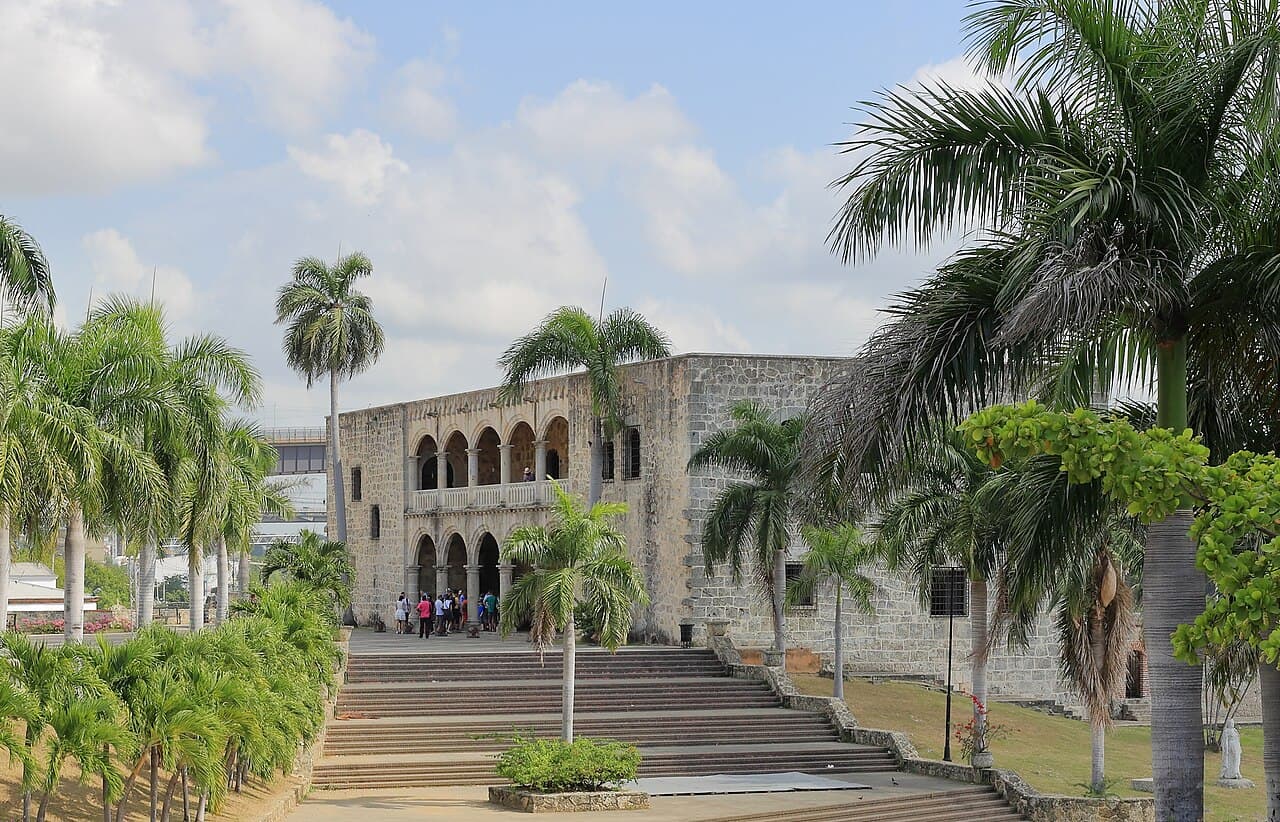
The Alcázar de Colón is a bastioned fortress type structure, designed to serve both as a luxurious residence and a defensive stronghold. Its thick stone walls and bastions were intended to protect against potential attacks by pirates and rival colonial powers. The palace's layout includes a central courtyard, surrounded by various chambers, halls, and service areas. Its towers and battlements emphasize its fortified nature, while the interior spaces reflect the comfort and status befitting a viceroy's household.
The palace's façade is marked by pointed Gothic arches and decorative stonework, while the Renaissance influence is evident in the symmetry and proportion of the building's design. The use of local materials combined with European construction techniques illustrates the early colonial adaptation of Old World architecture to New World conditions.
Historical significance and occupants
The Alcázar de Colón is unique as the only known residence of a member of Christopher Columbus's family in the Americas. Diego Columbus and his wife, María Álvarez de Toledo, lived in the palace, along with their children Juana, Isabel, Luis, and Christopher. After Diego's death in 1526 in Spain, María Álvarez de Toledo continued to reside in the palace until her death in 1549.
The palace remained the home of the Columbus family for three generations, likely until the late 16th century, serving as a center of power and governance in the early Spanish colonies. It witnessed the administrative and social evolution of the colony, embodying the Spanish Crown's authority in the Caribbean.
Decline and restoration
By the mid-18th century, the Alcázar de Colón had fallen into disrepair and was largely abandoned. The building suffered from neglect and the harsh tropical climate, leading to significant deterioration. It remained in ruins for over two centuries, a silent witness to the changing fortunes of Santo Domingo and the Dominican Republic.
In 1957, a major restoration project was undertaken to preserve and restore the palace. The restoration aimed to maintain the historical integrity of the structure while adapting it for use as a museum. Today, the Alcázar de Colón houses a remarkable collection of artifacts, including an extensive tapestry collection that spans the 15th to 17th centuries.
Tapestry collection and cultural heritage
The palace's tapestry collection is one of the most significant in the Caribbean. It includes works produced by the Flemish Van Den Hecke family, based on designs by the renowned French artist Charles Le Brun. These tapestries provide insight into the artistic and cultural exchanges between Europe and the New World during the colonial period.
As the most visited museum in Santo Domingo, the Alcázar de Colón plays a vital role in educating visitors about the early colonial history of the Americas and the legacy of the Columbus family. Its preservation allows for a tangible connection to the past, showcasing the architectural styles, social history, and cultural artifacts of the early 16th century.
Visiting the alcázar de colón
Visitors to the Alcázar de Colón can explore the restored rooms, courtyards, and exhibition spaces that highlight the palace's historical and architectural significance. The museum offers guided tours that explain the building's history, the Columbus family's life, and the broader context of Spanish colonization.
The palace's location in the Ciudad Colonial makes it easily accessible to tourists exploring Santo Domingo's historic district, which features other colonial-era buildings, plazas, and churches. The site is open to the public with specific visiting hours and ticket prices, which can vary seasonally.
Frequently asked questions (FAQ)
- When was the Alcázar de Colón built?
- The Alcázar de Colón was constructed between 1511 and 1514 during the early Renaissance period.
- What architectural styles are present in the Alcázar de Colón?
- The palace predominantly features Gothic architecture with Renaissance influences, reflecting early 16th-century Spanish design.
- Who lived in the Alcázar de Colón?
- It was the residence of Diego Columbus, Christopher Columbus's eldest son, his wife María Álvarez de Toledo, and their children for three generations.
- Is the Alcázar de Colón open to visitors?
- Yes, the Alcázar de Colón operates as a museum open to the public, offering tours that showcase its history and collections.
- What makes the tapestry collection at the Alcázar de Colón unique?
- The tapestry collection includes pieces from the 15th to 17th centuries, notably produced by the Flemish Van Den Hecke family, based on designs by Charles Le Brun.
Photo gallery

Information
Address
Calle Las Damas, Ciudad Colonial, Santo Domingo, Dominican Republic
Loading map...
Visitor reviews
No reviews yet. Been here? Write the first review and help other travelers!
Write the first reviewVisited this castle? Share your experience
Your review helps other travelers and adds first-hand knowledge to our encyclopedia.