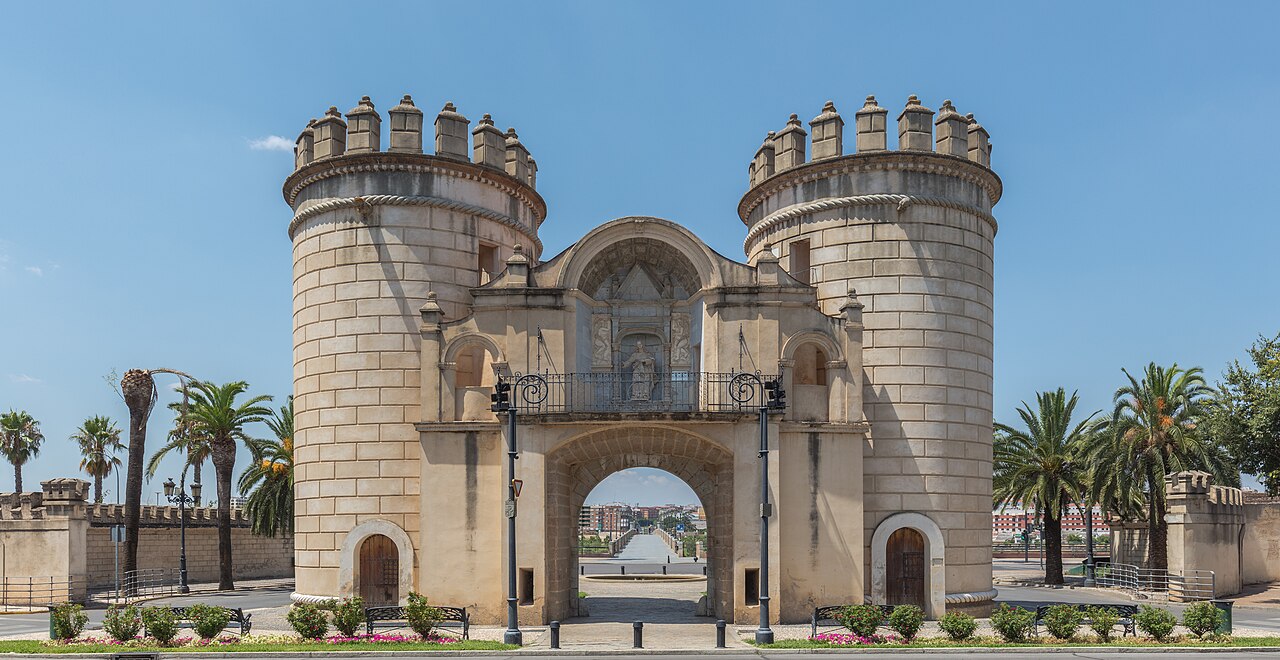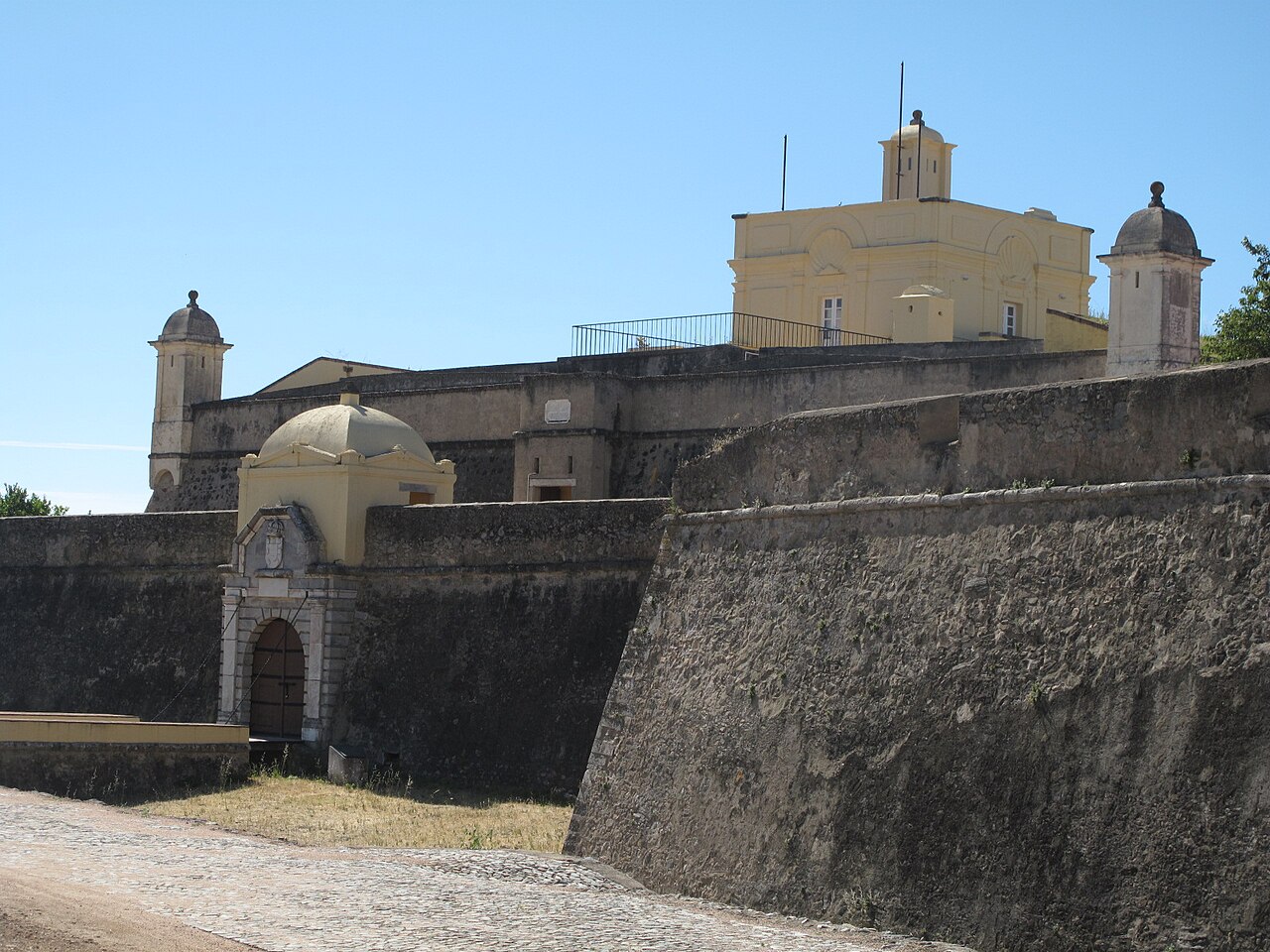
The Alcazaba of Badajoz stands as a monumental testament to the rich military and cultural history of southwestern Spain. This fortified citadel is located in the city of Badajoz, near the border with Portugal, and represents one of the most significant examples of Islamic military architecture on the Iberian Peninsula. Originally constructed in 875 AD during the early medieval period, the Alcazaba was founded by Abd-al Rahman Ibn Marwan under the authority of the Cordoban emir Muhammad I. Its strategic siting on the Cerro de la Muela hill allowed control over vital north-south and east-west routes, enhancing its defensive and administrative importance.
The fortress evolved over centuries, reflecting the complex political and military shifts in the region. Early construction utilized rammed earth (argamasa), a typical material in early Islamic fortifications, before transitioning to more durable stone and lime masonry during the 10th and 11th centuries. The citadel became the royal residence for the Taifa kings of Badajoz after the collapse of the Caliphate of Córdoba, marking its role as a center of power and culture in the 11th and 12th centuries.
Architectural evolution and defensive features
Early muslim foundations and almohad enhancements
The initial fortified walls date back to the 9th and 10th centuries, with significant rebuilding under Abdallah Ibn el-Aftas (Almanzor I) around 1030, which introduced stronger stonework and lime mortar. The Almohad caliph Abu Yaqub Yusuf further expanded and reinforced the fortress in the 12th century, enhancing its scale and fortification to withstand the increasing military threats during the period of Almohad dominance in Al-Andalus.
Structural components and materials
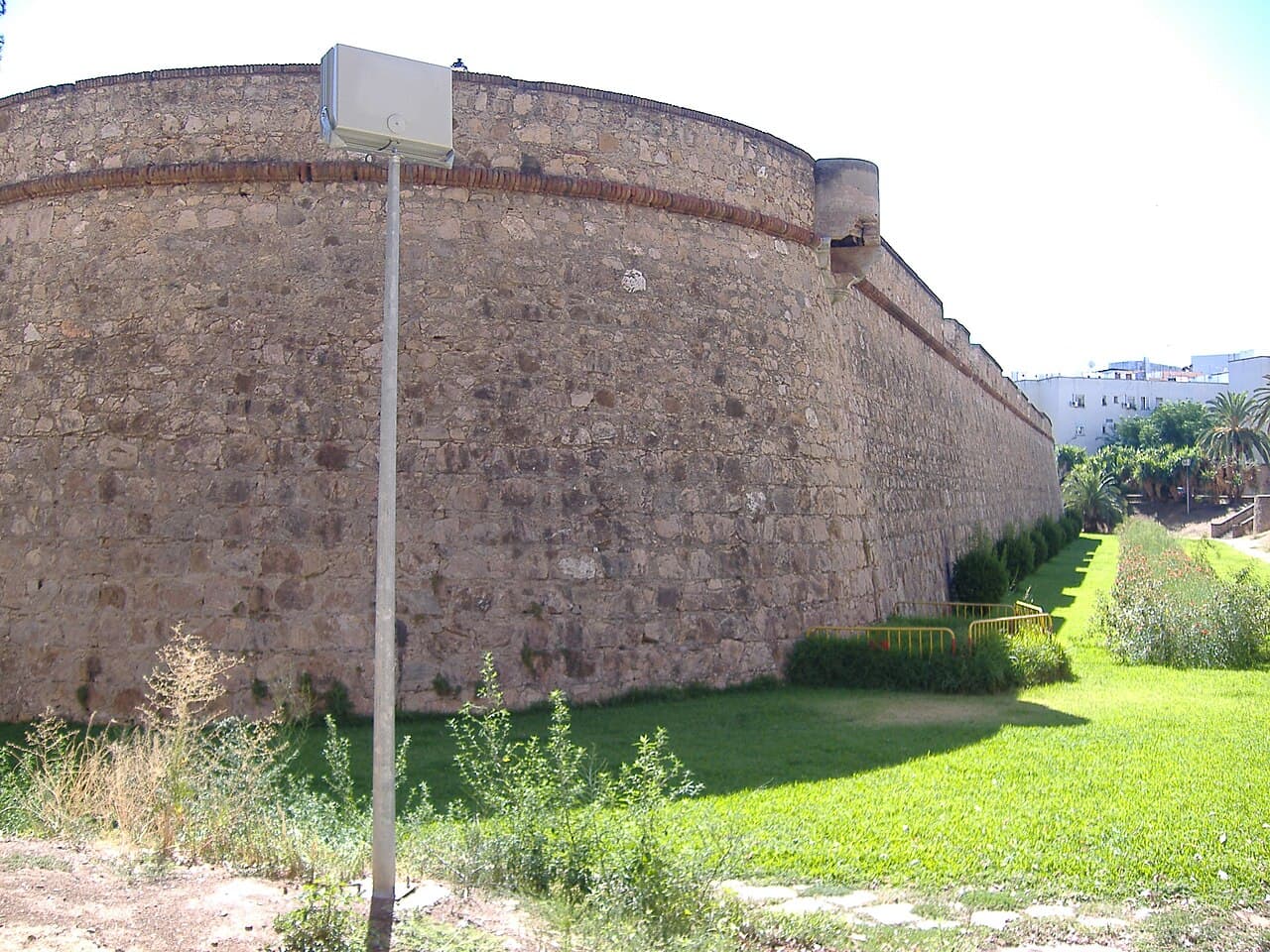
The Alcazaba’s walls, spanning approximately 1,300 meters today, enclose an oval area of about eight hectares. Historically, the fortress was much larger, with a perimeter reaching nearly 6,000 meters including the older Cerca Vieja fortifications. The construction features a mix of masonry, rammed earth (tapial), brick, and finely cut ashlar stone. The walls exhibit distinctive Almohad encintado decoration, characterized by alternating bands of stone and brick, a hallmark of Almohad military architecture.
Many structural elements incorporate reused Visigothic and Roman materials, such as capitals and columns, revealing the layered history of the site and its surroundings. Natural defenses are provided by the Guadiana River to the north and the Rivillas stream to the east, which acted as natural moats in conjunction with the man-made fortifications. The fortress’s positioning on steep slopes further enhanced its defensive capabilities.
Towers, gates, and defensive walkways
The Alcazaba contains numerous towers of varied design and function. The Torre de Espantaperros is a prominent three-story octagonal albarrana tower built in the 12th century, detached from the main walls but connected by a bridge. It features a 16th-century Mudéjar-style rooftop addition and historically served as a grain store and later a museum space. Other notable towers include the Torre Abarlongada, Torre del Capitel, Torre de la Horca, and the Torre del Pendón, each with distinct architectural features and historical uses ranging from defensive bastions to execution sites.
The fortress walls are topped by a continuous adarve (wall-walk), allowing defenders to move around the perimeter. This elevated path, largely dating from the Almohad period, features crenellated battlements with merlons for cover and distinctive pyramidal-albardilla wall caps. The 17th century saw the addition of artillery platforms for cannon placements, reflecting adaptations to gunpowder warfare.
Several well-preserved gates provide access to the fortress. The Puerta del Capitel is a notable Almohad gate with a horseshoe arch framed by a stone alfiz, incorporating a Roman capital into its structure. The Puerta de Yelves, Puerta de la Coracha, and Puerta del Alpéndiz are other significant entrances, each with unique historical and architectural characteristics.
Historical significance and transformations
Taifa period and christian conquest
During the Taifa period following the fragmentation of the Caliphate of Córdoba, the Alcazaba served as the royal residence for the independent Muslim rulers of Badajoz. This era saw the citadel as a political and cultural hub until the Christian conquest in 1230 by Alfonso IX of León. After the conquest, the fortress was adapted for Christian military use and continued to serve as a key defensive site.
Renaissance to modern military adaptations
From the 13th to 16th centuries, the Alcazaba was maintained and modified as a medieval castle. The Renaissance period introduced new architectural elements, including the Palacio de los Duques de la Roca, a palace with a trapezoidal plan and Renaissance decorations. Between the 17th and 19th centuries, the fortress was integrated into a larger bastioned fortification system, reflecting advances in artillery and military engineering. These changes included the construction of barbacanas, corachas (protected water access passages), and extensive subterranean chambers and tunnels for troop support and armament storage.
The fortress played a role in the Peninsular War during the early 19th century, sustaining damage but remaining strategically important. Restoration efforts have been ongoing since the 20th century, preserving the site’s historical fabric and adapting it for cultural and educational use.
Cultural heritage and archaeological discoveries
Declared a Historic-Artistic Monument in 1931, the Alcazaba is recognized for its exceptional cultural and historical value. Its associated structures, such as the Palacio de los Duques de la Roca, were also granted heritage status in 1962. Today, the site hosts important cultural institutions including the Provincial Archaeological Museum, the Extremadura Library, and facilities of the University of Extremadura.
Archaeological excavations have revealed significant remains from the Muslim period, including the original palace of Ibn Marwan, Islamic baths, mosques, and urban infrastructure. These findings provide insight into the social, religious, and military life within the citadel during its peak. The layering of Visigothic, Roman, Islamic, and Christian elements throughout the fortress illustrates the complex history of cultural interchange in this border region.
Visitor experience and site environment
The Alcazaba today offers visitors a comprehensive experience of a multi-period fortress. The site’s extensive walls and towers provide panoramic views of the city of Badajoz and the surrounding landscape. The large park within the fortress grounds has been rehabilitated to reflect its historical setting and serves as a venue for cultural events, including celebrations commemorating the foundation of Badajoz.
Visitors can explore the continuous adarve along the walls, access various towers, and view the remains of key interior buildings such as the former Great Mosque, now the Church of Santa María de Calatrava, and the Renaissance palace. The presence of inscriptions and graffiti on walls offers a tangible connection to the many generations who have lived, fought, and governed from this site.
Subterranean features, such as 17th-century tunnels and water reservoirs, add to the depth of the visitor experience, illustrating the fortress’s adaptation to changing military needs over centuries. The Alcazaba of Badajoz remains a vital cultural landmark, embodying the layered history of the Iberian Peninsula and showcasing the ingenuity of medieval and early modern fortification design.
Frequently asked questions (FAQ)
- What is the historical significance of the Alcazaba of Badajoz?
- The Alcazaba of Badajoz is a Moorish fortress built in the 9th century, reflecting the rich history of Islamic architecture in Spain. It served as a military stronghold and played a crucial role in the defense of the city throughout the centuries.
- When was the Alcazaba of Badajoz constructed?
- The construction of the Alcazaba began in 875 AD under the rule of the Emir of Córdoba, Abd al-Rahman II. Over the centuries, it was expanded and modified, showcasing various architectural styles that evolved through different historical periods.
- Can I visit the Alcazaba of Badajoz?
- Yes, visitors are welcome to explore the Alcazaba of Badajoz. The site offers guided tours and allows guests to wander through its historic walls and towers, providing a glimpse into its storied past.
- What are the opening hours for the Alcazaba of Badajoz?
- The Alcazaba is typically open to visitors from 10 AM to 6 PM, though hours may vary seasonally. It’s advisable to check the official website or local resources for any updates on opening times before your visit.
- Is it possible to access the Alcazaba with limited mobility?
- The Alcazaba has some accessibility options, but due to its historic nature, certain areas may be difficult to navigate for those with limited mobility. It’s best to contact the site in advance to inquire about available accommodations and accessibility routes.
- What is the best time to visit the Alcazaba of Badajoz?
- The best time to visit the Alcazaba is during the spring and fall when the weather is mild, making it more enjoyable to explore the site. Summer can be quite hot, while winter may bring cooler temperatures.
- What are the ticket prices for the Alcazaba of Badajoz?
- Ticket prices for the Alcazaba of Badajoz are generally affordable, with discounts available for students and seniors. It’s a good idea to check the official website for the most current pricing and any available promotions.
- Are there any nearby attractions to visit after the Alcazaba?
- Yes, nearby attractions include the Cathedral of Badajoz and the Plaza Alta, both of which showcase the city's rich architectural heritage. Exploring the surrounding areas will enhance your experience and provide a deeper understanding of Badajoz’s history.
Photo gallery

Photo by No machine-readable author provided. Gianni86~commonswiki assumed (based on copyright claims).•Public domain
Information
Website
Visit websiteSources & official resources
Verify the information above using these authoritative references.
Loading map...
Visitor reviews
No reviews yet. Been here? Write the first review and help other travelers!
Write the first reviewVisited this castle? Share your experience
Your review helps other travelers and adds first-hand knowledge to our encyclopedia.