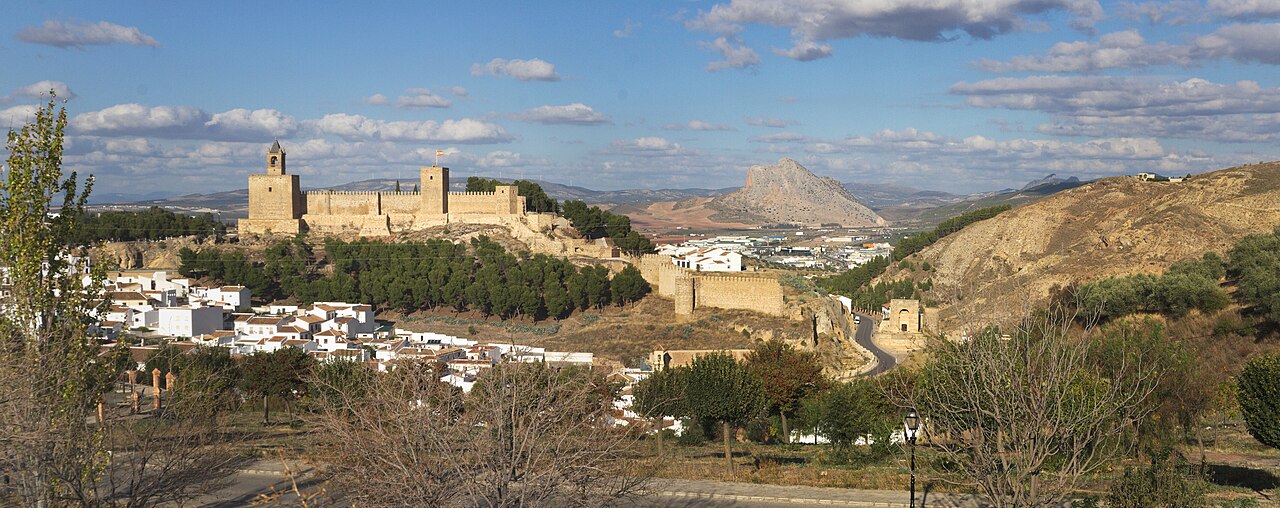
Alcazaba of Antequera
The Alcazaba of Antequera stands as a remarkable example of 14th-century Muslim military architecture in southern Spain. Erected on Cerro del Castillo, a strategic hill overlooking the city of Antequera in the province of Málaga, this fortress was built to defend the frontier between the Nasrid Kingdom of Granada and the expanding Christian kingdoms to the north. Its origins lie on a site with a deep historical legacy, built over Roman ruins and earlier Iberian settlements, reflecting centuries of cultural and military significance.
The fortress is rectangular in plan, featuring three defensive lines that include massive walls, towers, and gates. Among its most notable architectural features is the Torre del Homenaje, or Keep, one of the largest and tallest Moorish towers in al-Andalus, second only to the tower of La Calahorra in Gibraltar. This pentagonal tower rises over 17 meters high and is surmounted by a Catholic bell tower and chapel added in 1582, symbolizing the fortress's transformation after the Christian conquest.
Historical background and strategic importance
Early settlement and Roman influence
The site of the Alcazaba has been inhabited since the 7th millennium BCE, with archaeological evidence of early Iberian peoples. During the late 1st millennium BCE, the Romans established the city of Anticaria, developing it as a key center for olive oil production. The city's strategic location on a hill provided natural defense advantages and control over important trade routes linking Granada and Seville.
Medieval Muslim rule and fortress construction
Following the Berber conquest in 711 CE, the city was renamed Medina Antaquira and became an important military outpost. Initial defensive walls were constructed during the Caliphate of Córdoba (912–1016). Successive Muslim dynasties, including the Hammudids, Almoravids, and Almohads, reinforced the city's defenses with two rings of walls enclosing a large area. The current fortress, the Alcazaba, was built in the 14th century during the Nasrid period to strengthen the frontier against Christian advances.
Sieges and Christian conquest
The fortress played a critical role during the turbulent period of the Reconquista. In 1361, it successfully withstood a siege by King Pedro I of Castile, demonstrating its formidable defenses. However, in 1410, after a prolonged five-month siege, the fortress fell to forces led by Fernando I of Aragon, who earned the nickname "Fernando de Antequera" for this victory. The subsequent Christian conquest led to the expulsion of the Muslim population and the fortress's conversion into a Catholic stronghold.
Architectural features and layout
Fortress plan and defensive structures
The Alcazaba occupies a rectangular layout on the hilltop, incorporating three concentric defensive walls. The innermost line encloses the central citadel, where the keep and key military buildings are located. Surrounding this are barracks and other facilities for the garrison, while the outer walls protect the old city below. The walls are constructed with ashlar masonry, combining finely cut stone blocks and brick vaults, showcasing the skilled craftsmanship of Nasrid builders.
Notable towers
- Torre del Homenaje (Keep): This pentagonal tower measures approximately 17 by 17 meters and rises over 17 meters high. It contains three rooms arranged around a central hall and originally had a flat roof accessed by stairs. The 1582 addition of a bell tower with a pitched roof, known locally as "Papabellotas," houses the city's main bell and later a clock. This addition was financed by selling a cork oak forest, illustrating the community's investment in the fortress.
- Torre Blanca: Built during the Nasrid era, this rectangular tower measures about 9.7 by 9 meters and stands 19.25 meters tall. It has two floors; the ground floor served military purposes, while the upper floor contained five small rooms, including one with a balcony likely reserved for honored guests or residents. Its entrance is located in the western wall of the fortress.
- Torre del Quiebro: An outer tower adjacent to Torre Blanca, destroyed in 1510 during post-conquest conflicts. Archaeological excavations have reconstructed this tower based on surviving remains.
- Torre Albarrana de la Estrella: A detached albarrana tower connected to the fortress walls, reinforcing the defensive perimeter.
Additional defensive elements
The fortress includes several small gates such as the postigo and the Puerta del Agua, both near albarrana towers. These gates and towers are reinforced with buttresses and connected by curtain walls featuring horseshoe-shaped arches and loopholes for archers. The presence of these architectural elements reflects the Islamic military design principles prominent in al-Andalus.
Functional spaces within the fortress
Inside the fortress, there is a rectangular cistern measuring 6.20 by 4.10 meters, essential for water storage during sieges. An underground prison approximately 6 by 3 meters in size also exists, highlighting the fortress's role in controlling and detaining prisoners. Barracks and administrative buildings supported the garrison and the fortress's role as a military and political center.
Transformation after the Christian conquest
Following the capture of Antequera in 1410, the fortress was adapted to serve the needs of the new Christian rulers. The addition of the bell tower and chapel in 1582 atop the keep symbolizes this transformation from a Muslim military bastion to a Catholic administrative and religious site. The fortress also hosted the Cortes of Aragon in 1429 under Alfonso V, underscoring its continued strategic and political importance.
Some parts of the fortress suffered damage over the centuries, including the destruction of the Torre del Quiebro in 1510. Archaeological efforts have since reconstructed damaged sections, preserving the fortress for future generations. Today, the Alcazaba stands as a well-preserved monument reflecting the complex history of medieval Spain.
Preservation and visitor experience
The Alcazaba of Antequera is currently well preserved thanks to careful restoration efforts that maintain its key architectural features and reconstruct damaged parts. Visitors can explore the layered defenses, towers, and internal spaces, gaining insight into the fortress's military, administrative, and cultural roles throughout history.
The fortress's location on Cerro del Castillo offers panoramic views of Antequera and the surrounding Andalusian landscape, making it a popular destination for history enthusiasts and tourists alike. Interpretive signage and guided tours provide detailed information about the site's Nasrid origins, Christian modifications, and archaeological significance.
Overall, the Alcazaba of Antequera is a testament to the military ingenuity and cultural fusion that characterize medieval Spain, embodying centuries of history within its formidable walls.
Frequently asked questions (FAQ)
- What is the Alcazaba of Antequera?
- The Alcazaba of Antequera is a well-preserved Moorish fortress dating back to the 14th century. It is renowned for its impressive architecture and stunning views over the surrounding landscape, making it a significant historical landmark in Antequera, Spain.
- When was the Alcazaba of Antequera built?
- The construction of the Alcazaba began in the early 14th century, specifically around the year 1400, under the Nasrid dynasty. It was strategically built to defend the region and was later expanded and modified over the centuries.
- How do I get to the Alcazaba of Antequera?
- The Alcazaba is easily accessible by foot from the town center of Antequera. Visitors can also reach the castle by car, with nearby parking available, making it convenient for those traveling from other areas in Spain.
- What are the opening hours of the Alcazaba of Antequera?
- The Alcazaba is typically open to the public from 9:00 AM to 8:00 PM during the summer months and from 9:00 AM to 6:00 PM in winter. It is advisable to check the official website for any changes in hours or special closures before planning your visit.
- Can I purchase tickets in advance for the Alcazaba?
- Yes, tickets can be purchased in advance through the official website or at the entrance of the Alcazaba. Buying tickets ahead of time is recommended during peak tourist seasons to avoid long waits.
- Is it possible to explore the Alcazaba on my own?
- Visitors are free to explore the Alcazaba at their own pace, as there are no guided tours required. However, informative signage is available throughout the site, enhancing the self-guided experience.
- Why is the Alcazaba of Antequera historically significant?
- The Alcazaba of Antequera holds historical significance as a symbol of the Moorish presence in Spain and the architectural advancements of the period. It reflects the cultural fusion of Muslim and Christian influences in the region, making it an important site for understanding Spanish history.
- What is the best time to visit the Alcazaba of Antequera?
- The best time to visit the Alcazaba is during the spring and fall when the weather is mild, making for a comfortable exploration experience. Additionally, these seasons tend to attract fewer crowds compared to the summer months.
- Are there any nearby attractions to visit while in Antequera?
- Yes, visitors can also explore other nearby attractions such as the Dolmens of Antequera, a UNESCO World Heritage site, and the picturesque town center with its charming streets and local cuisine. These sites complement the historical experience at the Alcazaba and provide a fuller view of the region's rich heritage.
Information
Website
Visit websiteSources & official resources
Verify the information above using these authoritative references.
Loading map...
Visitor reviews
No reviews yet. Been here? Write the first review and help other travelers!
Write the first reviewVisited this castle? Share your experience
Your review helps other travelers and adds first-hand knowledge to our encyclopedia.