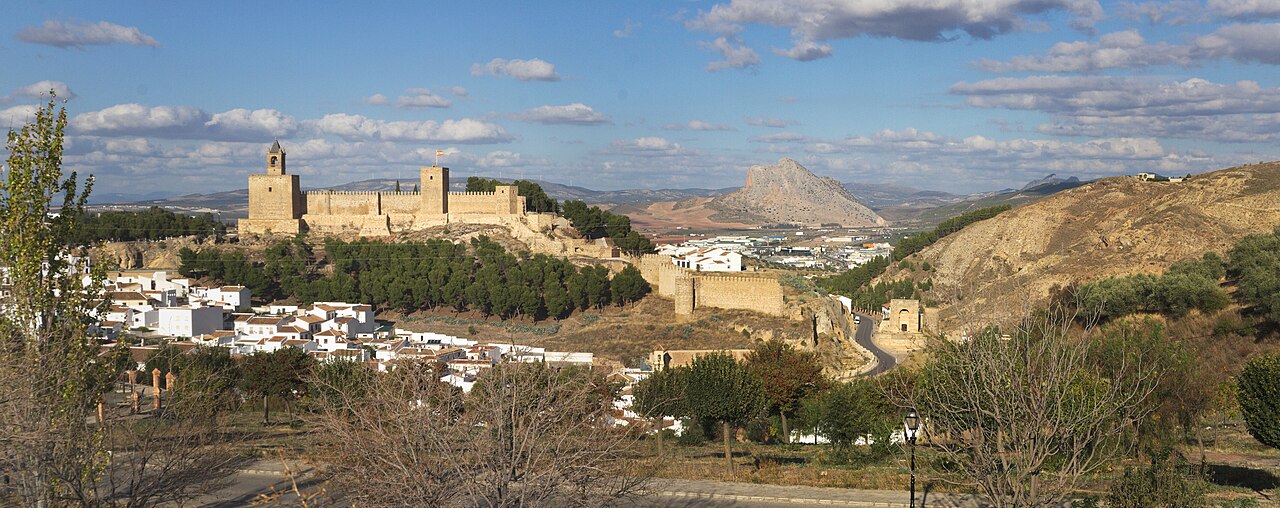
Castillo de Jévar
Castillo de Jévar is a notable hill castle situated in Antequera, Spain, with origins dating back to the Islamic period in Andalusia. This modest fortress played a crucial defensive role within the medieval Muslim community of Antequera, serving both military and residential functions over several centuries. Its strategic location on a hilltop allowed it to form part of a larger network of fortifications protecting the city and surrounding rural settlements.
Historical context and significance
The castle's construction likely occurred between the 11th and 15th centuries, a period marked by the complex interplay between Muslim and Christian powers in southern Spain. Initially, Castillo de Jévar functioned as a refuge and permanent home for rural populations associated with the nearby Muslim village settlements known as alquerías. Its role extended beyond mere military defense, reflecting the social and political dynamics of the Islamic presence in Andalusia.
In the early 15th century, Castillo de Jévar became part of a defensive network alongside the castles of Aznalmara and Cauche. These fortresses collectively secured the Islamic city of Antequera against advancing Christian forces. Historical accounts describe a significant event in 1410 during the Christian conquest efforts when the outer defenses of Antequera fell. The Muslim defenders retreated into the castle's keep, where they mounted a determined resistance, inflicting heavy casualties on the attackers before escaping under cover of darkness.
Following the city's surrender, governance of the castle was transferred to Pero Sánchez Escobar by Infante Fernando. The garrison at this time consisted of six knights and thirty infantry soldiers. The castle later returned briefly to the control of the Nasrid dynasty, who partially demolished it before abandoning the site. Subsequently, Rodrigo de Narváez, mayor of Antequera, undertook repairs and reinforced the fortress with a larger garrison of 100 knights and 100 foot soldiers.
From this period, Castillo de Jévar operated as a frontier outpost under the jurisdiction of Antequera's mayoralty. In 1442, King Juan II officially granted the castles of Cauche, Jévar, and Aznalmara to Antequera. Despite these efforts, the fortress endured a prolonged siege between 1443 and 1446, during which it likely fell briefly under Granada's control. After the Granada War, the military importance of Castillo de Jévar declined, leading to its gradual deterioration.
Architectural features and design
Location and layout
Castillo de Jévar occupies a modest hilltop within a rural landscape, commanding views over the surrounding terrain. The fortress features a double enclosure with an irregular shape adapted to the contours of the hill. The outer walls are constructed from well-arranged limestone blocks, showcasing careful masonry techniques. The foundation consists of large, roughly fitted cyclopean stones, which transition to smaller, more regular stones toward the upper sections of the walls. Remnants of a pale plaster coating survive in some areas, indicating the castle's former finished appearance.
Defensive structures
The fortress is anchored by a central tower that serves as the main defensive stronghold. This tower features a solid base supporting an upper chamber connected to the surrounding wall walk, known as an adarve. A distinctive feature of the tower is its battered outer wall—a sloping design on the side with the entrance intended to strengthen defense against attackers.
The main gate employs a bent or angled layout called a puerta de codo, a design typical of the Almohad era. This angled entryway was intended to disrupt the momentum of cavalry charges and impede direct assaults. In addition to the main gate, the fortress likely had at least one smaller gate and a lintelled postern gate used for emergencies or quick escapes.
The primary enclosure, sometimes referred to as an alcázar, is fortified with battlements and solid towers spaced at regular intervals along the walls. These features provided elevated positions for defenders to observe and repel attackers. The secondary enclosure served as a protective space for servants and nearby civilians during times of conflict, forming a communal area known as a qasba.
At the heart of the castle lies the plaza de armas, an open courtyard that functioned as a gathering place within the fortification. This space would have been central to the castle's daily activities and military organization.
Military role and historical events
Throughout its history, Castillo de Jévar played a significant role as a defensive stronghold in the contested borderlands between Christian and Muslim territories. Its inclusion in a network of fortifications around Antequera highlights its strategic importance during the Reconquista period.
The castle's resilience during the 1410 siege demonstrated the effectiveness of its defensive design and the determination of its Muslim garrison. The subsequent changes in control between Christian and Nasrid forces reflect the turbulent political landscape of the region during the 15th century.
Despite efforts to maintain and reinforce the fortress, the prolonged siege from 1443 to 1446 likely weakened its defenses and contributed to its eventual decline following the conclusion of the Granada War. The castle's military function diminished as the frontier shifted and new political realities emerged.
Current condition and preservation
Today, Castillo de Jévar remains a partially preserved ruin offering valuable insights into medieval Islamic military architecture in Andalusia. The surviving walls, towers, and gate structures provide a tangible connection to the region's complex history.
Visitors to the site can observe the castle's masonry techniques, defensive features, and layout, which collectively illustrate the blend of military necessity and accommodation of local communities characteristic of rural fortresses during the Islamic period.
Frequently asked questions (FAQ)
- When was Castillo de Jévar built?
- Castillo de Jévar was constructed between the 11th and 15th centuries during the Islamic period in Andalusia.
- What is the architectural style of Castillo de Jévar?
- The castle features typical Islamic military architecture of the medieval period, including a double enclosure, a central tower with a battered wall, and a bent main gate known as puerta de codo.
- Can visitors access Castillo de Jévar today?
- Yes, Castillo de Jévar is partially preserved and open to visitors who wish to explore its ruins and learn about its historical significance.
- What role did Castillo de Jévar play in the Reconquista?
- Castillo de Jévar was part of a defensive network protecting the Islamic city of Antequera and resisted Christian conquest efforts during the early 15th century.
- How is the castle constructed?
- The fortress is built with well-arranged limestone blocks and large cyclopean stones in the foundation, showcasing careful masonry and defensive design features.
Information
Loading map...
Visitor reviews
No reviews yet. Been here? Write the first review and help other travelers!
Write the first reviewVisited this castle? Share your experience
Your review helps other travelers and adds first-hand knowledge to our encyclopedia.