Albrechtsburg
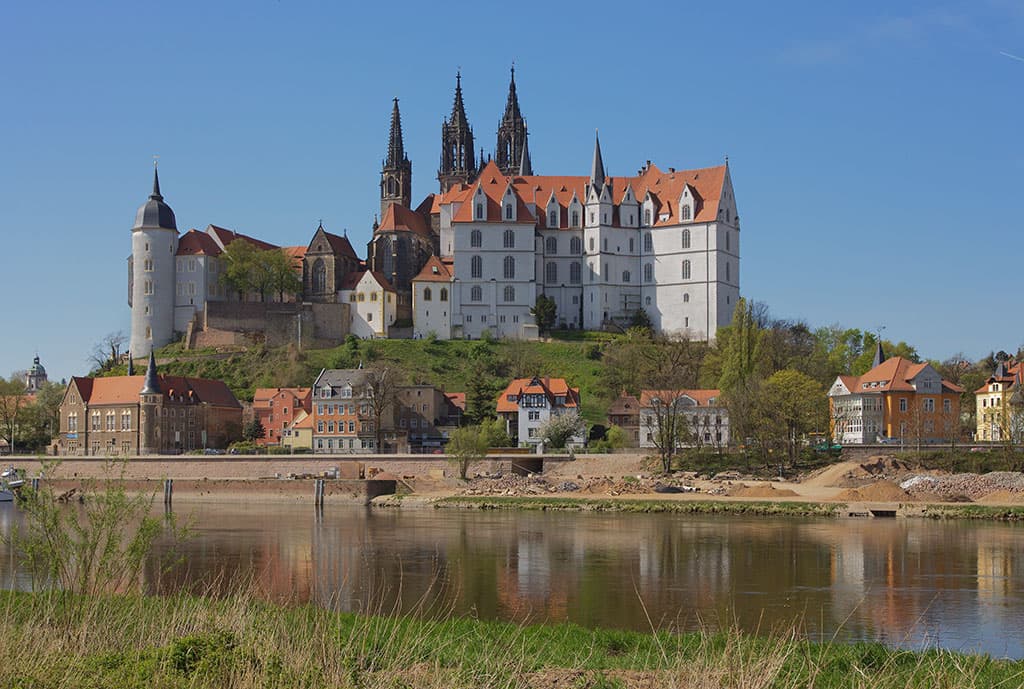
Albrechtsburg castle stands as a remarkable example of Late Gothic architecture in the historic town of Meissen, Saxony, Germany. Perched on the Burgberg hill overlooking the Elbe River and adjacent to the Meissen Cathedral, it dominates the town center with its striking silhouette. The castle is renowned not only for its architectural significance but also for its pivotal role in the history of European porcelain manufacturing.
The castle's origins trace back to a medieval fortress known as Misni, established after King Henry I's victory over the Slavic Glomacze tribe in 929. This early fortification served as a strategic stronghold due to its commanding position on a rocky outcrop above the river, controlling vital trade and military routes in the region. Over the centuries, the site witnessed shifting control among German rulers, the Polish Piast dynasty, and the Bohemian Přemyslids, reflecting its contested political importance in Central Europe.
The construction and architectural innovation of Albrechtsburg
In 1471, the Wettin brothers, Ernst and Albrecht, commissioned the construction of a new palace to replace the old fortress, marking a significant architectural milestone as one of the earliest examples of a true palace in Germany. The project was led by the master builder Arnold von Westfalen, who introduced innovative design elements that combined defensive features with residential comfort and aesthetic grandeur.
Architectural layout and features
The castle is built on a distinctive hook-shaped plan atop a steep rocky plateau. Its structure comprises a high base with a low ground floor, two main floors featuring large arched windows, and a noble floor within the roof area illuminated by a series of lucarnes—dormer windows that form a crown of tower-like figures along the roofline. This design creates the impression of a cluster of towers unified under a massive roof, with only one true tower rising prominently above the central section facing the Elbe River.
A hallmark of the castle is the main staircase tower on the courtyard side, housing a large spiral staircase with elegantly curved steps winding around an open central void. Originally, the staircase's windows were open to allow visual contact between those ascending and people in the courtyard, enhancing communication and social interaction within the castle. A smaller stair tower at the courtyard's corner between the north and east wings complements this feature.
Interior spaces and residential quarters
The first floor contains two large vaulted halls: an unheated festival hall accessed via the main staircase tower, and a heated banqueting hall equipped with a large tiled stove, used for meals by the male court household. Above the door connecting these halls is a musician’s gallery, reflecting the castle's role as a venue for courtly entertainment.
Surrounding these halls are three separate apartments, each featuring a heated main room and smaller chambers for sleeping and storage. The northeast apartment is architecturally notable for its tower-like structure rotated 45 degrees, offering panoramic views of the Elbe valley on three sides. The second floor houses the Elector’s three-room apartment, including a reception room, bedroom, and a small retreat inspired by French and Italian Renaissance designs. A separate room with three window fronts was reserved for female court members, somewhat apart from the main court activities. The third floor within the lucarne zone likely contained the Electress’s apartment, connected by internal stairs to her attendants' rooms.
Historical significance and later uses
After the division of Wettin lands in 1485, Albrecht received Meissen and the newly constructed castle, which was later named Albrechtsburg in 1676 in his honor. His son, Georg the Bearded, was the first Wettin to reside there. The castle endured significant damage during the Thirty Years’ War and subsequently fell into a period of neglect and partial abandonment.
A defining chapter in the castle’s history began in 1710 when King Augustus II the Strong established the Royal-Polish and Electoral-Saxon Porcelain Manufactory within its walls. This was the first European hard-paste porcelain manufacture, a groundbreaking development that placed Meissen at the forefront of European ceramics. The manufactory's secluded location within the castle helped protect the closely guarded secrets of porcelain production. The manufactory operated at Albrechtsburg until 1863, when production moved to a new facility.
Restoration and preservation
Between 1864 and 1870, Albrechtsburg underwent extensive restoration to remove industrial modifications and restore its historical character. Artists from the Dresden Academy of Fine Arts contributed elaborate historical murals, enriching the castle’s interiors with period-appropriate decoration. These efforts transformed Albrechtsburg into a cultural monument and tourist attraction, preserving its architectural and historical legacy for future generations.
Architectural details and artistic elements
The castle’s vaulting system, featuring cellular vaults and curtain-like window finishes, was innovative for its time and influenced regional architectural styles. The balustrades of the Great Staircase Tower are adorned with early Renaissance figural reliefs by the sculptor Christoph Walther I, showcasing the fusion of Gothic and Renaissance artistic trends.
Defensive structures and surroundings
Defensive elements include three round towers positioned at the corners of the Burgberg plateau and a stone castle bridge attributed to Florentine builders, serving as a grand entrance. The White Tower, part of the Burggraf’s domain and protector of the castle bridge, was dismantled in 1607. The castle’s elevated position and robust construction ensured its strategic importance throughout its history.
Albrechtsburg today
Today, Albrechtsburg is a well-preserved cultural heritage site, largely retaining its original Late Gothic features thanks to 19th-century restorations. It is open to the public as a museum, offering visitors insight into its architectural grandeur, historical significance, and the pioneering role it played in European porcelain production. The castle's combination of defensive design, residential comfort, and artistic innovation makes it a unique monument in German and European history.
Visitors can explore the grand halls, intricate staircases, and richly decorated apartments, while also learning about the castle’s role in the Wettin dynasty and the development of Meissen porcelain. Its location on the Elbe River and proximity to the Meissen Cathedral add to its appeal as a key destination for those interested in medieval architecture, Renaissance art, and European cultural history.
Frequently asked questions (FAQ)
- How do I get to Albrechtsburg castle in Meissen?
- Albrechtsburg castle is located on Burgberg hill in Meissen, Saxony. It is accessible by foot from the town center, with signage guiding visitors to the castle entrance near the Meissen Cathedral.
- What is the historical significance of Albrechtsburg castle?
- Albrechtsburg castle is significant for its role as one of the earliest German palaces and as the site of Europe's first hard-paste porcelain manufactory, established in 1710 by King Augustus II the Strong.
- When was Albrechtsburg castle built?
- The current Late Gothic structure of Albrechtsburg castle was constructed in the 15th century, commissioned by the Wettin brothers Ernst and Albrecht.
- Can I visit the porcelain manufactory at Albrechtsburg?
- The original porcelain manufactory operated at Albrechtsburg until 1863 and is now part of the castle museum exhibits, but the active manufactory has since moved to a separate location in Meissen.
- What architectural styles are represented in Albrechtsburg castle?
- Albrechtsburg castle primarily showcases Late Gothic architecture with early Renaissance elements, including innovative vaulting and figural reliefs by Christoph Walther I.
- What are the opening hours and ticket prices for Albrechtsburg castle?
- The castle is open daily from 10:00 to 18:00. Tickets cost €8 for adults and €4 for children, with discounts available for groups and families.
Photo gallery

Information
Opening hours
10:00-18:00, daily
Ticket prices
€8 adult, €4 child
Current owner
State museum
Website
Visit websiteSources & official resources
Verify the information above using these authoritative references.
Loading map...
Visitor reviews
No reviews yet. Been here? Write the first review and help other travelers!
Write the first reviewVisited this castle? Share your experience
Your review helps other travelers and adds first-hand knowledge to our encyclopedia.