Akhalkalaki Castle
Akhalkalaki Castle is located in the town of Akhalkalaki, within the Aspindza municipality of the Samtskhe–Javakheti region in Georgia. This historic fortress occupies a strategic position on a small spur of land between the Paravani and Kirkhbulaki rivers, giving it a naturally defensible location that was important for controlling the surrounding region.
The origins of Akhalkalaki Castle date back to the founding of the town itself, traditionally placed in 1064. Initially, it was part of the Kingdom of Georgia, serving as a fortified settlement and a regional center. Over the centuries, the castle and town shifted between Georgian and Armenian control, reflecting the complex political and ethnic history of this borderland area. Eventually, it came under the authority of the Georgian Bagrationi dynasty, who used it as the political and economic hub of the Javakheti region.
Destruction and Ottoman reconstruction
During the turbulent 15th century, the town and castle suffered near-total destruction, likely due to regional conflicts and invasions common in the late medieval Caucasus. This devastation left the fortress in ruins for some time.
In 1637, the Ottoman Empire conquered Akhalkalaki and undertook significant rebuilding efforts. The Ottomans transformed the castle into a formidable fortress, adapting it to their military and administrative needs. This period saw the addition of key structures such as a mosque and a caravanserai, which served both religious purposes and supported trade and travel along regional routes.
Architectural features and layout
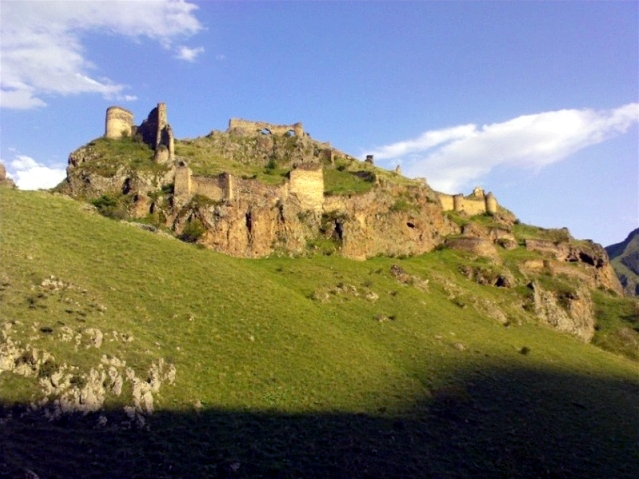
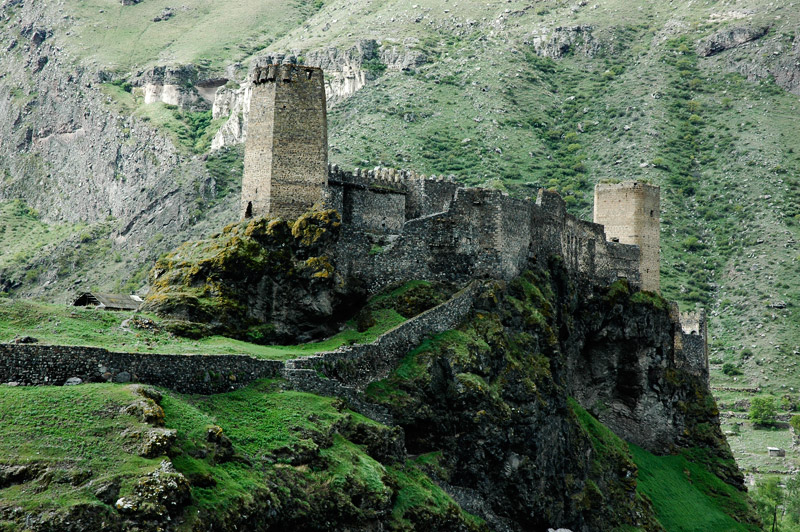
The castle's layout is roughly rectangular, designed to fit the contours of the spur between the two rivers. It features several square towers positioned along the walls, which would have provided vantage points for defense and surveillance. The walls and towers display characteristics typical of late medieval fortifications in the Caucasus, with robust masonry designed to withstand sieges.
Adjacent to the castle ruins are the remains of the Ottoman mosque, now repurposed as a shelter for livestock, and the caravanserai, which would have accommodated merchants and travelers. These structures highlight the castle's role not only as a military installation but also as an administrative and commercial center during Ottoman rule.
Historical significance and later history
Akhalkalaki Castle's strategic location made it a focal point in the power struggles between regional kingdoms and empires. Its control was essential for dominance over the Javakheti region and the surrounding areas. The fortress remained under Ottoman control until the Russo-Turkish War of 1828-1829, when it was captured by Russian forces commanded by General Ivan Paskevich. Following this, the castle became part of the Russian Empire, marking another shift in the region's political landscape.
Present condition and accessibility
Today, Akhalkalaki Castle stands as a collection of ruins that include the fortress walls, towers, the mosque, and caravanserai remains. The site is freely accessible to visitors, offering a tangible connection to the layered history of the region. While the structures are largely in a state of ruin, they provide valuable insights into medieval Georgian and Ottoman architecture and the historical dynamics of the Caucasus.
Frequently asked questions (FAQ)
- What is the best time to visit Akhalkalaki Castle?
- The best time to visit Akhalkalaki Castle is during the late spring to early autumn months when the weather is mild and suitable for exploring the ruins comfortably.
- Is Akhalkalaki Castle accessible to the public?
- Yes, Akhalkalaki Castle is freely accessible to visitors. There are no entrance fees, and visitors can explore the castle ruins, mosque remains, and caravanserai structures at their own pace.
- What are the main historical periods represented at Akhalkalaki Castle?
- The castle reflects significant historical periods including its original construction in the late medieval era, its destruction in the 15th century, and its reconstruction and adaptation during Ottoman rule in the 17th century.
- Can I see Ottoman architectural features at Akhalkalaki Castle?
- Yes, visitors can observe remnants of Ottoman architecture such as the mosque and caravanserai adjacent to the castle ruins, which were added during the 17th-century Ottoman reconstruction.
- How did Akhalkalaki Castle change after the Russo-Turkish War?
- After the Russo-Turkish War of 1828-29, Akhalkalaki Castle was captured by Russian forces and incorporated into the Russian Empire, marking the end of Ottoman control in the region.
Information
Loading map...
Visitor reviews
No reviews yet. Been here? Write the first review and help other travelers!
Write the first reviewVisited this castle? Share your experience
Your review helps other travelers and adds first-hand knowledge to our encyclopedia.