Khertvisi Castle
Khertvisi Castle stands as one of the oldest and most historically significant fortifications in Georgia. Located near the village of Khertvisi in the Aspindza municipality within the Samtskhe–Javakheti region, this fortress occupies a strategic position at the confluence of the Paravani and Kura rivers (known locally as the Mtkvari). The castle's location atop a rocky ridge overlooking deep river canyons allowed it to control an important medieval route connecting the Byzantine Empire with the Caucasus region.
The origins of Khertvisi Castle are ancient and somewhat shrouded in legend. While the earliest surviving structures date from the 10th century, local tradition holds that a fortress or city existed here as early as the 2nd century BC. A popular legend claims that Alexander the Great passed through this area during his eastern campaigns and that the original fortress was destroyed by his forces. Although this story cannot be historically verified, it underscores the site's long-standing military importance.
Historical development and significance
The castle's earliest extant components, including the St. George Church, date from around 985 AD. Throughout the 10th and 11th centuries, Khertvisi served as the administrative center of the Meskheti region, a key area in medieval Georgia. By the 12th century, the fortress had evolved into a fortified town, reflecting its growing political and military role.
Khertvisi endured significant destruction during the 13th century Mongol invasions, which devastated much of the Caucasus. Following this, the fortress experienced a period of decline until the mid-14th century. In 1356, the castle was substantially rebuilt under the direction of Zakaria Kamkamishvili, the Royal Treasurer, who commissioned the construction of the keep and the outer defensive walls. These fortifications enhanced the castle's defensive capabilities and are among the most prominent surviving features today.
During the 15th and 16th centuries, Khertvisi was controlled by the feudal Hertvisari family. However, in 1578, it fell to the invading Ottoman Empire, marking a significant shift in regional power. The Ottomans maintained control of the fortress for nearly three centuries, integrating it into their defensive network in the Caucasus.
In the late 18th century, during the Russo-Turkish War of 1768–1774, the Georgian king Erekle II briefly recaptured Khertvisi. However, due to internal betrayal, the castle was soon lost again to Ottoman forces. It remained under Ottoman control until the Russo-Turkish War of 1828–1829, when it was annexed by the Russian Empire. Subsequently, the fortress was garrisoned by Russian and Georgian troops, although its strategic importance gradually diminished in the 19th century.
Architectural features and layout
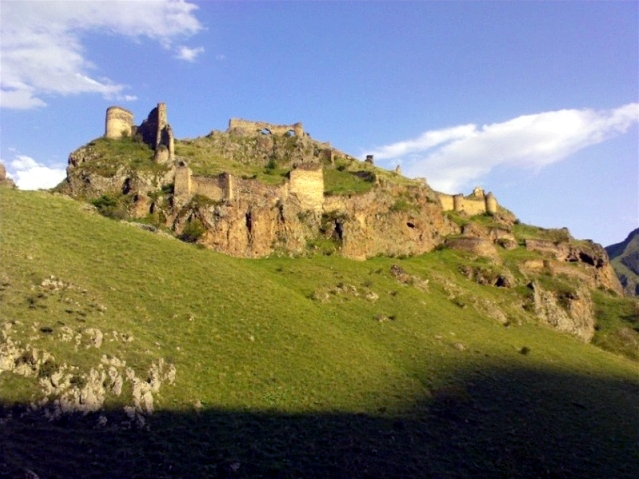
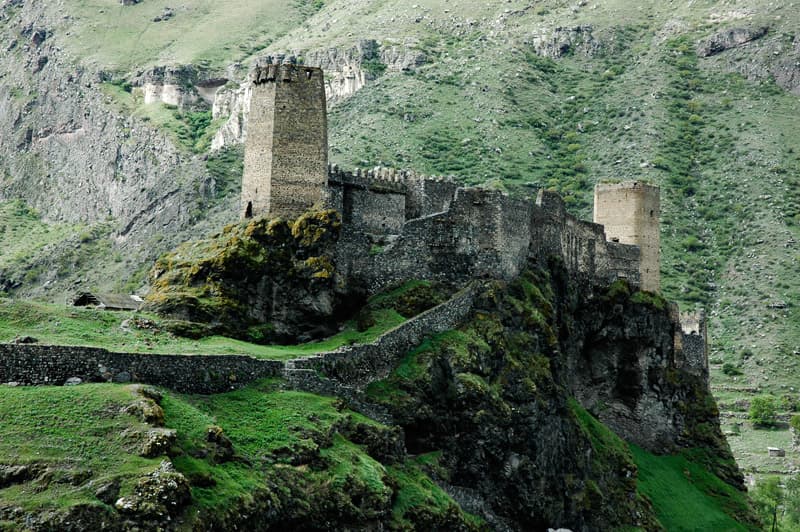
Khertvisi Castle is characterized by its elongated layout, adapted to the rocky ridge on which it sits. The fortress is surrounded by a restored outer defensive wall that once enclosed the complex and provided a first line of defense. Inside the walls, several notable structures remain:
- A five-sided watchtower that provided extensive views over the surrounding river valleys and approaching roads.
- A prominent square keep, built during the 14th-century reconstruction, served as the last refuge during sieges.
- The St. George Church, dating from the late 10th century, stands as a significant religious and architectural monument within the castle grounds.
- Remnants of a tunnel that once connected the fortress to the river below, likely used for secret access or water supply during sieges.
The castle's construction materials primarily consist of local stone, with masonry techniques reflecting the evolving medieval Georgian architectural styles. The defensive walls feature battlements and arrow slits designed to repel attackers, while the keep's robust construction highlights its role as a stronghold.
Strategic importance and military history
Khertvisi's location at the junction of two rivers and along key trade and military routes made it a vital defensive site throughout its history. It guarded access to the southern Georgian region of Meskheti and served as a bulwark against invasions from the south and west.
The fortress witnessed numerous military engagements, including destruction by the Mongols in the 13th century and occupation by the Ottomans in the 16th century. Its capture and recapture during the Russo-Turkish conflicts of the 18th and 19th centuries further underscore its enduring military relevance.
Current state and visitor information
Today, Khertvisi Castle exists as ruins, with significant portions of its walls and key structures preserved or restored. The site is freely accessible to visitors during office hours, offering a tangible connection to Georgia's medieval past. The castle's dramatic setting in a narrow canyon with river views adds to its appeal for tourists and history enthusiasts alike.
Visitors can explore the remains of the keep, watchtower, and church, as well as walk along parts of the outer wall. The castle's location also provides opportunities for scenic views and photography.
Recommended visiting tips
- Wear sturdy footwear due to uneven terrain and rocky surfaces.
- Plan a visit during daylight hours for safe exploration and best views.
- Combine a visit to Khertvisi with nearby historical sites in the Samtskhe–Javakheti region.
Khertvisi Castle remains a significant cultural monument in Georgia, reflecting centuries of military architecture and regional history.
Frequently asked questions (FAQ)
- What is the historical significance of Khertvisi Castle?
- Khertvisi Castle, one of the oldest fortifications in Georgia, dates back to the 10th century. Its strategic location on a hilltop overlooking the junction of the Mtkvari and Vardzia rivers made it crucial for controlling trade routes and military defense throughout history.
- When was Khertvisi Castle built?
- The construction of Khertvisi Castle began in the 10th century, with various renovations and expansions occurring over the centuries. This impressive fortress witnessed significant historical events and changes in rulers, particularly during the medieval period.
- Can I visit Khertvisi Castle year-round?
- Yes, Khertvisi Castle is open to visitors throughout the year, although the best time to visit is during the spring and autumn months when the weather is mild. It's advisable to check local weather conditions and any potential accessibility issues during winter.
- What are the opening hours for Khertvisi Castle?
- Khertvisi Castle typically opens at 10 AM and closes at 6 PM, but these hours may vary seasonally. It is always a good idea to check ahead for the latest information or any special events that might affect access.
- Is it possible to reach Khertvisi Castle by public transport?
- While public transport options to Khertvisi Castle are limited, visitors can take a bus or taxi to the nearby town of Aspindza and then hike to the castle. Alternatively, renting a car can provide a more convenient and flexible way to explore the area.
- What is the architecture style of Khertvisi Castle?
- Khertvisi Castle showcases a blend of medieval Georgian and Byzantine architectural styles, characterized by its sturdy stone walls and impressive towers. The castle's design reflects its military purpose, with strategic features that enhanced its defensive capabilities.
- Are there any nearby attractions to visit?
- Yes, near Khertvisi Castle, you can explore the famous Vardzia Cave Monastery, a UNESCO World Heritage site carved into the cliffs. Additionally, the surrounding landscapes offer beautiful hiking trails and picturesque views of the region.
- What are the ticket prices for visiting Khertvisi Castle?
- The ticket prices for Khertvisi Castle are generally affordable, with discounts available for students and seniors. It's best to check the current rates upon arrival or on the official tourism website for Georgia.
Photo gallery

Information
Loading map...
Visitor reviews
No reviews yet. Been here? Write the first review and help other travelers!
Write the first reviewVisited this castle? Share your experience
Your review helps other travelers and adds first-hand knowledge to our encyclopedia.