Tmogvi Castle
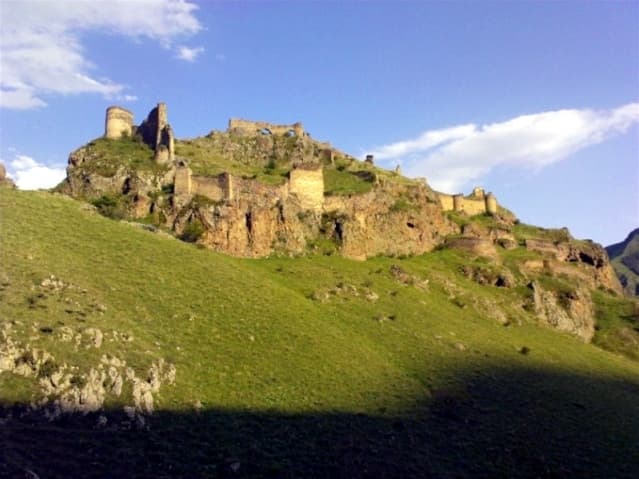
Tmogvi Castle, also known as Tmkaberd, is a significant medieval fortress ruin located in the Samtskhe-Javakheti region of southern Georgia. Positioned on the left bank of the Kura River (called the Mtkvari in Georgian), it lies a few kilometers downstream from the famed cave city of Vardzia. The castle's strategic location atop three joined hills overlooking a deep river gorge allowed it to control an important ancient trade route that connected the Javakheti plateau with Asia Minor through the Kura River canyon.
Early history and strategic significance
The earliest documentary mention of Tmogvi Castle dates back to the 9th century. It was likely constructed by the Georgian Bagratid dynasty, the feudal lords who controlled the region during the early medieval period. The Bagratids were instrumental in consolidating power in southwestern Georgia, and Tmogvi served as a crucial military stronghold in the Javakheti region.
After the destruction of the nearby fortress and town of Tsunda around 900 AD, Tmogvi rose in prominence as the dominant fortress in the area. Its commanding position over the river gorge enabled it to monitor and protect trade and military movements along this vital passageway.
In 914 AD, the fortress was captured by Arab forces under the command of Abdul-Kassim, reflecting the turbulent power struggles in the Caucasus during this era. By the early 11th century, the castle came under the direct control of the unified Kingdom of Georgia, marking its integration into a centralized Georgian state.
Feudal ownership and architectural evolution
In 1073, Tmogvi Castle was granted in apanage to the nobleman Niania Kuabulisdze. His descendants maintained control of the fortress for several centuries, although ownership eventually passed to other prominent feudal families, including the Toreli, Tmogveli, Shalikashvili, and Jaqeli dynasties. From the late 12th century, it served as the residence of the Tmogveli family, who governed the frontier duchy centered on the castle.
The castle suffered significant damage from several earthquakes, notably in 1088, 1283, and 1319. Each time, it was rebuilt, demonstrating its continued strategic and symbolic importance. The medieval Georgian writer Sargis Tmogveli hailed from this fortress, highlighting its cultural as well as military significance.
Fortress layout and defensive features
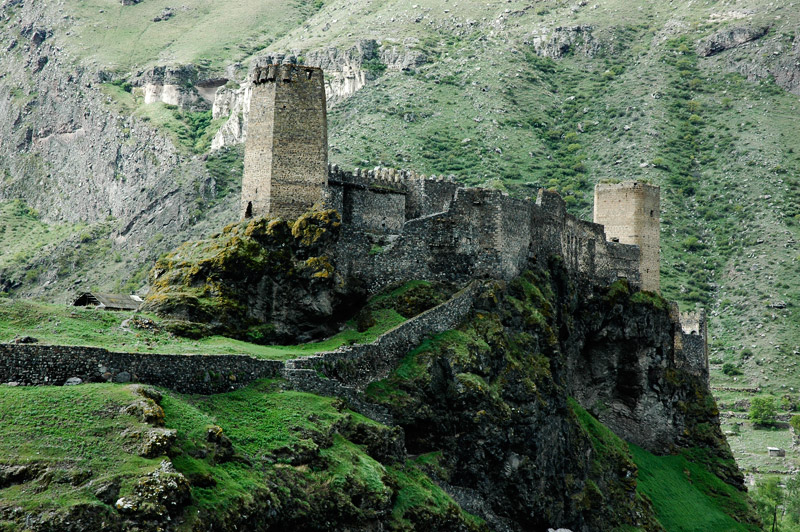
Tmogvi Castle is spread across three adjacent hills, which are encircled by a thick defensive wall approximately 150 meters long and 3 meters wide. This wall augmented the natural defenses provided by the steep cliffs and rugged terrain. Numerous towers were constructed on each hill, enhancing the fortress's defensive capabilities and providing vantage points over the surrounding landscape.
A notable feature of the castle is a secret tunnel that connects the fortress to the river below. This tunnel ensured a reliable water supply during sieges, a critical factor in medieval fortress defense. The western section of the fortress is better preserved than other parts, offering insight into the castle's original structure.
Within the castle grounds, a few buildings remain, including a quadrangular structure built of tuff stone on a basalt foundation, believed to have been a church. Outside the walls on the western side stands the ruined church of Saint Ephrem, which contains fragments of 13th-century frescoes, attesting to the site's religious and cultural importance.
Later history and decline
In the 16th century, control of Tmogvi Castle passed through several noble families. Initially held by the Rachulashvili family, it later came under the Shalikashvili family. Between 1576 and 1578, the fortress was seized by the Jaqeli family, the Atabegs of Samtskhe. In 1578, the Jaqeli transferred the castle to the Ottoman Empire, marking the beginning of Ottoman rule in the region.
Following the Russo-Turkish War of 1828-1829, the Treaty of Adrianople compelled the Ottomans to cede Tmogvi Castle and the surrounding territory to the Russian Empire. After this transfer, the fortress and the adjacent town lost their military and administrative significance, leading to their gradual abandonment and ruin.
Modern access and preservation status
Today, Tmogvi Castle remains in a state of ruin, classified as an archaeological site. The castle's remote location on steep mountain slopes makes access challenging. Visitors often require a sturdy 4WD vehicle or must undertake a lengthy hike to reach the site. Even then, entering the inner parts of the fortress is risky due to the precarious terrain and deteriorated structures.
The western outer sections of the castle are more accessible, allowing visitors to explore part of the fortress. The site is freely accessible to the public, offering a glimpse into Georgia's medieval military architecture and the historical dynamics of the South Caucasus region.
Cultural and historical significance
Tmogvi Castle holds considerable importance as a military, cultural, and historical landmark in Georgia. Its role in controlling trade routes, its connection to prominent feudal families, and its endurance through centuries of conflict and natural disasters reflect the complex history of the region. The surviving architectural elements, including defensive walls, towers, and religious buildings, provide valuable insights into medieval Georgian fortress design and feudal society.
Frequently asked questions (FAQ)
- What is Tmogvi Castle known for?
- Tmogvi Castle is renowned for its stunning location on a steep cliff overlooking the Vardzia Monastery and the surrounding landscape. The castle's architecture showcases a blend of medieval Georgian styles, making it a significant landmark in the region's history.
- When was Tmogvi Castle built?
- Tmogvi Castle was constructed in the 10th century, during a period of significant development in the Kingdom of Georgia. It served as a strategic fortress and played a vital role in protecting the region from invasions.
- Can I visit Tmogvi Castle?
- Yes, visitors are welcome to explore Tmogvi Castle and its picturesque surroundings. The site is open to the public, allowing guests to experience its historical significance and breathtaking views.
- What are the opening hours for Tmogvi Castle?
- Tmogvi Castle is typically open from sunrise to sunset, allowing ample time for visitors to explore the ruins and enjoy the scenery. However, it's advisable to check local resources for any seasonal changes in visiting hours.
- Is Tmogvi Castle accessible for all visitors?
- While Tmogvi Castle can be reached by walking, the terrain may be challenging for individuals with mobility issues. Visitors should be prepared for steep paths and uneven surfaces when exploring the castle grounds.
- What is the best time to visit Tmogvi Castle?
- The best time to visit Tmogvi Castle is during the spring and early autumn months when the weather is mild and the surrounding nature is in full bloom. This season offers stunning views and a comfortable climate for exploring the historical site.
- Are there any nearby attractions to Tmogvi Castle?
- Yes, nearby attractions include the famous Vardzia Monastery, a rock-hewn monastery complex, and the picturesque town of Aspindza. These sites complement a visit to Tmogvi Castle, providing additional historical and cultural experiences.
- What are the ticket prices for Tmogvi Castle?
- Currently, there are no entry fees required to visit Tmogvi Castle, making it an accessible destination for all. However, contributions to the preservation of the site are often appreciated.
Photo gallery

Information
Loading map...
Visitor reviews
No reviews yet. Been here? Write the first review and help other travelers!
Write the first reviewVisited this castle? Share your experience
Your review helps other travelers and adds first-hand knowledge to our encyclopedia.