Ajloun Castle
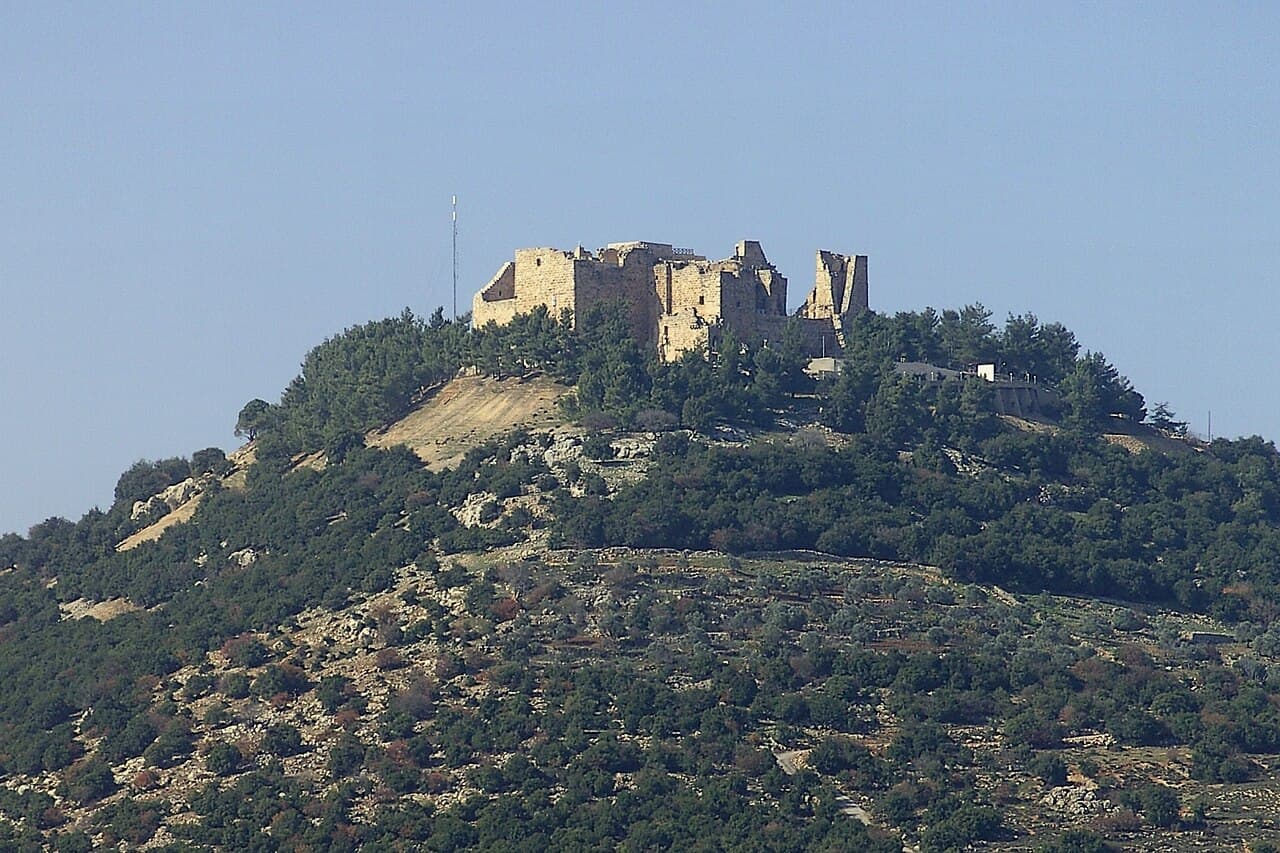
Ajloun Castle, also known by its medieval name Qalʻat ar-Rabad, is a significant 12th-century Muslim fortress located in northwestern Jordan. Perched atop a strategic hill in the Mount Ajloun district, also historically called Jabal Auf after the local Arab tribe, the castle commands sweeping views over three wadis descending toward the Jordan Valley. This elevated position was carefully chosen to control vital routes and monitor movements in the region, particularly along the road connecting Damascus and Egypt.
The castle was originally constructed in 1184 AD by Izz al-Din Usama, a general serving under the renowned Muslim leader Saladin. It was built on the site of an earlier monastery, traces of which were uncovered during archaeological excavations, demonstrating the site's long-standing importance. Ajloun Castle is one of the few Ayyubid fortresses designed specifically to defend against Crusader incursions from the west and south, including threats from the Crusader-held castles of Belvoir and Karak.
Strategic importance and military architecture
The castle's primary purpose was to help the authorities in Damascus maintain control over the Bedouin tribes of Jabal Auf, who had allied with Crusader forces at times. According to Saladin's historian Baha ad-Din ibn Shaddad, the fortress was built to curb the autonomy of these tribes, who had even established a large camp near the Hospitaller castle of Belvoir across the Jordan Valley.
Ajloun Castle's original design featured four corner towers connected by robust curtain walls and protected by a double gate. The walls incorporated arrow slits for archers, and the entire structure was surrounded by a deep moat approximately 16 meters wide and 12 to 15 meters deep. This defensive moat enhanced the castle's resilience against siege warfare and made direct assaults difficult.
Expansion under the Mamluks
Following the death of Izz al-Din Usama, the castle was expanded in 1214–1215 AD by Aibak ibn Abdullah, the Mamluk governor of the region. He added a new tower at the southeast corner and constructed a new gate, further strengthening the fortress. During this period, the castle shifted from a purely military outpost to also serving as an administrative center.
Historical events and transformations
After the Ayyubids captured Karak in 1187 AD, Ajloun Castle's strategic military importance declined somewhat but it remained a key regional stronghold. In the mid-13th century, the castle was granted to Yousef ibn Ayoub, emir of Aleppo and Damascus, who restored the northeastern tower and used it for administrative purposes.
The castle suffered damage during the Mongol invasions of 1260 AD, including destruction of its battlements. However, after the Mamluks defeated the Mongols at the Battle of Ain Jalut, Sultan ad-Dhaher Baibars undertook restoration work, clearing the castle's defensive moat (fosse) and repairing fortifications. Under his rule, the castle was also repurposed as a storehouse for crops and provisions.
Inscriptions found in the castle's southwest tower attest to renovations carried out by Izz ad-Din Aibak during his governorship. The fortress continued to hold military relevance during the Ottoman period, when a garrison of fifty soldiers was stationed there. In the early 17th century, Prince Fakhr ad-Din al-Ma'ni II used the castle during his conflicts with rival factions, provisioning it with troops, ammunition, and supplies.
Architectural features and layout
Ajloun Castle exemplifies typical hill castle architecture of the High Medieval period with a focus on defensive strength and control of surrounding terrain. The castle’s corner towers provided vantage points for surveillance and defense. The curtain walls were thick and robust, pierced with narrow arrow slits that allowed defenders to fire upon attackers while remaining protected.
The double gate system added an extra layer of security, forcing any attackers to breach two successive barriers. The presence of a wide, deep moat further hindered enemy advances. The castle's layout also included internal courtyards and chambers used for administration, storage, and housing the garrison.
Restorations and current condition
Today, Ajloun Castle is well preserved thanks to ongoing restoration efforts. Archaeological work has revealed the foundations of the original monastery beneath the castle, highlighting the site's multi-period significance. Visitors can explore many parts of the fortress, including the towers, walls, and gatehouse.
The castle also houses a small museum exhibiting artifacts from different historical periods, providing insight into the region's cultural heritage. Its location on a hilltop offers panoramic views of the surrounding landscape, making it a popular destination for tourists interested in medieval Islamic architecture and Jordanian history.
Visiting Ajloun Castle
Open to the public, Ajloun Castle attracts numerous visitors each year. The site offers a tangible connection to the Ayyubid and Mamluk eras and presents a rare example of a Muslim fortress built explicitly to counter Crusader threats. Its combination of military design, historical significance, and scenic setting make it a key cultural landmark in Jordan.
Frequently asked questions (FAQ)
- How do I get to Ajloun Castle from Amman?
- Ajloun Castle is about 76 kilometers north of Amman. Visitors can reach it by car or taxi via the Highway 35 route, which takes approximately 1.5 hours.
- What is the best time to visit Ajloun Castle?
- The best time to visit Ajloun Castle is during spring and autumn when the weather is mild and the surrounding landscape is lush and green.
- Is Ajloun Castle accessible for visitors with mobility issues?
- While the castle has uneven terrain and some steep steps, efforts have been made to improve accessibility. Visitors with mobility issues should check with the site management for specific accommodations.
- What are the opening hours and ticket prices for Ajloun Castle?
- Ajloun Castle is open daily from 08:00 to 17:00. The entrance fee is approximately 2 Jordanian dinars for adults, with discounts for children and groups.
- Can I explore the entire castle during my visit?
- Many areas of Ajloun Castle are open to visitors, including towers, walls, and courtyards. However, some sections may be restricted for safety or conservation reasons.
- What historical periods does Ajloun Castle represent?
- Ajloun Castle primarily represents the <strong>Ayyubid</strong> and <strong>Mamluk periods</strong>, showcasing Islamic military architecture from the 12th and 13th centuries.
Photo gallery

Information
Opening hours
08:00-17:00 daily
Ticket prices
Approximately 2 Jordanian dinars
Current owner
Jordanian Department of Antiquities
Loading map...
Visitor reviews
No reviews yet. Been here? Write the first review and help other travelers!
Write the first reviewVisited this castle? Share your experience
Your review helps other travelers and adds first-hand knowledge to our encyclopedia.