Aizpute
Aizpute Castle, located in the town of Aizpute, Latvia, is a significant medieval fortress originally constructed by the Livonian Order in the 13th century. Perched on a prominent hill overlooking the Tebra River, the castle's strategic position exploited natural slopes and an artificial moat for defense. It represents a classic example of a hill castle with a near-square layout typical of the military orders' fortifications in the Baltic region.
The castle's origins trace back to the mid-13th century, with construction initiated by Dietrich von Grüningen, the Landmeister of the Livonian Order. The initial structure, known as Hasenpot Castle, featured a corner tower guarding the main gate and wooden buildings arranged around a square courtyard. This design was characteristic of the castella type fortresses used by the Order, emphasizing compactness and defensive capability.
Historical development and military significance
Following the Battle of Durbe in 1260, the castle gained prominence when the Bishopric of Courland relocated its seat from Klaipėda to Hasenpot, marking the castle as an important ecclesiastical and military center. The town of Aizpute developed across the river, with the local church elevated to cathedral status. By the late 13th century, after the construction of the Piltene Castle and the bishop's court moving there, Hasenpot became the seat of the cathedral chapter.
Throughout the 14th and 15th centuries, the castle served as a border fortress separating the Livonian Order's territories from those of the Bishopric of Courland. It was part of the Goldingen Commandery by 1341 and is documented as an Order castle in the late 14th and early 15th centuries. During the 15th century, the castle underwent significant expansion, including the addition of an eastern wing outside the original ring wall, creating a two-winged complex enclosed by a single curtain wall on the north and west sides.
The castle's defensive role diminished after the Livonian War (1558-1583), during which it suffered damage and was repurposed as a grain storehouse by 1555. The secularization of the Livonian Order in 1561 brought Aizpute under the Duchy of Courland and Semigallia, leading to restoration efforts that included decorative sgraffito plasterwork adorning the castle walls, a rare artistic embellishment for military structures of that era.
During the Polish-Swedish War (1600-1629), the castle was ravaged by Swedish troops, sustaining serious damage. In 1665, Duke Jacob Kettler of Courland ordered a reconstruction to house a military garrison, reinforcing the castle's defensive capabilities with artillery. However, after Duke Jacob's death in 1682, the castle passed into private hands under Michael Friedrich Nolde, who transformed it into a residential manor, altering its medieval fortress character.
Architectural features and modifications
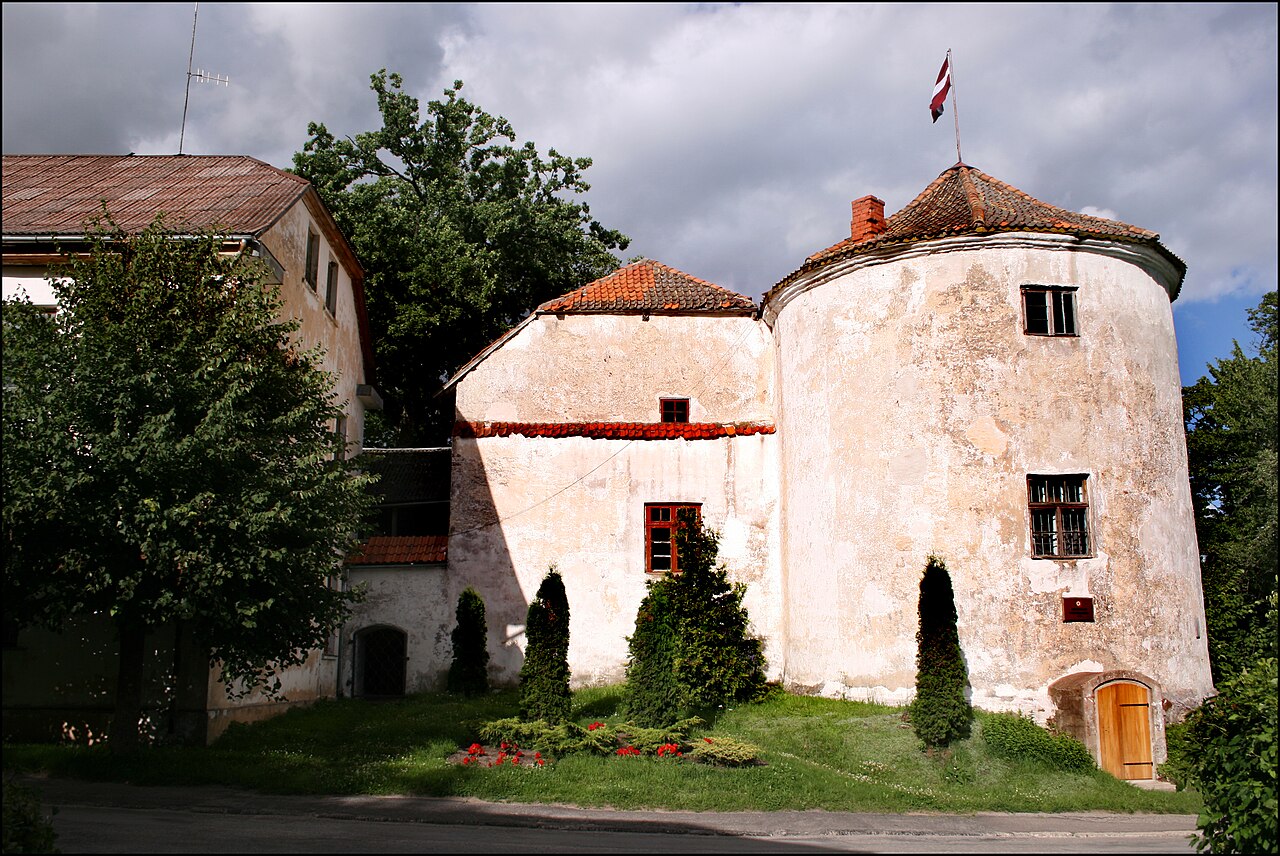
The castle's original fortifications consist of a robust ring wall approximately two meters thick, constructed from fieldstones and rubble with some brickwork. The southeastern corner houses a large tower near the main gate, measuring about nine meters square, which served as a key defensive structure. The western side's large opening is a later modification, reflecting changing uses over time.
The 14th-century addition of a two-story residential wing outside the southern part of the eastern wall was extended and heightened in the 15th century, projecting beyond the curtain wall. This wing contained essential functional spaces such as a chapel, chapter house, and guest rooms for the cathedral chapter, illustrating the castle's evolution from purely military to administrative and residential purposes.
Decorative plasterwork known as sgraffito was applied around 1600, featuring intricate motifs like cornerstones, rosettes, and acanthus leaves, showcasing Renaissance artistic influence. Though only fragments remain, these decorations highlight the castle's aesthetic significance during its post-medieval phase.
In 1698, a new residential wing was constructed along the inner southern wall, comprising three rooms per floor with fireplaces, likely intended for servants or lower-status residents. The castle's interior includes barrel vaulting in the basement, a typical medieval architectural feature providing structural support.
Later adaptations and decline
By the mid-18th century, the castle's owners relocated to a newly built manor house nearby, converting the castle buildings into partial residences and agricultural use. In the early 19th century, modifications included installing flat vaulting and partition walls in the eastern wing and southeastern tower to adapt to changing residential needs.
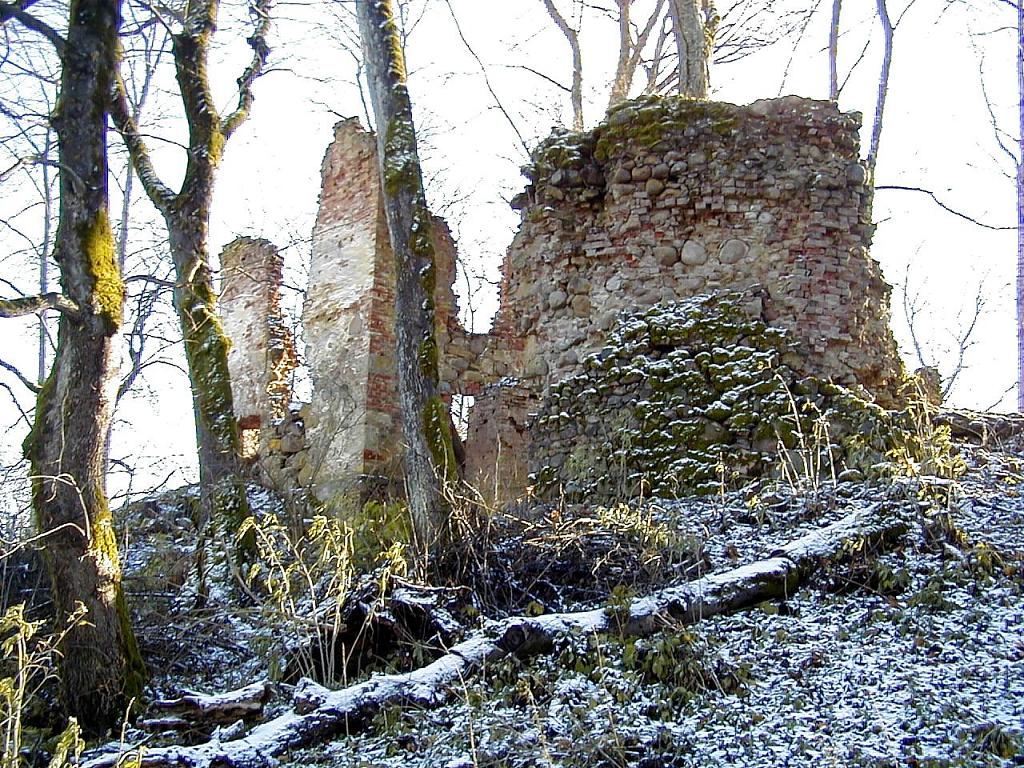
During the 20th century, the castle was repurposed as a school from 1939 until the 1970s. Subsequent abandonment led to deterioration, including a wall collapse in 1977 and a destructive fire in 1983. Restoration efforts began in 1990, focusing on stabilizing the ruins, reinforcing walls with porous concrete blocks and steel supports, and installing protective roofing over the southern wing.
Current state and conservation efforts
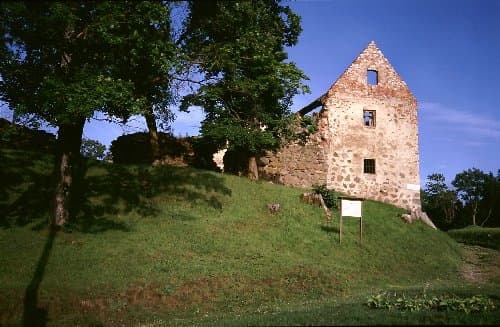
Today, Aizpute Castle stands as ruins, with remnants of two wings, the main gate, and sections of the stone walls preserved. The site offers valuable insights into the architectural and historical evolution of a hill castle transitioning from a medieval fortress to a Renaissance residence and later manor complex.
Conservation measures prioritize maintaining the structural integrity of surviving walls while respecting the original materials and construction methods. The castle's location within the urban fabric of Aizpute, alongside the Evangelic-Lutheran Church and nearby manor buildings, forms a cohesive historical ensemble reflecting the region's cultural heritage.
Visitors to the site can explore the remains of the castle's defensive walls, towers, and residential quarters, gaining an understanding of the Livonian Order's military architecture and the subsequent adaptations reflecting changing political and social contexts in Latvia's history.
Frequently asked questions (FAQ)
- What is the historical significance of Aizpute Castle?
- Aizpute Castle, built in the 13th century, is an important historical site that reflects the medieval architecture and the cultural history of Latvia. Originally constructed by the Livonian Order, it played a significant role in the regional power dynamics during the Middle Ages.
- When was Aizpute Castle built?
- Aizpute Castle was constructed in 1253, making it one of the oldest stone castles in Latvia. It has undergone various renovations over the centuries, which have helped preserve its historical integrity.
- What are the opening hours for Aizpute Castle?
- Aizpute Castle is open to visitors from 10 AM to 6 PM during the summer months and from 10 AM to 4 PM in the winter. It is advisable to check the official website for any special holiday hours or events.
- Can I visit Aizpute Castle year-round?
- Yes, Aizpute Castle is open to visitors throughout the year, although accessibility may vary depending on weather conditions, especially in winter. Some areas may be restricted during certain months for maintenance and preservation purposes.
- Is there an admission fee to enter Aizpute Castle?
- Yes, there is a modest admission fee to enter Aizpute Castle, which helps in the maintenance and preservation of this historical site. Ticket prices can vary, so it's best to check the official website for the most current information.
- When is the best time to visit Aizpute Castle?
- The best time to visit Aizpute Castle is during the late spring and summer months when the weather is pleasant and the gardens are in full bloom. This allows for a more enjoyable experience while exploring the castle grounds and nearby attractions.
- What nearby attractions should I visit while at Aizpute Castle?
- While visiting Aizpute Castle, consider exploring the charming town of Aizpute, which is rich in history and local culture. Nearby, you can also find beautiful parks and the scenic Aizpute River, perfect for leisurely walks and picnics.
- Is Aizpute Castle accessible for visitors with disabilities?
- Aizpute Castle strives to be accessible; however, some areas may present challenges due to the historic nature of the site. It is recommended to contact the castle administration in advance to inquire about specific accessibility options available for visitors with disabilities.
Photo gallery

Information
Website
Visit websiteSources & official resources
Verify the information above using these authoritative references.
Loading map...
Visitor reviews
No reviews yet. Been here? Write the first review and help other travelers!
Write the first reviewVisited this castle? Share your experience
Your review helps other travelers and adds first-hand knowledge to our encyclopedia.