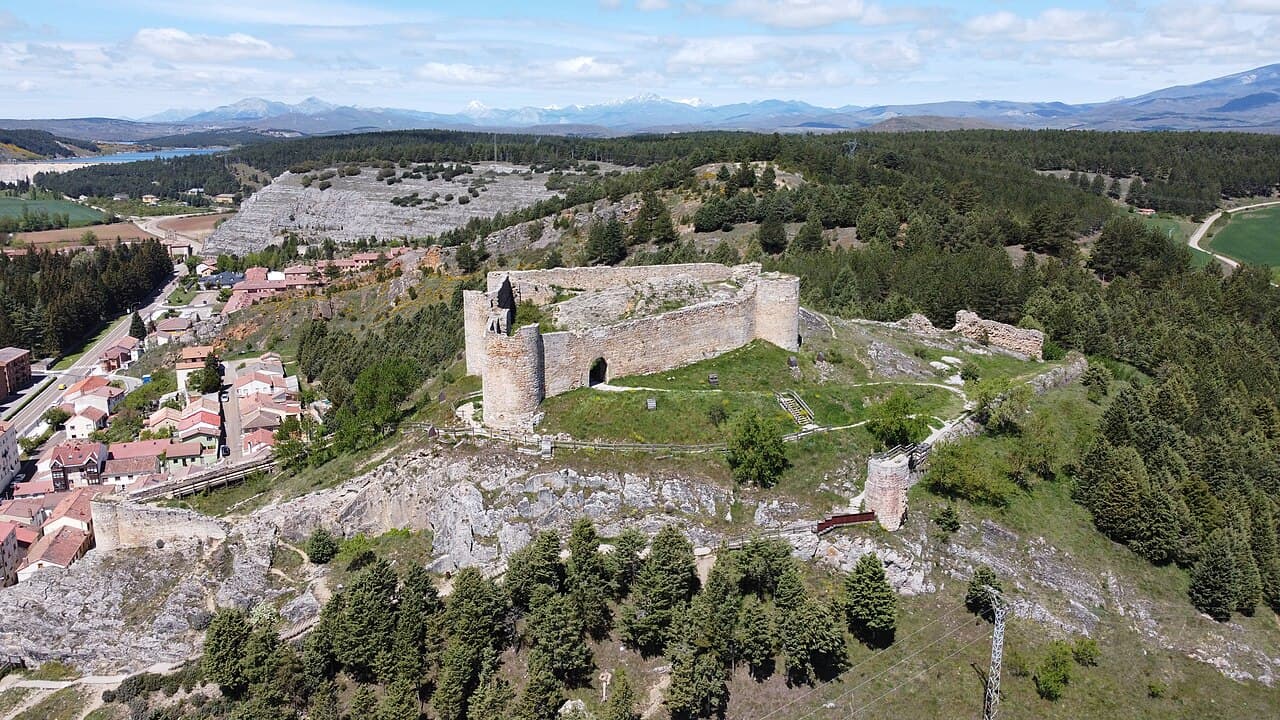
Aguilar de Campoo Castle
Aguilar de Campoo Castle stands as a significant example of medieval military architecture in northern Spain. Situated on a strategic hilltop in the town of Aguilar de Campoo, this hill castle was originally established in the 12th century, during the High Medieval period. The castle occupies a site with a long history of fortification, built atop earlier Celt-Iberian vernacular structures that reflect the area's ancient defensive importance.
Early origins and strategic location
The site of Aguilar de Campoo Castle was first fortified in pre-Roman times by Celt-Iberian peoples, who constructed vernacular fortifications adapted to the local terrain. This early use of the hill for defense highlights its commanding view over the surrounding landscape, including key routes through the region. In the 12th century, during the consolidation of Christian kingdoms in northern Spain, the castle was constructed as a stone fortress to secure the area against Muslim forces and rival lords.
Medieval construction and architectural features
The castle underwent several phases of construction and modification, with the most prominent development occurring in the 15th century when the Manrique family rebuilt and expanded the fortress. This reconstruction incorporated the existing medieval walls and adapted the structure to evolving military needs. The castle's design includes thick defensive walls, towers positioned for optimal surveillance and defense, and a keep that served as the last refuge during sieges.
The layout reflects typical High Medieval military architecture with a focus on defense and control of the surrounding territory. The walls are constructed of local stone, with battlements and arrow slits allowing defenders to repel attackers effectively. The castle's elevated position on the hill enhances its defensive capabilities, providing clear sightlines for early warning of approaching enemies.
The Manrique family's influence
The Manrique family, prominent nobles in the region, played a crucial role in the castle's history. Their 15th-century renovations modernized the fortress to meet the demands of late medieval warfare, including the introduction of artillery. The family's coat of arms and heraldic symbols are believed to have been displayed prominently within the castle, emphasizing their authority and status.
Historical significance and role in regional defense
Throughout the Middle Ages, Aguilar de Campoo Castle served as a key defensive stronghold in the Kingdom of Castile. Its position allowed control over important trade and military routes in the region, making it a focal point in conflicts between Christian and Muslim forces as well as internal disputes among nobility.
The castle's fortifications were tested during various military campaigns, and its resilience contributed to the stability of the surrounding territory. Over time, as warfare evolved and the political landscape changed, the castle's military importance declined, leading to periods of neglect and partial ruin.
Architectural legacy and current condition
Today, Aguilar de Campoo Castle is recognized for its historical and architectural value. While some sections remain in ruins, significant portions of the medieval walls and towers are partially preserved, offering visitors insight into the castle's original defensive capabilities. Archaeological studies have helped uncover the layers of construction, revealing the castle's evolution from a Celt-Iberian fortification to a medieval stronghold.
The castle is an important cultural landmark in the region, attracting historians, architects, and tourists interested in Spain's medieval heritage. Preservation efforts aim to maintain the site's integrity while facilitating public access and education about its role in regional history.
Visiting Aguilar de Campoo Castle
The castle is accessible to visitors interested in exploring its ruins and learning about its historical context. Informational signage and guided tours provide details on the architectural features and historical events associated with the site. The surrounding town of Aguilar de Campoo offers additional attractions, including Romanesque churches and local museums that complement the castle experience.
Architectural characteristics and style
Aguilar de Campoo Castle exemplifies High Medieval military architecture with elements characteristic of northern Spain's defensive structures. Its robust stone walls, battlements, and strategically placed towers reflect the practical needs of fortification during the period. While the castle does not exhibit ornate stylistic flourishes, its functional design and adaptation to the hilltop terrain demonstrate the ingenuity of medieval castle builders.
Construction materials and techniques
The castle's construction utilized locally sourced stone, shaped and assembled to create thick defensive walls capable of withstanding sieges. Mortar was used to bind the stones, and the builders incorporated natural rock formations into the foundation to enhance stability. The use of arrow slits and battlements allowed defenders to maximize offensive capabilities while minimizing exposure.
Frequently asked questions (FAQ)
- What is the historical significance of Aguilar de Campoo Castle?
- Aguilar de Campoo Castle, built in the 11th century, played a crucial role in the defense against Muslim invasions during the Reconquista. It served as a strategic military stronghold and has witnessed numerous historical events that shaped the region.
- When was Aguilar de Campoo Castle built?
- The construction of Aguilar de Campoo Castle began in the late 11th century, around the year 1075. Over the centuries, it has undergone various renovations and restorations, reflecting different architectural styles.
- Can I visit Aguilar de Campoo Castle?
- Yes, Aguilar de Campoo Castle is open to visitors throughout the year. Explore its impressive towers and walls while enjoying panoramic views of the surrounding countryside.
- What are the opening hours for Aguilar de Campoo Castle?
- The castle is typically open from 10 AM to 7 PM during the summer months and from 10 AM to 5 PM in the winter. It's advisable to check the official website for any seasonal changes or special closures.
- Is it possible to access Aguilar de Campoo Castle with mobility issues?
- While there are some pathways leading to the castle, the terrain can be uneven and steep in certain areas. Visitors with mobility issues should contact the castle's administration in advance to inquire about accessibility options.
- What is the best time to visit Aguilar de Campoo Castle?
- The best time to visit is during the spring and early autumn when the weather is mild, and the surrounding landscapes are lush. These seasons also tend to have fewer tourists compared to the summer months.
- Are there any nearby attractions to explore when visiting Aguilar de Campoo Castle?
- Yes, nearby attractions include the charming town of Aguilar de Campoo itself, known for its historical architecture and local gastronomy. The Natural Park of Fuentes Carrionas is also close by, offering beautiful hiking trails and stunning natural scenery.
- What are the ticket prices for Aguilar de Campoo Castle?
- Ticket prices for Aguilar de Campoo Castle are typically around €3 for adults, with reduced prices for children and seniors. Check for any special family packages or discounts available during your visit.
Photo gallery

Information
Loading map...
Visitor reviews
No reviews yet. Been here? Write the first review and help other travelers!
Write the first reviewVisited this castle? Share your experience
Your review helps other travelers and adds first-hand knowledge to our encyclopedia.


