Aberdeen Castle — United Kingdom castle

Aberdeen Castle

Aberdeen Castle: medieval fortress on Castle Hill, Scotland
Aberdeen, Scotland, United Kingdom
Late Medieval (14th–15th c.)
Ruins

Aberdeen Castle was a significant medieval fortification located in the city of Aberdeen, Scotland. Positioned strategically on Castle Hill, now known as the Castlegate, the castle played an important role during the late Middle Ages. Although the castle itself no longer stands, its historical footprint remains a key part of Aberdeen's heritage and urban landscape.

Historical context and significance

Constructed in the 13th century, Aberdeen Castle was a hill castle built to oversee and defend the surrounding area, including the important trading port of Aberdeen. Its elevated position on Castle Hill provided a commanding view of the city and the nearby North Sea coastline, making it a valuable military and administrative center.

The castle was involved in several notable historical events, including conflicts during the Wars of Scottish Independence in the late 13th and early 14th centuries. It was captured and destroyed by English forces in 1296 under the command of King Edward I, a pivotal moment that reflected the turbulent political climate of the time.

Architectural features and layout

Though no visible remains of Aberdeen Castle survive today, historical records suggest it featured typical hill castle characteristics. The castle was likely constructed with robust stone walls enclosing a central keep or donjon, surrounded by defensive battlements and possibly a moat or ditch to enhance its defenses.

The castle's location on a natural rise would have been enhanced by man-made fortifications, including curtain walls and towers at strategic points. The central courtyard would have contained essential buildings such as the great hall, barracks, and storage facilities.

Castle hill and surrounding defenses

Castle Hill itself was a natural defensive feature, with steep slopes on several sides. The castle's design leveraged this terrain to provide formidable protection against attackers. The Castlegate area, where the castle once stood, later became a focal point for the city's development.

Destruction and legacy

The destruction of Aberdeen Castle in 1296 marked the end of its military importance. The castle was deliberately slighted by the English to prevent its reuse by Scottish forces. Over the following centuries, the site was gradually cleared and redeveloped.

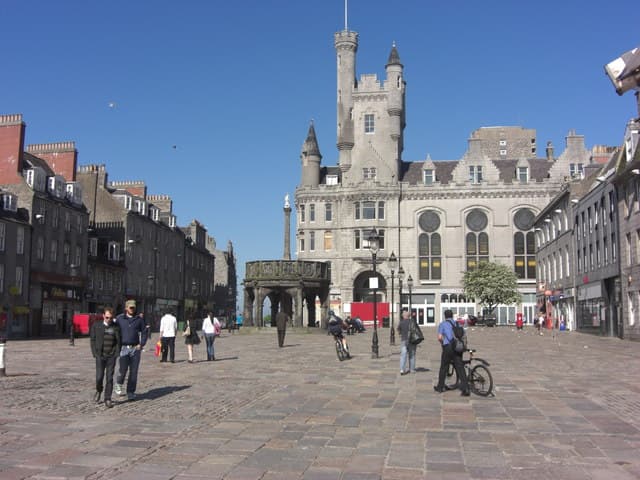
Today, the original castle site is occupied by modern buildings, including residential flats, but the name Castle Hill and Castlegate preserve the memory of the castle's former presence. Archaeological investigations have been limited, but the location remains a point of historical interest in Aberdeen.

Aberdeen Castle in the context of Scottish castles

Aberdeen Castle is one of many medieval castles in Scotland that illustrate the country's turbulent history during the Middle Ages. Its role in the Wars of Scottish Independence connects it to a broader narrative of national struggle and resilience.

Although it does not survive physically like some other Scottish castles, its historical significance is recognized locally and nationally. It contributes to understanding the development of urban centers in medieval Scotland and the strategic military architecture of the period.

Frequently asked questions (FAQ)

How do I get to Aberdeen Castle?
Aberdeen Castle is located in the heart of Aberdeen, easily accessible by public transportation. You can take local buses or the train to Aberdeen station, followed by a short walk to the castle. There are also parking facilities nearby for those traveling by car.
What is the historical significance of Aberdeen Castle?
Aberdeen Castle, originally built in the 12th century, played a crucial role in the power struggles of medieval Scotland. It served as a royal residence and a stronghold during various conflicts, reflecting the tumultuous history of the region. Today, it stands as a testament to the architectural and cultural heritage of Aberdeen.
When was Aberdeen Castle built?
Construction of Aberdeen Castle began in the early 1100s under King David I, making it one of the oldest structures in the area. Throughout the centuries, it underwent various modifications and expansions, showcasing different architectural styles. The castle's long history adds to its allure as a historical site.
Can I visit Aberdeen Castle year-round?
Yes, Aberdeen Castle is open to visitors throughout the year, though some areas may be restricted during certain seasons for preservation purposes. It's advisable to check the official website for any seasonal events or temporary closures before planning your visit. Guided tours are available at various times to enhance your experience.
Why is Aberdeen Castle a popular tourist destination?
Aberdeen Castle attracts visitors for its rich history, stunning architecture, and beautiful surrounding gardens. It offers an opportunity to explore the medieval past of Scotland while enjoying breathtaking views of the city. Additionally, the castle hosts various events and exhibitions throughout the year, making it a vibrant cultural hub.
Is it possible to access all areas of Aberdeen Castle?
While many areas of Aberdeen Castle are open to the public, some sections may have limited access due to preservation efforts or safety regulations. Guided tours provide insight into the castle's history and architecture while highlighting the most significant areas. Be sure to inquire at the entrance for accessibility details and any specific restrictions.
What are the opening hours for Aberdeen Castle?
Aberdeen Castle typically opens at 10 AM and closes at 5 PM, but these hours may vary seasonally. It is recommended to check the official website for the most current information regarding opening hours and any special holiday schedules. Arriving early can help you avoid crowds and enjoy a more leisurely visit.
What are the ticket prices for visiting Aberdeen Castle?
Ticket prices for Aberdeen Castle vary based on age and group size, with discounts available for students and seniors. Children under a certain age may enter for free, making it a family-friendly destination. For the latest pricing information and any special deals, please consult the official website before your visit.
What are some nearby attractions to visit along with Aberdeen Castle?
In addition to Aberdeen Castle, visitors can explore the nearby Aberdeen Maritime Museum, which showcases the city's rich maritime history. The picturesque Union Terrace Gardens and the bustling city center are also within walking distance, offering shops, cafes, and stunning views. Combining these attractions makes for a full day of exploration in Aberdeen.

Photo gallery

Aberdeen Castle
Click to view

Photo by Anthony Foster•CC BY-SA 2.0

1 photo • Click any image to view in full screen

Information

Hill Castle

Address

Castle Hill, Castlegate, Aberdeen, Scotland, UK

Loading map...

Visitor reviews

No reviews yet. Been here? Write the first review and help other travelers!

Write the first review

Visited this castle? Share your experience

Your review helps other travelers and adds first-hand knowledge to our encyclopedia.

Write a review

(5/5)

0/2000 characters

Your review will be visible after admin approval

Nearby castles

15.6 km

Muchalls Castle

Muchalls, United Kingdom

Muchalls Castle is a remarkable historic site located in the countryside of Kincardine and Mearns, overlooking the North Sea in northeast Scotland. This castle uniquely combines architectural elements from the 13th century and the 17th century, reflecting centuries of Scottish history and noble lineage. The castle's origins lie in a well-preserved Romanesque double-groined towerhouse constructed in the 13th century by the Frasers of Muchalls, a prominent Scottish family of the High Medieval period. This original towerhouse forms the lower courses of the present-day structure, showcasing early medieval defensive architecture with its robust stone walls and characteristic groined vaulting. Evolution from medieval towerhouse to 17th-century castle In the early 17th century, the castle underwent significant expansion and transformation under the ownership of the Burnett family of Leys. Alexander Burnett initiated the construction of what would become the current four-storey castle, built atop the existing medieval towerhouse. His son, Sir Thomas Burnett, 1st Baronet, completed the work in 1627. The resulting structure is designed in the classic L-plan style, typical of Scottish castles of that era, with an additional extension wing at the west end. This architectural style combines both residential comfort and defensive features, including thick stone walls, narrow windows, and battlemented parapets. Architectural highlights and interior features Muchalls Castle is particularly renowned for its elaborate plasterwork ceilings in the principal drawing rooms, which date to 1624. These ceilings are considered among the finest examples of plasterwork in Scotland, preserved in virtually perfect condition. The intricate designs feature the heraldry of the Burnett of Leys family, intertwined with the coats of arms of allied families and biblical iconography. This decorative program reflects the social status and religious affiliations of the Burnett family during a period of significant political and religious upheaval in Scotland. The Great Hall contains a notable overmantel above the fireplace, which displays the arms of King James VI flanked by striking Egyptianesque figures. This unique artistic element highlights the Renaissance influences permeating Scottish noble residences in the early 17th century, blending traditional heraldry with exotic motifs. Historical significance and events Muchalls Castle holds an important place in Scottish national history. In 1638, it was the site of a significant Covenanter gathering, a pivotal event in the religious and political conflicts that eventually led to the English Civil War. The Covenanters were Scottish Presbyterians who opposed attempts by the monarchy to impose Anglican practices, and their meetings at Muchalls Castle helped to galvanize resistance to royal authority. The castle's strategic location near the North Sea and its robust construction made it a key site during turbulent times in Scotland's history. Over the centuries, it has remained a symbol of the region's noble heritage and religious struggles. Preservation and current status Today, Muchalls Castle is well preserved, with much of its original medieval and early modern fabric intact. Visitors can appreciate the blend of Romanesque defensive architecture and 17th-century Renaissance decorative arts. The castle's condition allows for detailed study of Scottish castle design evolution from the High Medieval period through the early modern era. Its combination of historical, architectural, and artistic significance makes Muchalls Castle a valuable cultural landmark in northeast Scotland, attracting historians, architects, and tourists interested in Scotland's rich heritage.

High Medieval (11th–13th c.)
Details
17.2 km
Drum Castle — United Kingdom castle

Drum Castle

Drumoak, United Kingdom

Drum Castle stands as one of Scotland's most remarkable medieval fortifications, located near Drumoak in Aberdeenshire. Its name derives from the Gaelic word druim, meaning "ridge," a fitting description for its strategic position overlooking the surrounding landscape. This castle has served as the ancestral seat of the Clan Irvine for over six centuries, embodying a rich tapestry of Scottish history, architecture, and heritage. Medieval origins and architectural significance The core of Drum Castle is its 13th-century tower house, which is among the three oldest surviving tower houses in Scotland and remains notably unaltered. This stone-built tower exemplifies the defensive architecture typical of the high medieval period, featuring thick walls, narrow windows, and battlements designed for protection against sieges. The tower's construction is often attributed to Richard Cementarius, a prominent medieval architect known for his work on the Bridge of Don in Old Aberdeen, linking Drum Castle to significant medieval Scottish architectural heritage. The tower served as the fortified residence of the clan chief, providing both defense and domestic space. Inside, the discovery of secret passages and hidden chambers sealed in the 19th century underscores the castle's role in turbulent times, particularly during the Covenanting Rebellion and other conflicts. Expansion and architectural evolution In 1619, the castle underwent a major expansion when the ninth laird of Clan Irvine added a large Jacobean wing. This addition reflects the architectural transition from purely defensive structures toward more comfortable and stylistically elaborate residences. The wing features characteristic elements of the Jacobean style, including ornate stonework, larger windows, and more spacious living quarters, blending functionality with aesthetic appeal. The Victorian era brought further modifications between 1800 and 1875, including the restoration of the courtyard, the introduction of an arched entrance, and the addition of an angle tower. These Victorian interventions combined romantic medieval revival motifs with practical improvements, enhancing the castle's grandeur while preserving its historical character. Historical context and clan heritage Drum Castle's history is deeply intertwined with the fortunes of Clan Irvine. The estate was granted to William de Irwyn in 1323 by King Robert the Bruce, who appointed him as armour bearer and secretary. This royal grant marked the beginning of the Irvine family's long stewardship of the castle, which lasted until 1975. The castle witnessed significant historical events, including its involvement in the Covenanting Rebellion during the mid-17th century, when it was attacked and sacked three times. Later, during the Jacobite uprisings of the 18th century, Drum Castle served as a refuge for Alexander Irvine of Crimond, who hid in a secret chamber for nearly three years following the defeat of the Jacobite cause in 1746. The chapel and religious heritage The castle chapel reflects centuries of religious and architectural evolution. Originating as an older church before the 16th century, it underwent significant modifications in the 1500s and 1600s. The 19th-century restorations included enlarging the prominent west window, adding a cross, renewing the roof, and refurbishing the interior. The chapel houses notable features such as a stained glass window and a silver Madonna crafted in Augsburg, adding layers of artistic and spiritual significance to the castle complex. Gardens, grounds, and modern legacy Surrounding Drum Castle are extensive late 18th-century gardens, including a rose garden and an arboretum that features a diverse collection of trees sourced from across the British Empire during the 18th century. These gardens are carefully maintained and divided into distinct sections, showcasing both botanical interest and the estate's historical connections to global exploration and horticulture. The estate today includes modern visitor facilities such as a tearoom, a small shop, and outdoor play areas, enhancing the visitor experience. The castle's Victorian library contains over 4,000 books, alongside fine furniture and paintings, enriching the cultural value of the site. Drum Castle is currently owned by the National Trust for Scotland and is open to the public during the summer months. Its historic spaces, including the chapel and dining hall, are available for weddings and corporate events, maintaining the castle's role as a vibrant cultural venue. The estate also hosts various local events such as classic car rallies and musical festivals, further integrating the castle into contemporary community life. Archaeological discoveries and preservation In 2013, archaeological investigations revealed two previously walled-off rooms within the castle, likely connected to the secret hiding place used by Alexander Irvine in the 18th century. These discoveries have provided valuable insights into the castle's complex history and its role during times of political unrest. Drum Castle holds a Category A Listed building status, recognizing its exceptional architectural and historic importance in Scotland's cultural heritage. The preservation efforts by the National Trust for Scotland ensure that Drum Castle remains a well-preserved example of medieval and post-medieval Scottish architecture, offering visitors a tangible connection to Scotland's past.

High Medieval (11th–13th c.)
Details
19.1 km

Hallforest Castle Ruins

Kintore, United Kingdom

Hallforest Castle stands as one of the oldest surviving keeps in Scotland, dating back to the 14th century. Located near Kintore in Aberdeenshire, this castle was originally constructed as a fortified hunting lodge by Robert the Bruce, one of Scotland's most famous medieval kings. The castle later passed to Robert II Keith, the Marischal of Scotland, who was the predecessor of the Earls of Kintore. This connection ties Hallforest Castle closely to important Scottish noble families and the country's medieval history.Architectural features and layoutHallforest Castle is a plain oblong tower measuring approximately 15 meters in length and 11 meters in width. It originally rose to six floors, a considerable height for a late medieval keep. The structure was built primarily of stone, with evidence suggesting it once had a parapet and possibly a stone roof supported by an upper arch. The castle's interior was divided into two vaults separated by entresol floors, which are intermediate floors between main floors, a feature not commonly found in all Scottish keeps of the period.The main entrance likely led to the first entresol floor rather than the ground level, which was a defensive design to make direct assault more difficult. The basement contained small gun-loops for defense, and may have included a cattle door, indicating the keep also served practical purposes beyond residence and defense. Notably, there is no evidence of masonry stairs inside the tower; instead, access between floors was probably via ladders and hatches, a common security feature in medieval keeps to restrict movement during attacks.Historical significance and eventsHallforest Castle's history is closely linked to Scotland's turbulent medieval and early modern periods. It is reputed that Mary, Queen of Scots visited the castle in 1562, marking it as a site of royal interest. During the 17th-century wars, which included the Wars of the Three Kingdoms and related conflicts, the castle was frequently attacked. These assaults likely contributed to its decline and eventual abandonment shortly after this period.Despite its ruinous state, Hallforest Castle remains the property of the Earls of Kintore, descendants of the original owners. The castle's location and structure provide insights into the defensive strategies and domestic arrangements of Scottish nobility during the late medieval period.Surrounding features and current conditionTo the north of the tower, there are traces of what might have been an enclosing wall, suggesting the castle was once part of a larger fortified complex. Additionally, to the northwest, there are remnants of a possible ditch or moat, typical defensive features designed to hinder attackers and protect the keep.Today, the interior of Hallforest Castle is ruinous, with much of the original structure lost to time. However, the remaining stonework still allows visitors to appreciate the castle's original scale and defensive design. The absence of masonry stairs and the presence of gun-loops reflect the castle's dual role as a residence and fortress.Architectural context and styleHallforest Castle exemplifies the late medieval Scottish keep style, characterized by simple, robust stone construction with minimal decorative elements. Its plain oblong shape and vertical emphasis reflect the practical defensive priorities of the time. The use of entresol floors and the probable stone roof indicate a degree of architectural sophistication uncommon in smaller keeps.The castle's design reflects the transitional period in Scottish castle architecture when the focus shifted from purely military fortifications to fortified residences that balanced defense with domestic comfort. The presence of gun-loops also shows adaptation to the changing nature of warfare with the introduction of firearms in the late medieval period.Visiting Hallforest Castle ruinsWhile Hallforest Castle is privately owned by the Earls of Kintore, the ruins can be viewed from public areas nearby. The site offers a glimpse into Scotland's medieval past and the architectural evolution of keeps. Visitors interested in Scottish history and castle architecture will find the ruins a valuable, if modest, example of a 14th-century defensive residence.The castle's rural setting near Kintore provides a scenic backdrop, and the nearby town offers additional historical sites and amenities. Due to its ruinous condition, visitors should exercise caution when exploring the immediate vicinity of the remains.

Late Medieval (14th–15th c.)
Details