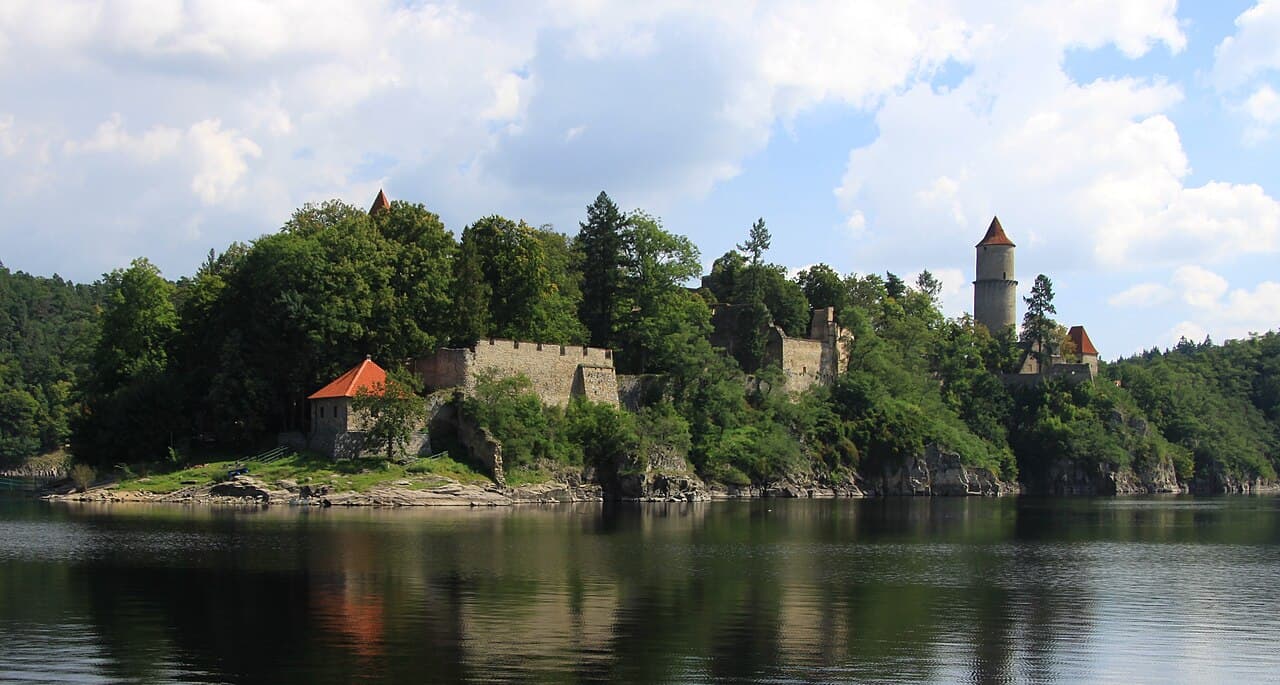
Zvikov Castle
Zvíkov Castle, often hailed as "the king of Czech castles," is a remarkable example of early Gothic architecture and a significant historical monument in the Czech Republic. Perched on a steep hill castle at the confluence of the Vltava and Otava rivers, it commands a strategic position that has been valued since prehistoric times. The site shows evidence of human settlement dating back to the Bronze Age and the Late La Tène period, indicating its long-standing importance as a natural fortress.
The castle's origins trace to the 13th century, most likely founded by King Přemysl Otakar I, with the first documented mention in 1234. It was constructed on a rocky promontory naturally protected by steep cliffs and rivers, making it a formidable defensive stronghold. The oldest surviving structure is the massive Hlízová Tower (also known as the Markomanka Tower), a prismatic residential donjon built around 1230 using rusticated blue sieinite stone blocks, with walls up to 3.5 meters thick.
The strategic location and early construction
Zvíkov Castle's position above the junction of two rivers provided natural defense on three sides, with the only vulnerable approach protected by a deep moat and fortified gate complex. The castle was originally a royal residence and fortress, serving as a key seat for the Přemyslid dynasty. Its initial layout included a great square tower, palace buildings, and curtain walls, reflecting the High Medieval architectural style prevalent in Bohemia during the 13th century.
The castle's fortifications were enhanced over time, notably around 1270 when a new fortified wall curtain and a distinctive cylindrical tower with a sharp-edged "bec" facing the direction of potential attacks were constructed. This tower, known as the Glaska Tower, was later heightened during Renaissance renovations to reach 32 meters in height, becoming a dominant feature of the castle skyline.
Architectural features and palace complex
The castle complex includes multiple residential wings arranged around an inner courtyard with a rare surviving arcade gallery from the 13th century. The palace buildings were expanded significantly under King Přemysl Otakar II in the mid-13th century, who commissioned the construction of the Chapel of St. Wenceslaus and enhanced the living quarters with vaulted rooms and decorative elements influenced by the Danube region's masonry traditions.
The chapel is a masterpiece of early Gothic architecture, featuring two bays with six-segment vaults, richly decorated capitals with naturalistic motifs, and mullioned windows with trefoil patterns. It retains original elements such as the altar, wall paintings, and stained glass fragments, reflecting the artistic influences of the Cistercian order and the French High Gothic style.
The castle's halls display ribbed vaulting supported by octagonal pillars, with some rooms adorned with late Gothic murals depicting secular and religious themes. The so-called "wedding room" is notable for its extensive green-hued murals portraying electors, dancers, and other figures, offering insight into the castle's cultural life during the late medieval period.
Historical significance and ownership
Throughout its history, Zvíkov Castle was a royal seat and administrative center. It was governed by royal burgraves, often two simultaneously, underscoring its importance. The castle was temporarily pledged to noble families such as the Rožmberks, Švamberks, Eggenbergs, and Schwarzenbergs, who contributed to its maintenance and architectural evolution.
During the Hussite Wars in the early 15th century, Zvíkov withstood a four-month siege by the Taborites in 1429, demonstrating its formidable defenses. Subsequent fortifications included the addition of bastions and deepened moats to resist artillery attacks. The castle also played a role in the Thirty Years' War, holding out against a much larger Habsburg force until 1622 before capitulating.
After the wars, the castle declined in military significance and was repurposed for agricultural use. A fire in 1751 caused significant damage, accelerating its deterioration. However, the Schwarzenberg family undertook extensive restorations in the 19th century, reviving key architectural elements and preserving the castle's heritage.
Defensive structures and later modifications
Zvíkov Castle's fortifications are a blend of medieval and Renaissance military architecture. The southern gate complex, known as the Písecké Gate, features a semicircular arch and defensive walls with battlements and shooting galleries. The northern edge is guarded by the Red Tower, a bastion with thick walls and vaulted interiors, which historically served as a prison.
The castle's moat and drawbridge system were modernized over time, with the original wooden drawbridge replaced by a stone bridge in 1777. This bridge is notable for its multiple arches and a Baroque chapel dedicated to St. John of Nepomuk, adding to the site's architectural diversity.
Restoration and cultural importance today
Major restoration efforts in the late 19th and 20th centuries preserved Zvíkov Castle's structural integrity and artistic decorations. Renowned Czech artists contributed to the restoration of wall paintings and other interior elements, ensuring the castle's status as a cultural monument.
Today, Zvíkov Castle is a popular tourist destination open from spring to autumn. It hosts art exhibitions, stage plays, and cultural events, continuing its legacy as a center of Bohemian heritage. The castle's ghost story of the "Zvíkov imp" adds a layer of folklore and mystique, enriching the visitor experience.
Zvíkov Castle remains a testament to the architectural ingenuity and historical significance of medieval Bohemia, embodying the evolution of castle construction, royal power, and cultural expression from the High Medieval period through the Renaissance and beyond.
Frequently asked questions (FAQ)
- How do I get to Zvíkov Castle?
- Zvíkov Castle is accessible by road and is located near the village of Zvíkovské Podhradí in South Bohemia. Visitors can reach the castle by car or public transport, followed by a short walk from the parking area.
- What are the opening hours for visiting Zvíkov Castle?
- The castle is open to visitors from April to October, daily from 9:00 to 17:00. It is advisable to check for any seasonal changes or special closures before planning your visit.
- What is the historical significance of Zvíkov Castle?
- Zvíkov Castle is one of the most important early Gothic castles in the Czech Republic, known for its strategic location and role in medieval Bohemian history, including resisting the Hussite siege and involvement in the Thirty Years' War.
- Can I explore the interior of Zvíkov Castle?
- Yes, visitors can explore the castle's interiors, including the Hlízová Tower, the Chapel of St. Wenceslaus, and the palace halls with their Gothic vaulting and murals. Guided tours are often available to enhance the experience.
- Is Zvíkov Castle suitable for families and children?
- The castle is family-friendly, offering spacious courtyards and engaging historical exhibits. However, some areas may have uneven surfaces or stairs, so supervision is recommended for young children.
- What is the best time of year to visit Zvíkov Castle?
- The best time to visit is during the spring to autumn months when the castle is open and the surrounding landscape is at its most picturesque, ideal for hiking and outdoor exploration.
- Are there any special events held at Zvíkov Castle?
- Zvíkov Castle hosts various cultural events, including art exhibitions and stage plays, particularly during the warmer months, providing visitors with a rich cultural experience alongside historical exploration.

Information
Opening hours
April to October, daily 9:00-17:00
Ticket prices
€5 adult, €3 child
Current owner
State
Website
Visit websiteSources & official resources
Verify the information above using these authoritative references.
Loading map...
Visitor reviews
No reviews yet. Been here? Write the first review and help other travelers!
Write the first reviewVisited this castle? Share your experience
Your review helps other travelers and adds first-hand knowledge to our encyclopedia.



