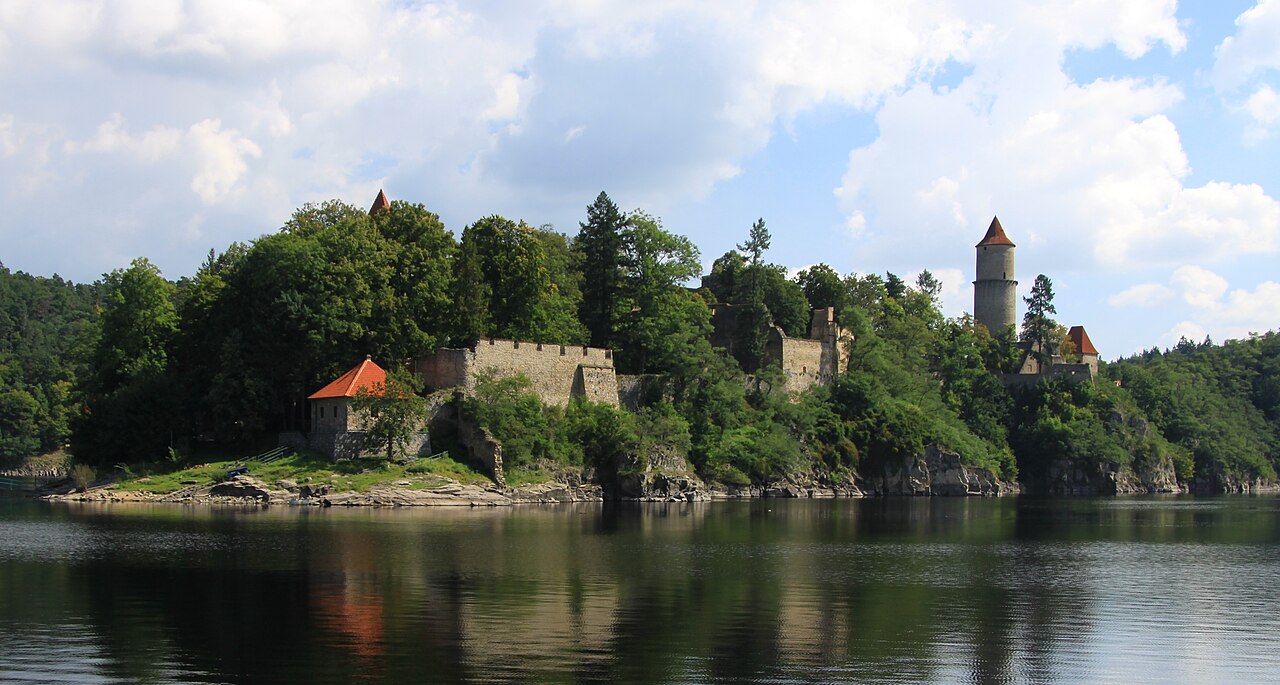
Orlik Castle
Orlík Castle stands as a magnificent example of a hill castle perched on a rocky promontory overlooking the Vltava River in the Czech Republic. This castle, with its origins dating back to the early 13th century, embodies centuries of Bohemian history, architectural evolution, and noble lineage. Its strategic location on a high plateau approximately 60 meters above the river not only provided natural defense but also controlled vital trade routes and toll collection along the Vltava, making it a significant stronghold in medieval and early modern Central Europe.
The castle’s initial construction is attributed to the Bohemian royal authority, likely under the reign of King Přemysl Otakar II in the late 13th century. Orlík was originally conceived as a Gothic fortress, designed with defensive features typical of the period, including thick stone walls, rounded towers, and a French-style gate placement between two defensive towers. Over the centuries, Orlík Castle underwent numerous expansions and reconstructions, reflecting the changing architectural styles and functional needs of its owners, from Gothic fortifications to Renaissance enhancements and finally to 19th-century Neo-Gothic romanticism.
Early history and medieval significance
The earliest documented existence of a stronghold on the Orlík site dates to the beginning of the 13th century. The castle was strategically built to protect a river crossing and to administer customs duties on the Vltava, a crucial commercial artery in the region. Initially held by royal supporters, the castle was granted by Charles IV in 1357 to his chancellor, Dětřich of Pordice. Over the following decades, ownership shifted among various noble families, including the Zmrzlík family in the early 15th century, who played a pivotal role during the Hussite Wars.
Role in the Hussite Wars
During the religious upheavals of the early 15th century, Orlík Castle became a center of Hussite resistance. The castle was notably associated with Petr Zmrzlík, a supporter of the Hussite movement, and famously hosted the celebrated Hussite commander Jan Žižka in 1422. This period marked Orlík as a bastion opposing the Catholic stronghold at nearby Zvíkov Castle, underscoring its strategic and symbolic importance in the Bohemian religious conflicts.
Renaissance transformation and fortifications
Following a devastating fire in 1508, the castle was acquired by the Švamberk family in 1514. They undertook extensive renovations that transformed Orlík from a medieval fortress into a Renaissance residence. Between 1575 and 1578, the castle’s living quarters were expanded vertically with the addition of a second floor, and the outer bailey was fortified with stone walls, a round tower, and two gates to enhance its defensive capabilities. These Renaissance fortifications reflected the evolving military architecture of the period, adapting to the increased use of artillery and changing warfare tactics.
Baroque and classical era ownership
After the Battle of White Mountain in 1620, the castle was confiscated by Emperor Ferdinand II and granted to the Eggenberg family in 1623. The Eggenbergs repaired and maintained the castle, including its military garrison during the turbulent years of the Thirty Years’ War. In 1683, amid fears of Ottoman incursions, Orlík was further fortified and rearmed. Ownership passed to the Schwarzenberg family in 1717, who would hold the castle for centuries and transform it into a noble residence surrounded by a vast English landscape park.
19th-century neo-gothic renovation and park development
In the early 19th century, after another fire in 1802, the castle was expanded with the addition of a third floor under the direction of Field Marshal Karl Philipp Schwarzenberg. The mid-19th century saw the most significant aesthetic transformation when architect Bernhard Grueber redesigned the castle’s facades in the Neo-Gothic style, adding romantic elements such as a bay window to the knight’s hall. This renovation reflected the 19th-century European fascination with medieval revival styles and romanticism.
The castle is set within an extensive English landscape park, originally spanning 180 hectares but now reduced to about 140 hectares due to flooding caused by the construction of the Orlík Dam in the 1960s. The park features rare plant species, wooden sculptures, and the Schwarzenberg family crypt, built in the 1860s, which serves as the burial site for the family. The park’s design and naturalistic style complement the romantic character of the castle and its surroundings.
Architectural features and interior highlights
Orlík Castle’s architecture is a palimpsest of styles and periods. The original Gothic core includes a chapel with late 13th to 14th-century architectural elements, evidencing the castle’s religious and cultural significance. Renaissance additions brought larger windows and ribbed vaults, while the Baroque and Classical periods introduced structural repairs and expansions.
The castle’s defensive structures originally included three main towers: a full or semi-cylindrical tower on the east side, a round battery tower on the northwest corner designed for artillery, and a large semi-cylindrical kitchen building. The French-style gate between two rounded towers was a distinctive feature of the original fortifications.
Inside, one of the most notable rooms is Teska’s Hall, named after the master woodcarver Jan Teska, who crafted its elaborate wooden ceiling. The castle also houses an extensive library of over 18,000 volumes and a corridor displaying more than 300 hunting weapons, showcasing the cultural wealth and aristocratic lifestyle of its owners.
Modern history and preservation
Following the nationalization of the castle by the communist government in 1948, Orlík was managed as a state-owned historical monument. After the fall of communism in 1989, the castle was restituted to the Schwarzenberg family, who have since maintained it as a cultural landmark. Archaeological excavations in 1989 and 2000 have further illuminated the castle’s origins and historical development.
Today, Orlík Castle remains well preserved and accessible to the public, offering visitors a rich experience of Bohemian history, architecture, and art. Its combination of Gothic fortifications, Renaissance expansions, Baroque and Classical modifications, and Neo-Gothic romanticism make it a unique testament to the evolving tastes and historical circumstances of Central European nobility.
Frequently asked questions (FAQ)
- What is the historical significance of Orlik Castle?
- Orlik Castle, built in the 13th century, has a rich history as a noble residence and a strategic military stronghold. It played a significant role during various conflicts in Czech history, especially during the Hussite Wars and the Thirty Years' War. Today, it serves as a cultural monument, showcasing the heritage of the region.
- When was Orlik Castle built?
- Orlik Castle was originally constructed in the mid-13th century, with significant renovations and expansions occurring in the following centuries. The castle's architecture reflects various styles, primarily Gothic and Renaissance, showcasing the evolution of building techniques over time. The castle continues to be preserved as a historical site, allowing visitors to experience its timeless beauty.
- Can I visit Orlik Castle with my family?
- Yes, Orlik Castle is family-friendly and welcomes visitors of all ages. The castle offers guided tours that are engaging for children and adults alike, with various educational exhibits and activities. Families can enjoy exploring the castle grounds and the beautiful surrounding landscapes.
- What are the opening hours of Orlik Castle?
- Orlik Castle is typically open to visitors from April to October, with specific hours varying by season. During the peak summer months, the castle generally opens from 9 AM to 6 PM. It is advisable to check the official website for the most current hours and any special events that may affect accessibility.
- Is it possible to access Orlik Castle by public transport?
- Yes, Orlik Castle is accessible by public transport, with regular bus services connecting it to nearby towns. Visitors can take a bus from major cities like Prague or Písek, followed by a short walk to the castle. Additionally, ample parking is available for those who prefer to drive.
- What is the best time to visit Orlik Castle?
- The best time to visit Orlik Castle is during the spring and early autumn months when the weather is mild and the surrounding nature is particularly beautiful. These seasons also tend to have fewer crowds, allowing for a more enjoyable experience. Summer can be busy, but it offers a variety of events and activities at the castle.
- How much do tickets to Orlik Castle cost?
- Ticket prices for Orlik Castle vary based on age and whether you are part of a guided tour. Generally, adult tickets cost around 100 CZK, while discounted rates are available for students and seniors. It's recommended to check the official website for the latest pricing and any special offers.
- Are there any nearby attractions to Orlik Castle?
- Yes, there are several nearby attractions worth visiting, including the beautiful Orlík Dam and the picturesque Vltava River. The surrounding area is ideal for hiking and outdoor activities, providing stunning views of the landscape. Additionally, the charming town of Orlík nad Vltavou offers local dining and shopping experiences.
Information
Website
Visit websiteSources & official resources
Verify the information above using these authoritative references.
Loading map...
Visitor reviews
No reviews yet. Been here? Write the first review and help other travelers!
Write the first reviewVisited this castle? Share your experience
Your review helps other travelers and adds first-hand knowledge to our encyclopedia.