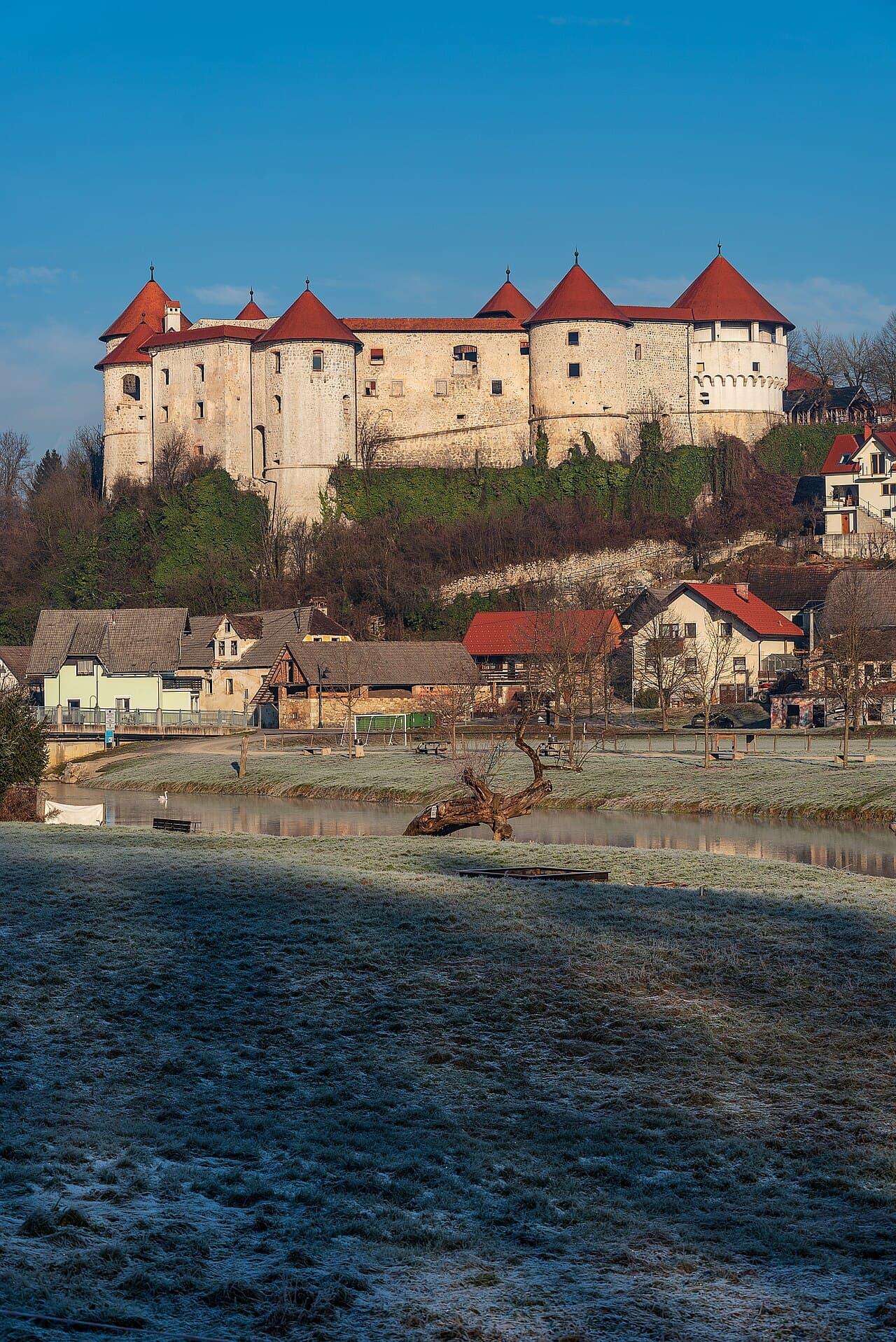
Zuzemberk Castle — Slovenia castle

Zuzemberk Castle

Žužemberk Castle: historic hill castle in Slovenia with 16th-century towers
Žužemberk, Slovenia
High Medieval (11th–13th c.)
Partially Restored

Žužemberk Castle is one of the most striking medieval fortresses in Slovenia, perched prominently on a terrace overlooking the Krka River in the town of Žužemberk, located in the historic region of Dry Carniola. Established in the 13th century, this hill castle has witnessed centuries of history, evolving from a medieval stronghold into a Renaissance fortress with significant architectural enhancements during the 16th century.

Historical development and ownership

The castle's origins trace back to the early High Medieval period, when it was initially constructed as a defensive stronghold to control the surrounding landscape and river route. Over time, its strategic importance grew, leading to substantial modifications in the 1500s. The most notable transformation occurred in 1538, when the castle was acquired by the noble Auersperg family of Turjak, who retained ownership until the upheavals of World War II.

Under the Auerspergs, Žužemberk Castle underwent significant fortification improvements, including the construction of seven massive round towers that enhanced its defensive capabilities and gave the castle its distinctive silhouette. These towers were designed to withstand artillery fire and provide comprehensive vantage points for surveillance and defense.

Architectural features and layout

Žužemberk Castle exemplifies the typical characteristics of a hill castle, strategically positioned on elevated terrain to dominate the surrounding valley. The castle complex includes a series of interconnected buildings arranged around an inner courtyard, which served as the heart of the castle's daily life and military operations.

The seven round towers are the castle's most prominent architectural feature, each constructed with thick stone walls and equipped with narrow arrow slits and embrasures for defensive weaponry. These towers encircle the courtyard, linked by robust curtain walls that provided a formidable barrier against attackers.

Additional elements include the castle gatehouse, which controlled access to the interior, and various residential and service buildings that housed the lord's family, soldiers, and servants. The castle's elevated position above the Krka River not only offered natural protection but also ensured control over river traffic and trade routes.

Damage and restoration efforts

Žužemberk Castle suffered extensive damage during World War II, when it was targeted and partially destroyed amid the conflict. The damage left the castle in a state of ruin, but restoration efforts have been ongoing since the mid-20th century to preserve and stabilize the remaining structures.

Restoration has focused on conserving the castle's distinctive towers, curtain walls, and courtyard, aiming to maintain its historical integrity while making it accessible for public visitation. These efforts have gradually revived the castle as a cultural landmark and tourist attraction.

Modern cultural significance and events

Today, Žužemberk Castle serves as a vibrant cultural venue, especially during the summer months. Its inner courtyard hosts a variety of open-air concerts, theatrical performances, and community events, drawing visitors from across Slovenia and beyond.

This use of the castle as a cultural hub helps connect contemporary audiences with its rich historical legacy, providing a unique setting that blends medieval architecture with modern artistic expression.

Location and setting

Situated in the town of Žužemberk within the Zužemberk region, the castle overlooks the picturesque landscape of the Dry Carniola area. Its position on a terrace above the Krka River not only provided defensive advantages but also contributed to the scenic beauty that makes it a popular destination for visitors interested in history, architecture, and nature.

The castle's proximity to the town center makes it easily accessible, and it remains a dominant feature of Žužemberk's skyline and cultural identity.

Frequently asked questions (FAQ)

How do I get to Zuzemberk Castle?
Zuzemberk Castle is located in the town of Žužemberk, Slovenia, and can be easily accessed by car or public transport. The nearest major city is Ljubljana, which is about an hour's drive away. There are also local bus services that connect Žužemberk to other towns in the region.
What is the historical significance of Zuzemberk Castle?
Zuzemberk Castle dates back to the late 15th century and is an important example of medieval architecture in Slovenia. It served as a defensive stronghold and has witnessed many historical events, including battles and sieges. The castle is a symbol of the region's rich history and cultural heritage.
When was Zuzemberk Castle built?
Zuzemberk Castle was constructed in the late 15th century, specifically around 1475. It was built during a time of political unrest in the region, serving both as a residence for the nobility and a fortress against invaders. Over the years, it has undergone various renovations, preserving its historical significance.
Can I visit Zuzemberk Castle?
Yes, Zuzemberk Castle is open to visitors who wish to explore its history and architecture. Guided tours are available, providing insights into the castle's past and the surrounding area. Be sure to check the opening hours before your visit to ensure a smooth experience.
Why is Zuzemberk Castle a popular tourist attraction?
Zuzemberk Castle is popular due to its stunning views of the surrounding countryside and its well-preserved medieval architecture. Visitors are drawn to its historical significance and the opportunity to learn about Slovenia's past. The picturesque setting makes it a favorite spot for photography and sightseeing.
Is it possible to hold events at Zuzemberk Castle?
Yes, Zuzemberk Castle offers facilities for hosting various events, including weddings, corporate gatherings, and cultural events. Its beautiful surroundings and historic ambiance provide a unique backdrop for special occasions. It’s advisable to contact the castle management for more details on availability and arrangements.
What are the opening hours for Zuzemberk Castle?
Zuzemberk Castle typically operates from 10 AM to 6 PM during the tourist season, which runs from April to October. During the off-season, hours may vary, so it's best to check their official website or contact them directly for the most current information. Planning your visit according to these hours will enhance your experience.
What are the ticket prices for Zuzemberk Castle?
Ticket prices for Zuzemberk Castle are generally affordable, with discounts available for students, seniors, and children. Adult tickets typically cost around €5, while reduced prices may apply for group visits. Always check the official website for the latest pricing and any special promotions.
What nearby attractions can I visit while at Zuzemberk Castle?
While visiting Zuzemberk Castle, you can also explore the charming town of Žužemberk, which features quaint streets and local shops. Nearby, you can find the scenic Krka River, ideal for hiking and nature walks. The region is rich in natural beauty and historical sites, making it perfect for a day trip.

Photo gallery

Zuzemberk Castle
Click to view

Photo by Darkoj82•CC BY-SA 4.0

1 photo • Click any image to view in full screen

Information

Hill Castle

Loading map...

Visitor reviews

No reviews yet. Been here? Write the first review and help other travelers!

Write the first review

Visited this castle? Share your experience

Your review helps other travelers and adds first-hand knowledge to our encyclopedia.

Write a review

(5/5)

0/2000 characters

Your review will be visible after admin approval

Nearby castles

10.2 km

Trebnje Castle

Trebnje, Slovenia

Trebnje Castle stands as a notable medieval fortress in the town of Trebnje, Slovenia, with origins tracing back to the 13th century. The castle was first documented in written sources in 1386, marking its significance in the region's feudal history. Originally owned by the lords of Trebnje from Carinthia, the castle passed through the hands of several prominent noble families, including the Ortenburger family, the Counts of Celje, and later the Habsburg dynasty. Between 1812 and 1824, it was owned by Frederic Irenaeus Baraga, a local missionary known for his cultural and religious contributions. Medieval origins and architectural evolution The castle's core structure reflects its high medieval origins, featuring a square tower that incorporates roman foundations, indicating the site's long-standing strategic importance. This tower is one of the oldest surviving elements, showcasing the transition from Roman to medieval fortification techniques. Another distinctive feature is the round tower, which was added during the period of the Ottoman Wars, serving as a defensive measure against incursions during the turbulent 15th and 16th centuries. The castle's construction and layout were largely completed by the 16th century, reflecting the architectural styles and defensive needs of that era. A notable artistic element is the stone lion statue from Roman times, which is prominently placed above the castle stairs, symbolizing strength and continuity from ancient to medieval times. Extensions and remodeling through the centuries During the 17th and 18th centuries, Trebnje Castle underwent significant extensions that adapted the fortress to changing military and residential needs. These expansions included the addition of new wings and the reinforcement of existing walls, blending functional improvements with aesthetic enhancements. The castle's current appearance owes much to a 19th-century remodeling executed in the historicist style. This renovation sought to revive and emphasize medieval architectural motifs, aligning with the broader European trend of romanticizing the medieval past. The historicist remodeling introduced stylistic details that enhanced the castle's visual appeal while preserving its historical character. Architectural features and layout Trebnje Castle's layout includes a combination of defensive and residential structures typical of a high medieval hill castle. The square tower and round tower form key elements of the defensive system, complemented by thick stone walls and battlements designed to withstand sieges. The interior spaces were adapted over time to serve as comfortable living quarters, administrative offices, and storage areas. The castle's position in the Trebnje region provided strategic oversight of the surrounding landscape, controlling important trade and communication routes. Its proximity to the town of Trebnje allowed it to serve both as a military stronghold and a noble residence. Historical significance and ownership lineage The castle's history reflects the complex political dynamics of the region, with ownership passing through influential families and rulers. The lords of Trebnje from Carinthia established the initial fortification, while the Ortenburgers and the Counts of Celje expanded its role within the feudal system. The Habsburgs later incorporated it into their extensive holdings, underscoring its strategic value. Frederic Irenaeus Baraga's ownership in the early 19th century adds a unique cultural dimension to the castle's history, linking it to religious and missionary activities in the region. Preservation and current status Trebnje Castle today is well preserved, retaining many of its medieval and later architectural features. The castle is a protected cultural monument, reflecting its importance in Slovenian heritage. Visitors can observe the blend of medieval fortifications and 19th-century historicist elements, providing insight into the castle's long and varied history.

High Medieval (11th–13th c.)
Details
17.2 km

Mirna Castle

Mirna, Slovenia

Mirna Castle is a significant high medieval fortress located in the town of Mirna, Slovenia. Constructed in the 12th century, this castle was originally built to serve as a strategic stronghold in the region, overseeing the surrounding plains and controlling important local routes. Despite suffering destruction during World War II, the castle remains an important cultural monument and a testament to medieval architectural principles in Slovenia. Historical background and ownership The castle's history is marked by frequent changes in ownership, reflecting the turbulent political landscape of medieval Europe. All the lords of Mirna were closely connected to the influential Šumberški family, a powerful noble lineage that played a key role in the region's governance. This family was itself a notable branch of the dynasty associated with Princess Emma, linking Mirna Castle to broader European noble networks. Throughout the centuries, Mirna Castle served as a residence and a defensive fortress, witnessing numerous historical events. Its strategic location in the Mirna Valley allowed it to control the surrounding lands and protect the local population from invasions and conflicts. Architectural features and style The castle exemplifies the high medieval architectural style typical of the 12th century in this part of Europe. It was originally constructed with robust defensive elements including thick stone walls, battlements, and fortified towers designed to withstand sieges. The castle's layout was adapted to the terrain, extending along the plain to maximize its defensive capabilities and visibility over the valley. Despite the destruction it faced in the 20th century, restoration efforts begun in 1962 have aimed to preserve and highlight the castle's original aesthetic principles. The restoration focused on maintaining the medieval character of the structure, emphasizing its stone masonry and the harmonious integration with the natural landscape. Destruction and restoration Mirna Castle was destroyed by the Partisans in December 1942 during World War II, a period marked by widespread conflict and upheaval in the region. This destruction left the castle in ruins, threatening the loss of an important historical and architectural monument. Restoration work started in 1962, reflecting a growing recognition of the castle's cultural value. These efforts have aimed not only to stabilize the remaining structures but also to restore parts of the castle to their former medieval appearance. Today, the castle stands as a partially restored monument, offering visitors a glimpse into the medieval past and the architectural heritage of Slovenia. Location and surrounding landscape Situated in the Mirna Valley, the castle overlooks a picturesque plain that extends to the town of Mirna. This location provides one of the most beautiful views in the valley, combining natural beauty with historical significance. The castle and its surroundings are an important part of the local landscape, attracting visitors interested in history, architecture, and scenic vistas. Access and tourism Mirna Castle is accessible to visitors who wish to explore its ruins and enjoy the panoramic views of the valley. While the castle is not fully restored, its remains offer valuable insights into medieval fortress construction and the region's history. The site is a popular destination for cultural tourism in Slovenia, contributing to the preservation of local heritage and the promotion of historical education. Legacy and cultural significance Mirna Castle represents an important chapter in the medieval history of Slovenia and the broader Central European region. Its connection to the Šumberški lords and the dynasty of Princess Emma highlights its role within the complex feudal networks of the time. The castle's architecture reflects the defensive needs and aesthetic values of the high medieval period, making it a valuable example for scholars and enthusiasts of medieval architecture. Today, Mirna Castle stands as a symbol of the region's historical resilience and cultural richness. Its preservation and restoration efforts underscore the importance of safeguarding medieval heritage sites for future generations.

High Medieval (11th–13th c.)
Details
17.7 km

Hmeljnik Castle

Novo mesto, Slovenia

Hmeljnik Castle stands prominently on a stone slope above the village of Karteljevo, near Novo mesto in Slovenia. This high medieval castle first appeared in written records in 1217, marking it as a significant medieval stronghold dominating the surrounding valley and the important road connecting Ljubljana to Bregana. Its strategic position allowed it to oversee and control local traffic and trade routes, reflecting its historical importance in regional defense and administration. Origins and early ownership The original builders and first owners of Hmeljnik Castle remain uncertain, but it is generally believed that the Lords of Višnja gora were among its earliest masters. There is also a possibility that the Lords of Hopfenbach or the Hmeljnik family themselves held the castle during its early years. The Hmeljnik family line ended in the 14th century, after which the castle changed hands several times. Architectural evolution through the centuries Original medieval structure The castle originally was constructed in the late 12th century as a vaulted fortress featuring two Roman palazzos and a prominent staircase tower. This design was typical for the period, focusing on defense and residential needs of the noble occupants. The vaulted construction provided strength and durability, while the palazzos served as living quarters and administrative centers. Gothic additions During the Gothic period, significant expansions were made to the castle. The southwest tower and the east wing were added, enhancing both the defensive capabilities and the residential space. Additionally, the castle chapel dedicated to Saint Pancras was constructed, reflecting the religious devotion of the inhabitants and serving as a private place of worship within the castle walls. Defensive enhancements during the Renaissance In response to the threat of Turkish attacks in the region, a double fortress wall equipped with circular towers was built to bolster the castle's defenses. These fortifications were typical of the Renaissance military architecture designed to withstand artillery and prolonged sieges. A Renaissance archway was also added, providing an elegant entrance flanking the inner courtyard. Unfortunately, this archway was demolished after World War II. Ownership by the Auersperg family and later history The castle came under the ownership of the Auersperg family for at least three centuries, a notable noble house in the region. Following the Auerspergs, the castle passed through various hands, including the Wamboldt family, who resided there until World War II. This period saw the castle serving more as a noble residence than a military fortress. Destruction and restoration Hmeljnik Castle suffered severe damage during World War II when it was burnt down in 1942. The ruins were further devastated by deliberate detonations after the war, leaving the castle in a ruined state. Restoration efforts began in the late 1950s, focusing on stabilizing the remaining structures. The castle was given a new roof and underwent static consolidation to preserve what remained of its historic fabric. Architectural features and significance The castle's architectural layout reflects its long history, combining elements from the high medieval vaulted construction to Gothic and Renaissance additions. The presence of Roman palazzos and a staircase tower highlight the castle's original defensive and residential functions. The double fortress walls with circular towers illustrate adaptations to evolving military threats, especially during the period of Turkish incursions into Central Europe. The castle chapel of Saint Pancras remains a notable feature, exemplifying the integration of religious spaces within noble residences of the medieval period. Although parts of the castle, such as the Renaissance archway, were lost, the restoration has helped maintain the castle's silhouette and historical presence in the landscape near Novo mesto. Visiting Hmeljnik Castle today Today, Hmeljnik Castle stands as a partially restored monument, offering visitors a glimpse into Slovenia's medieval past and the architectural evolution of a noble fortress. Its position above the valley provides scenic views and a tangible connection to the region's history. While the castle is not fully intact, its preserved elements and the surrounding landscape make it a significant cultural and historical site. Visitors interested in medieval architecture, Slovenian history, and noble residences will find Hmeljnik Castle a valuable destination. The castle's layers of construction tell stories of changing defensive needs, noble families, and regional conflicts over several centuries.

High Medieval (11th–13th c.)
Details

