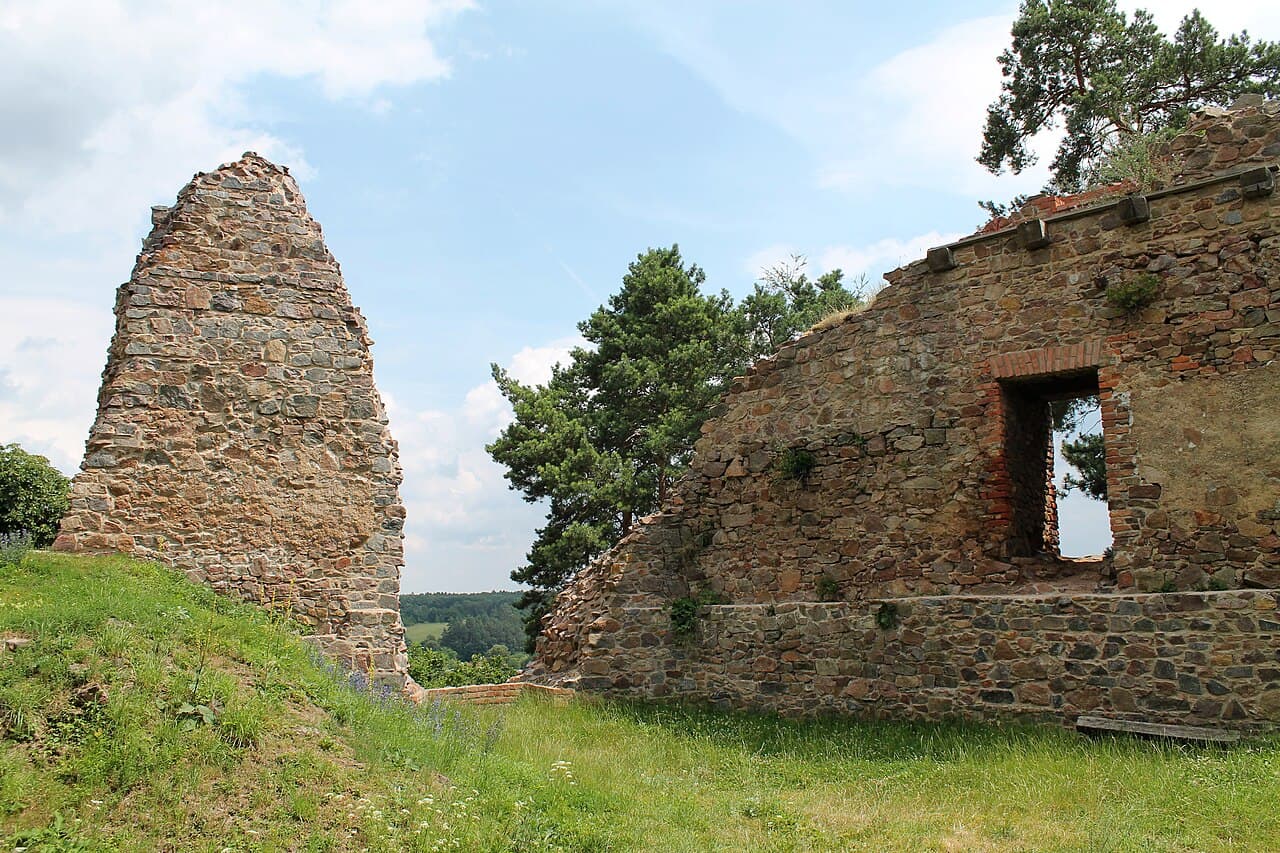
Zumberk Castle
Žumberk Castle stands as a remarkable example of a 13th-century hill castle located near the town of Chrudim in the Czech Republic. Perched atop a rocky promontory overlooking the Holetínka stream, the castle’s strategic position offered natural defensive advantages that were enhanced by its man-made fortifications. Known historically by its German name Sunenberg, the castle's origins are traced back to the late High Medieval period, with construction likely completed towards the end of the 13th century.
The castle’s history is intertwined with the turbulent medieval politics of Bohemia. It first appears in historical documents in 1318, associated with Pilunk of Žumberk amid the contest for the Bohemian crown between John of Luxembourg and Frederick of Habsburg. Although direct references to the castle itself emerge slightly later in 1487, the site’s significance as a noble stronghold was established early on. Over the centuries, ownership of Žumberk Castle passed through several noble families, including the Boskovic, Kavalec, Janovský, and Záruba families, reflecting the shifting allegiances and inheritances typical of the region’s feudal landscape.
Architectural design and fortifications
The castle’s layout is characterized by a roughly pentagonal curtain wall enclosing the main fortress area, supplemented by a secondary parkán wall that extended the defensive perimeter along the slopes of the promontory. This layered defense was further reinforced by a deep neck ditch cutting across the narrow land approach to the site, as well as smaller side ditches on the east and west. The curtain wall, about two meters thick, featured battlements and a stairway to the wall walk, with a notably thicker section at the northwest corner providing extra protection.
Unlike many contemporary castles, Žumberk did not include a separate central keep or donjon. Instead, the main palace building on the southern side of the promontory served dual roles as both the residence and the fortress's stronghold. This palace evolved from a single structure into a complex with east and west wings, rising to two stories and topped with a hipped roof. Around 1590, the castle underwent significant Renaissance-style renovations under the ownership of the Záruba family, which included the addition of a scarp wall at the southern corner to better resist artillery and the modification of window openings to improve living conditions.
Defensive earthworks and outer structures
The castle’s natural and artificial defenses integrated the rocky terrain with man-made earthworks. The neck ditch was a formidable obstacle for attackers, and the parkán wall followed the contours of the hillside, creating a protected outer courtyard. Access to the parkán was controlled through a small gate, allowing defenders to monitor and restrict entry. The service yard adjacent to the castle provided space for logistical support, though it was later replaced by agricultural developments in the 19th century.
Historical significance and ownership
Throughout its active use, Žumberk Castle played a modest but notable role in the regional power dynamics of Bohemia. The castle’s owners were involved in various disputes and military skirmishes, particularly during the 14th to 17th centuries, reflecting its function as a noble seat and defensive position. The transition of ownership through marriage, inheritance, and political shifts illustrates the castle’s embeddedness in the feudal fabric of the region.
By the early 18th century, the castle’s strategic importance waned as it became part of the larger Nasavrky estate. Although it was inhabited sporadically, including by a physician named Devoty in the 1760s or 1770s, Žumberk was eventually abandoned and fell into ruin. The surrounding landscape was transformed by agricultural expansion, with a farmstead established on the former outer bailey and a water reservoir constructed nearby in 1901.
Preservation and current status
In the 20th century, the ruins of Žumberk Castle attracted the interest of preservation groups. The Czech Tourist Club owned the site from 1926 to 1948 and undertook stabilization efforts to prevent further decay. Later stewardship passed to the Czechoslovak Sokol organization and state authorities, who performed limited restorations. Since the 1990s, the municipality of Žumberk has been responsible for the castle’s maintenance, ensuring public access remains free and unrestricted.
Today, visitors to Žumberk Castle can explore the substantial remains of the curtain walls, parkán defenses, and the foundations of the Renaissance palace. Interior features such as sgraffito-decorated plaster survive on the main façade and western wing, offering a glimpse into the castle’s artistic heritage. The vaulted cellars carved into the rock beneath the site remain accessible, providing insight into the castle’s functional design and use of natural geological features.
Architectural remnants and landscape impact
The castle’s ruins reveal the impact of later agricultural and infrastructural developments, including damage to the northeast core and parkán wall caused by 19th-century farm buildings and the 1901 water reservoir. Despite these alterations, the site remains a valuable cultural landmark, symbolizing the historical evolution of Bohemian noble estates and medieval military architecture.
Žumberk Castle’s enduring presence on its hilltop continues to attract visitors interested in medieval history, architectural heritage, and the scenic landscape of the Chrudim region. Its combination of natural defenses, historical significance, and Renaissance architectural elements make it a noteworthy example of a Bohemian hill castle that transitioned through centuries of change while retaining its distinctive character.
Frequently asked questions (FAQ)
- How do I get to Žumberk Castle from Chrudim?
- Žumberk Castle is located near the town of Chrudim in the Pardubice Region. Visitors can reach the castle by car or local bus services followed by a short walk uphill to the site. The castle is accessible via marked hiking trails from the village of Žumberk.
- What is the best time of year to visit Žumberk Castle?
- The best time to visit Žumberk Castle is during the late spring to early autumn months when the weather is mild and the surrounding landscape is lush and green. This period offers ideal conditions for exploring the ruins and enjoying panoramic views from the hilltop.
- Is Žumberk Castle suitable for families with children?
- Yes, Žumberk Castle is suitable for families, offering open grounds and safe walking paths around the ruins. However, visitors should exercise caution near uneven terrain and steep drops, especially with young children.
- Can I enter the interior of Žumberk Castle?
- While the castle is in ruins, visitors can explore the courtyard and some interior sections such as the vaulted cellars. Access is free and unrestricted, but some areas may be unstable, so care is advised.
- Are there any guided tours available at Žumberk Castle?
- Guided tours are not regularly offered at Žumberk Castle, but local tourist information centers in Chrudim or Žumberk may provide occasional guided visits or informational materials to enhance the visitor experience.
Photo gallery

Information
Sources & official resources
Verify the information above using these authoritative references.
Loading map...
Visitor reviews
No reviews yet. Been here? Write the first review and help other travelers!
Write the first reviewVisited this castle? Share your experience
Your review helps other travelers and adds first-hand knowledge to our encyclopedia.



