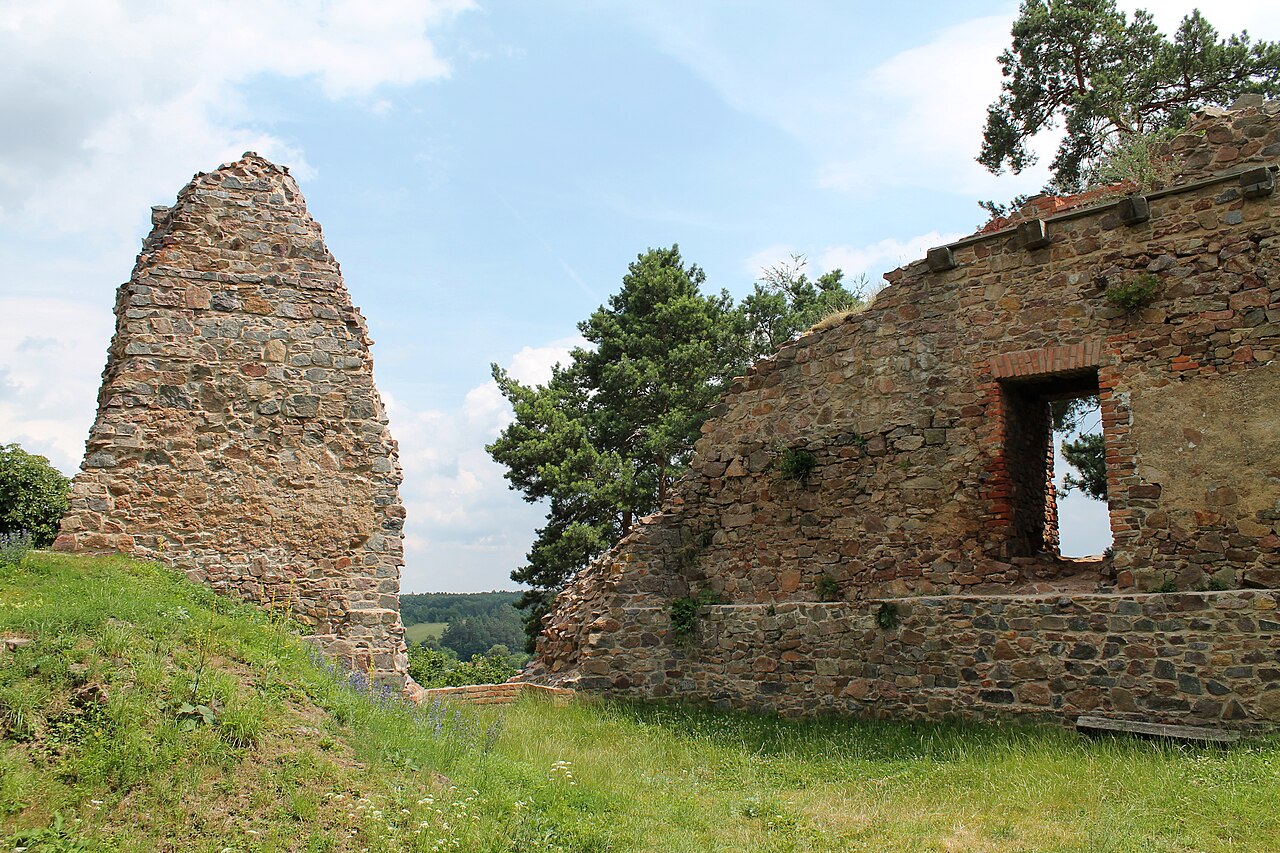
Kosumberk Castle
Kosumberk Castle stands as a remarkable example of medieval fortification and Renaissance architectural transformation in the Czech Republic. Situated near the town of Luže, this hill castle overlooks the Novohradka valley from a strategic elevation of 374 meters above sea level. Founded in the late 13th century, Kosumberk Castle was originally constructed as a Gothic fortress to control important regional routes and assert feudal dominance in the area.
The castle's earliest timber, dated by dendrochronological analysis to shortly after 1255, confirms its origins in the high medieval period. Its initial design focused on military defense, featuring thick stone curtain walls up to four meters wide and a formidable entrance tower guarding the most vulnerable approach. This tower was connected to the main castle by a wooden bridge, designed to be removed or destroyed in case of attack, demonstrating advanced defensive planning for its time.
Medieval origins and gothic architecture
During the 14th century, Kosumberk Castle became the seat of the Slavata family of Chlum and Kosumberk, who owned it for nearly three centuries. Under their stewardship, the castle underwent significant expansion and rebuilding, reflecting the late Gothic architectural style. This period saw the castle evolve from a purely military fortress into a residence that balanced defense with noble living.
The castle's Gothic features included not only the massive curtain walls and entrance tower but also a complex of residential buildings within the fortified perimeter. The layout was carefully adapted to the steep terrain, with natural slopes providing additional protection, especially on the south-eastern side where the hill descends sharply. The castle's role extended beyond military functions, serving as a local administrative center and symbol of feudal power.
Educational and cultural significance in the 16th century
In 1540, Diviš Slavata established a Czech Brethren school within the castle, marking a shift towards cultural and educational uses. This school attracted notable students such as Albrecht von Wallenstein, a key military leader during the Thirty Years' War, and Vilém Slavata, an influential nobleman. The presence of this institution highlights Kosumberk's importance not only as a fortress but also as a center of intellectual and religious activity in Bohemia.
Renaissance transformation and architectural features
The castle suffered a devastating fire in 1573, which led to substantial damage. In response, Diviš Slavata initiated a major reconstruction in the Renaissance style, completed around 1600 by his grandson, Diviš Lacembok. This renovation transformed Kosumberk from a medieval fortress into a more comfortable and representative noble residence.
The Renaissance additions included a large two-winged palace featuring an arcaded gallery and a distinctive clock tower overlooking the courtyard. The palace's façade was richly decorated with sgraffito, a plaster technique that reveals contrasting colors beneath the surface, considered one of the finest examples in the Chrudim region. These enhancements reflected the changing architectural tastes and social functions of castles during the Renaissance, emphasizing comfort, prestige, and aesthetic appeal alongside defense.
Fortifications and defensive elements
Despite the Renaissance transformation, Kosumberk retained many of its medieval defensive features. The thick curtain walls, entrance tower, and drawbridge mechanism remained integral to the castle's security. The wooden bridge connecting the entrance tower to the main castle could be removed to prevent enemy access, a common defensive strategy in hill castles of the period.
Ownership changes and decline in the modern era
Following the Thirty Years' War, Kosumberk Castle experienced decline due to military damage and economic hardship. In 1684, the castle passed into the hands of the Jesuit order, who established a church nearby and used the castle primarily for storage rather than residence. The Jesuits' presence marked a shift from feudal noble ownership to religious institutional control.
After the suppression of the Jesuit order in 1773, Kosumberk was abandoned and gradually fell into ruin. Throughout the 19th century, the castle changed hands among noble families such as Leopold de Laing and Prince Karl Max von Thurn und Taxis, neither of whom maintained the property as a residence. By the early 20th century, local communities organized efforts to preserve the site, creating a cooperative that conserved the ruins and opened a museum in the former burgrave's residence.
Since 1953, the castle has been state property managed by the town of Luže, serving as a cultural heritage site and tourist attraction. It hosts public events including commemorations of Jan Hus, the Bohemian religious reformer, as well as folk and rock music festivals, contributing to the castle's ongoing cultural significance.
Architectural remains and visitor experience
Today, visitors to Kosumberk Castle can explore the preserved ruins that vividly illustrate its historical layers. The burgrave's residence houses a museum with exhibits detailing the castle's history and a detailed model of its Renaissance appearance. The restored gatehouse serves as additional exhibition space, while remnants of the curtain walls, entrance tower, and palace wings remain visible.
The castle grounds are accessible via footpaths and roads, with a recently installed wooden barrier-free footbridge improving site navigation. Nearby chapels, including the Chapel of St. John Nepomuk and the Paletínská Chapel, reflect the religious heritage associated with the castle. A large sycamore maple tree beneath the castle adds to the site's picturesque character.
Kosumberk Castle's combination of Gothic defensive architecture and Renaissance residential elegance offers a comprehensive insight into the evolution of Czech castles from medieval fortresses to noble residences. Its enduring ruins and museum provide an engaging destination for those interested in history, architecture, and cultural heritage.
Frequently asked questions (FAQ)
- How do I get to Kosumberk Castle from Luže?
- Kosumberk Castle is located just outside the town of Luže and can be reached by a short walk or a brief drive. Signposted trails and local roads lead visitors to the castle entrance, making it accessible for day trips.
- What architectural styles are visible at Kosumberk Castle?
- The castle showcases a blend of Gothic and Renaissance architectural styles, with its original medieval fortress features complemented by a Renaissance palace added around 1600.
- When was Kosumberk Castle built and who were its original owners?
- Kosumberk Castle was built in the late 13th century by Bohemian nobility, with the Slavata family owning it from 1372 for nearly 300 years.
- Is Kosumberk Castle suitable for visitors with limited mobility?
- The castle grounds include a recently installed wooden barrier-free footbridge to facilitate movement, but some areas of the ruins may be challenging due to uneven terrain and historic structures.
- What can I see inside the castle today?
- Visitors can explore the burgrave's residence museum, view exhibits on the castle's history, see a detailed model of its Renaissance period appearance, and walk among the preserved ruins including the gatehouse and palace walls.
Information
Sources & official resources
Verify the information above using these authoritative references.
Loading map...
Visitor reviews
No reviews yet. Been here? Write the first review and help other travelers!
Write the first reviewVisited this castle? Share your experience
Your review helps other travelers and adds first-hand knowledge to our encyclopedia.