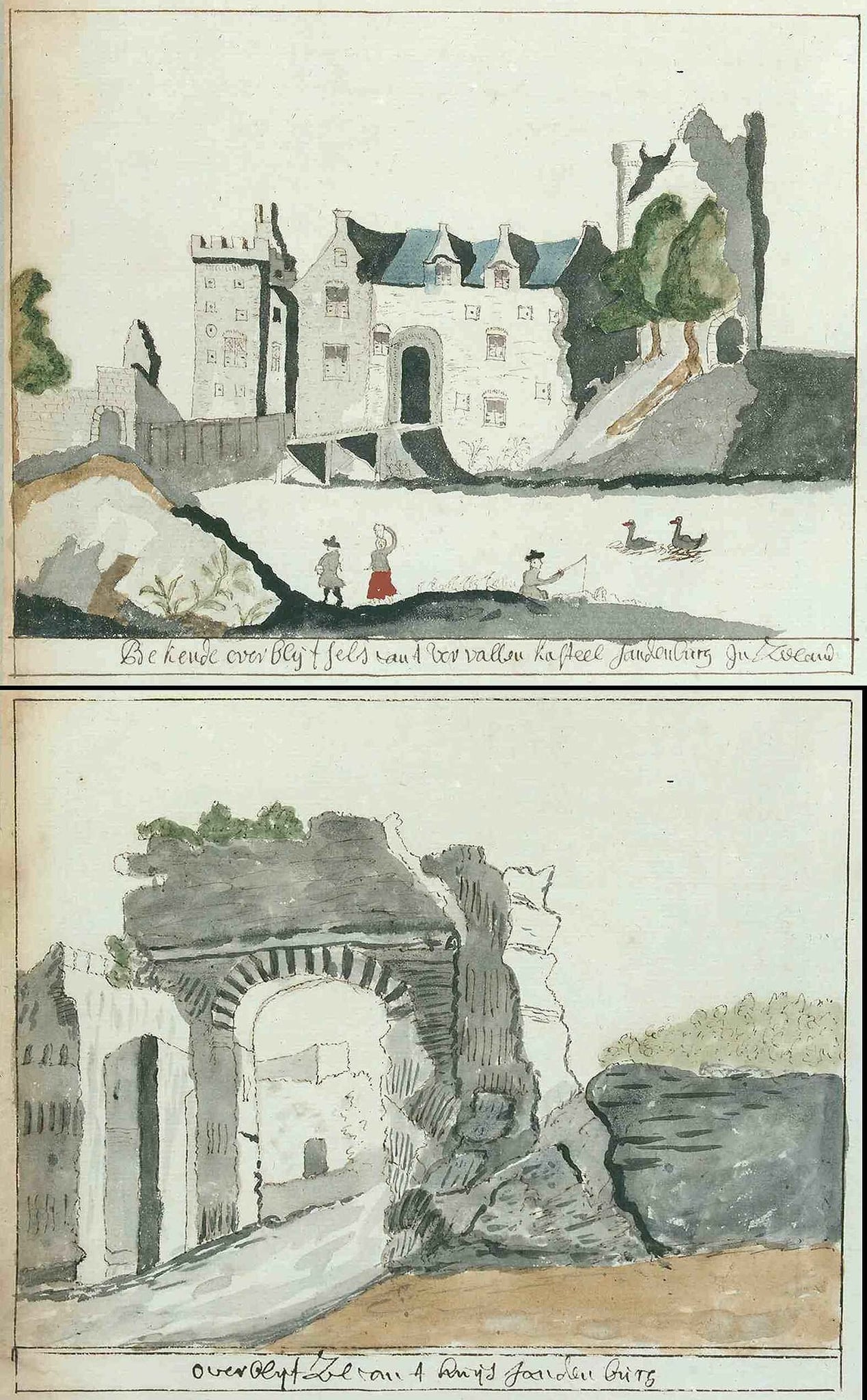
Popkensburg Castle
Popkensburg Castle was a medieval castle located in the village of Sint Laurens, within the province of Zeeland in the Netherlands. Although the exact date of its original construction remains unknown, historical records first mention the castle in the mid-14th century, specifically in 1353, when it was rebuilt by Claes of Borselen. It is believed that the castle was initially founded by Jan van Popkensborch, a Frisian settler in the area, which links the castle to early Frisian noble lineage and regional medieval settlement patterns.
Early history and ownership
Popkensburg Castle's early history is closely tied to the Borselen family, a prominent noble house in Zeeland. After Claes of Borselen's reconstruction, the castle passed to Adrian of Borselen in 1426, who was also the owner of St. Aldegonde Castle. Adrian resided primarily at St. Aldegonde, suggesting that Popkensburg served more as an administrative center or residence for a steward rather than a noble household. This usage reflects a common medieval practice where secondary castles supported larger family estates.
Transition through noble families and renovations
Through inheritance, Popkensburg came under the control of the Lords of Veere. In 1553, Maximilian of Burgundy, Marquis of Veere, commissioned renovations and improvements to the castle. These works likely included fortification enhancements and domestic upgrades, aligning with mid-16th century architectural trends in Zeeland's noble residences. However, Maximilian died financially ruined in 1558, leading to the public sale of the castle and its lands.
Role during the Dutch Revolt
The new owners after 1558 were supporters of the Spanish Crown. During the Siege of Middelburg (1572-1574), Popkensburg Castle was garrisoned by Spanish troops. This strategic use spared the castle from destruction by the Sea Beggars, the Dutch rebels who targeted Spanish-held fortifications. The castle's survival during this turbulent period highlights its military significance and the complex allegiances in Zeeland during the Eighty Years' War.
Ownership in the 17th and 18th centuries
In 1631, the castle was purchased by Walter Fourmenois. Upon his death, ownership passed to his sister, married to Pieter Boudaen Courten. Through subsequent marriages and inheritance, the castle came into the possession of Jacob van Citters in 1762. Jacob was a notable figure: mayor of Middelburg, sub-Stadtholder of Walcheren, and a member of the Guardianship Board of William V, Prince of Orange during his minority.
At the time Jacob van Citters acquired Popkensburg, the castle was reportedly in a dilapidated condition. He undertook restoration efforts to make the castle habitable again, reflecting 18th-century approaches to maintaining noble estates in Zeeland. This restoration likely included structural repairs and modernization of living quarters to suit contemporary standards.
Later history and demolition
After Jacob van Citters' death in 1792, the castle passed to his son, Jacob Verheye van Citters, a member of the Court of Holland. Although initially residing in The Hague, the political upheavals following the annexation of the Austrian Netherlands by the French First Republic in 1795 ended his career, prompting his move to Popkensburg Castle.
The castle remained in the family until 1863, when it was sold at a public auction to Agelink van Rentergem. Van Rentergem ordered the complete demolition of the castle, filled in its moat, and converted the grounds into farmland. This transformation was driven by economic considerations, as farmland was more profitable than maintaining a decaying noble residence. Despite local protests against the demolition, the castle was lost forever.
Architectural features and layout
Historical depictions and early photographs of Popkensburg Castle reveal a rectangular ground plan surrounded by a moat. The castle featured a rectangular bailey, which was also moated, indicating a typical defensive design of medieval moated castles in the Zeeland region. The presence of the moat and bailey suggests a fortified residence designed for both defense and status display.
While detailed architectural records are scarce, the castle's layout aligns with the characteristics of a water castle, common in the low-lying Dutch landscape. The use of water defenses was a strategic adaptation to the region's geography, providing protection against both military threats and flooding.
Present-day status
Today, no physical remains of Popkensburg Castle exist. The original site has been redeveloped and currently hosts a small housing community for the elderly. The complete loss of the castle underscores the challenges of preserving medieval heritage in areas undergoing modern development and agricultural transformation.
Despite its disappearance, Popkensburg Castle remains an important part of Zeeland's historical landscape, reflecting the region's feudal past, military history during the Dutch Revolt, and the evolution of noble estates through centuries.
Frequently asked questions about Popkensburg Castle
When was Popkensburg Castle first mentioned in historical records?
The castle was first mentioned in 1353, during a period when Claes of Borselen undertook rebuilding efforts. Its original founding date is unknown but is traditionally attributed to Jan van Popkensborch.
What type of castle was Popkensburg?
Popkensburg was a moated water castle with a rectangular ground plan and a moated bailey, typical for defensive structures in the Zeeland region.
Why was Popkensburg Castle demolished?
In 1863, the castle was demolished by its new owner to convert the land into farmland, which was considered more economically viable. Despite local protests, the castle was completely removed, and its moat filled in.
Are there any remains of Popkensburg Castle today?
No physical remains exist today. The site is now occupied by a housing community, and all castle structures have been lost.
What role did Popkensburg Castle play during the Dutch Revolt?
The castle was garrisoned by Spanish troops during the Siege of Middelburg (1572-1574), which protected it from destruction by the Sea Beggars, the Dutch rebels.
Frequently asked questions (FAQ)
- What is the historical significance of Popkensburg Castle?
- Popkensburg Castle, located in Sint Laurens, has a rich history dating back to the 14th century. It served as a defensive stronghold during various regional conflicts and reflects the architectural styles of its time, showcasing the evolution of medieval fortifications in the Netherlands.
- When was Popkensburg Castle built?
- Construction of Popkensburg Castle began in the late 1300s and it was completed in the early 1400s. Its design and structure have been preserved through centuries, making it a key landmark in the area.
- Can I visit Popkensburg Castle?
- Yes, Popkensburg Castle is open to visitors, offering guided tours that provide insight into its history and architecture. Visitors can explore the grounds and enjoy the beautiful surrounding landscape.
- What are the opening hours for Popkensburg Castle?
- Popkensburg Castle is typically open to visitors from Tuesday to Sunday, with specific hours depending on the season. It’s advisable to check the official website for the most current information regarding opening times.
- Is it possible to access Popkensburg Castle with a wheelchair?
- Popkensburg Castle aims to be accessible to all visitors; however, certain areas may pose challenges due to historical architecture. It’s best to contact the castle administration in advance to inquire about specific accessibility options and facilities.
- What are the ticket prices for Popkensburg Castle?
- Ticket prices for Popkensburg Castle vary depending on age and group size, with discounts available for children and seniors. It's recommended to purchase tickets online in advance for convenience and to ensure availability.
- When is the best time to visit Popkensburg Castle?
- The best time to visit Popkensburg Castle is during the spring and early autumn when the weather is mild and outdoor events are often held. Visiting during these seasons allows for a more enjoyable experience while exploring the castle and its grounds.
- Are there any nearby attractions to visit along with Popkensburg Castle?
- Yes, the area surrounding Popkensburg Castle features several attractions, including beautiful parks and local museums that highlight the region’s history. Visitors can also enjoy scenic walking trails and charming villages nearby.
Information
Loading map...
Visitor reviews
No reviews yet. Been here? Write the first review and help other travelers!
Write the first reviewVisited this castle? Share your experience
Your review helps other travelers and adds first-hand knowledge to our encyclopedia.