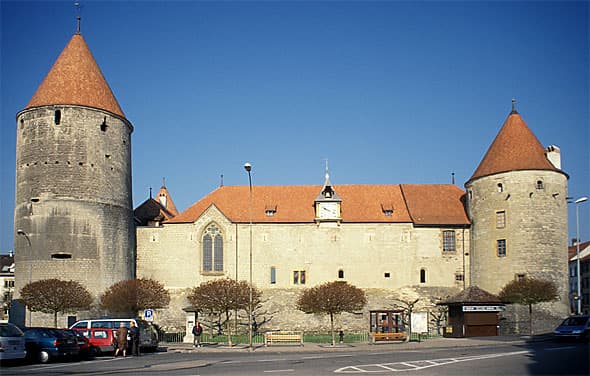
Yverdon-les-Bains Castle
Yverdon-les-Bains Castle stands as a remarkable example of 13th-century medieval military architecture in Switzerland. Constructed between 1260 and 1270 under the direction of the young mason and architect James of St. George, the castle embodies the Savoyard square architectural style, characterized by its quadrangular layout and four circular corner towers. This style was influential in the region and reflects the expertise of the masons John and James of Saint-Georges, linking the castle to other significant fortresses of the period. The castle's location in the municipality of Yverdon-les-Bains, near the Thièle river, provided natural defensive advantages enhanced by a drawbridge connecting the eastern gate to the town walls.
Historical development and ownership
The origins of the site date back to around 1235, when Amédée III of Montfaucon-Montbéliard established a large circular tower as the initial fortification. In 1260, ownership transferred to Peter II, Count of Savoy, who commissioned the construction of the castle in its current form. The castle served as the residence of the castellans appointed by the Savoy dynasty until 1536, when political control shifted to the city of Bern. Subsequently, the castle became the headquarters for Bernese bailiffs until 1798.
Ownership then passed to the Département du Léman during the short-lived Helvetic Republic imposed by Napoleon I. Soon after, the city of Yverdon acquired the castle and entrusted it to the renowned Swiss educator Johann Heinrich Pestalozzi, who operated his educational institute there from 1805 to 1825. This period marked the castle’s transformation into a center for educational reform. From 1838 until 1974, the castle housed public school classrooms, undergoing modifications such as the addition of interior walls and windows to accommodate its new function.
Architectural features and defensive design
The castle's roughly rectangular footprint measures approximately 40 by 48 meters, exemplifying the Savoyard square design with its quadrangular walls and circular towers at each corner. Built on fluvio-lacustrine alluvial deposits, the foundation provided a stable base for the imposing structure. Defensive elements include machicolations—openings between supporting corbels for dropping projectiles on attackers—topped by bay-crenellations with wooden shutters, indicating covered battlements for sheltered defense.
Additional fortifications featured wooden hoardings, temporary balconies supported by retractable beams along the towers and curtain walls, enabling defenders to extend their vantage points during sieges. The current roofs date from the late 15th century, replacing earlier medieval roofing systems. Originally, the castle was surrounded by strong outer walls called braies, which served as an innovative additional layer of defense but no longer survive.
One historically notable structure is the southwest tower, known as the "Jewish Tower", named after an event in 1702 when two Jewish merchants escaped from it. The tower itself was rebuilt after a collapse in 1605, reflecting ongoing maintenance efforts over the centuries.
Restoration and modern use
Following the cessation of its educational use in 1974, the castle underwent extensive restoration to remove 19th- and 20th-century modifications and revive its medieval appearance. Restoration projects were notably led by architects Otto Schmid in the early 20th century and Pierre Margot beginning in 1956.
Today, Yverdon-les-Bains Castle functions as a vibrant cultural center. It houses a regional museum dedicated to the history and heritage of Yverdon and its surroundings, a theatre, conference rooms, and the oldest public library in the French-speaking part of Switzerland, founded in 1763. The library is integrated into the castle museum, which has existed since 1830. The castle’s designation as a Swiss heritage site of national significance underscores its architectural, historical, and cultural importance.
The castle in cultural and historical context
Yverdon-les-Bains Castle exemplifies the strategic and architectural ambitions of the Savoy dynasty during the High Medieval period. Its design reflects military innovations of the 13th century, such as the use of the Savoyard square layout and advanced defensive features like machicolations and hoardings. The castle’s evolution from a feudal stronghold to an educational institute and finally a cultural hub illustrates the adaptive reuse of medieval fortifications in modern times.
The involvement of James of St. George connects Yverdon to a broader European narrative of castle building, as he later became a master builder for King Edward I of England, constructing the famous 'Iron Ring' of castles in North Wales. This association enhances the castle’s significance within the history of medieval military architecture.
Moreover, the castle’s role in local governance under the Savoy and Bernese authorities, its educational legacy through Pestalozzi’s institute, and its present cultural functions make it a multifaceted landmark. Visitors today can explore not only the architectural grandeur of a well-preserved High Medieval hill castle but also engage with the rich layers of history embedded within its walls.
Frequently asked questions (FAQ)
- What is the historical significance of Yverdon-les-Bains Castle?
- Yverdon-les-Bains Castle dates back to the 13th century and played a crucial role in the region's defense and administration. It has served various purposes over the centuries, including a residence for local nobility and a military stronghold, reflecting the rich history of the area.
- When was Yverdon-les-Bains Castle built?
- The construction of Yverdon-les-Bains Castle began in the early 13th century, specifically around 1230. The castle has undergone numerous renovations and restorations, preserving its historical architecture while adapting to modern needs.
- Can I visit Yverdon-les-Bains Castle?
- Yes, Yverdon-les-Bains Castle is open to the public, allowing visitors to explore its fascinating history and architecture. Guided tours are available, providing insight into the castle's past and its significance in Swiss history.
- What are the opening hours for Yverdon-les-Bains Castle?
- Yverdon-les-Bains Castle typically opens at 10 AM and closes at 5 PM, though hours may vary seasonally. It is advisable to check the official website for the most current information before planning your visit.
- Is it possible to access Yverdon-les-Bains Castle with a disability?
- Yes, Yverdon-les-Bains Castle is committed to accessibility and offers facilities for visitors with disabilities. There are ramps and designated paths to ensure everyone can enjoy the castle and its beautiful surroundings.
- What is the best time to visit Yverdon-les-Bains Castle?
- The best time to visit Yverdon-les-Bains Castle is during spring and early autumn when the weather is pleasant and many outdoor events occur. Additionally, visiting during these seasons allows you to enjoy the castle's gardens and the picturesque scenery of the surrounding area.
- Are there any nearby attractions to Yverdon-les-Bains Castle?
- Yes, nearby attractions include the Thermal Center of Yverdon-les-Bains, known for its wellness facilities, and the beautiful Lake Neuchâtel, which offers recreational activities and stunning views. These sites complement your visit to the castle and provide a full day of exploration.
- What are the ticket prices for Yverdon-les-Bains Castle?
- Tickets for Yverdon-les-Bains Castle are reasonably priced, with discounts available for students and seniors. Special family tickets and group rates may also be offered, ensuring an affordable visit for everyone.

Information
Website
Visit websiteSources & official resources
Verify the information above using these authoritative references.
Loading map...
Visitor reviews
No reviews yet. Been here? Write the first review and help other travelers!
Write the first reviewVisited this castle? Share your experience
Your review helps other travelers and adds first-hand knowledge to our encyclopedia.



