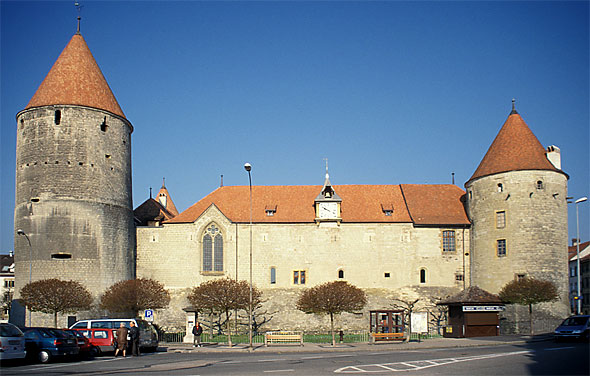
Mathod Castle
Mathod Castle stands as a distinguished example of an 18th-century hill castle located in the municipality of Mathod, Switzerland. This castle exemplifies the architectural and cultural evolution of aristocratic residences in the French-speaking part of the Swiss Confederation, blending Baroque, early Classical, and Palladian architectural influences with unique Dutch stylistic elements. Its historical trajectory reflects the broader social shifts and artistic preferences of the European nobility from the early 1700s through the mid-20th century.
Early history and noble ownership
Initially constructed in the early 18th century, Mathod Castle began as a large, rectangular manor house with a relatively simple and functional design. It was originally owned by prominent Bernese patrician families, notably the Wyss family, followed by Hieronymus Thormann. During this period, the castle served primarily as a noble residence, reflecting the lifestyle and status of the local aristocracy within the Swiss political landscape.
Architectural transformation under gaspard burman
A pivotal moment in the castle's history occurred around 1775 when Gaspard Burman (also spelled Brumann), a Dutch-born former equerry to King Louis XV of France, acquired the estate. Burman undertook an extensive renovation that dramatically altered the castle's appearance and architectural significance. Inspired by the works of Andrea Palladio, particularly his renowned Villa Barbaro near Maser, Italy, Burman introduced a refined Palladian style to the castle's façade.
This redesign featured three pedimented risalits projecting from the main rectangular structure, each crowned with curved pediments that incorporated Dutch architectural motifs. The central risalit functions as a prominent portico, supported by a series of Tuscan columns characterized by their simple, unadorned capitals and robust form. Above this portico, the upper floor includes sculptural decorations surrounding a clock and a distinctive oculus window, enhancing the building's classical elegance.
The side wings of the castle are visually articulated by Ionic pilasters, identifiable by their scroll-shaped capitals, which contribute to the building's classical vocabulary and symmetry. This blend of Baroque exuberance and early Classical restraint with Palladian principles makes Mathod Castle architecturally unique within the region.
19th and 20th-century ownership and artistic legacy
In the 19th century, the castle changed hands when it was sold to André Robert, a merchant from Marseille. The estate subsequently passed to his daughter, Madame Casimir de Rham. By 1919, the property was inherited by Julie Rivier de Rham, Robert's granddaughter. Julie and her husband, Louis Rivier, a noted Swiss painter, moved into the castle in 1939.
Louis Rivier used Mathod Castle as his artistic studio until his death in 1963, marking the castle's final significant phase as a center of creative activity. This period added a cultural dimension to the castle's history, linking it to Swiss artistic heritage beyond its aristocratic origins.
Architectural features and estate layout
Mathod Castle's architectural composition is defined by its rectangular plan enhanced by the three projecting risalits on the main façade. The central risalit, serving as the main entrance, is distinguished by its Tuscan column-supported portico, topped by an upper story adorned with sculptural elements around a clock and an oculus window. The side wings are marked by Ionic pilasters, which add vertical articulation and classical refinement.
The castle is set within a formal park notable for a fountain crowned by an obelisk, contributing to the estate's aesthetic and social function as a noble residence. The park and castle together create a harmonious ensemble that reflects 18th-century landscape design trends in Switzerland.
Although detailed records of building materials and exact dimensions are scarce, the castle's silhouette and decorative motifs clearly demonstrate the influence of French, Italian, and Dutch architectural traditions. This cross-cultural synthesis is a defining characteristic of Mathod Castle, distinguishing it from other Swiss aristocratic residences of the period.
Cultural significance and preservation status
Today, Mathod Castle and its dependencies are officially recognized as cultural properties of national significance in Switzerland. The castle's well-preserved state allows visitors and scholars to appreciate its architectural and historical value firsthand. It stands as a testament to the 18th-century aristocratic lifestyle and the artistic influences that shaped noble residences in the region.
The castle's preservation contributes to the understanding of regional history, architectural evolution, and the social dynamics of Swiss nobility. Its blend of Baroque, early Classical, and Palladian styles with Dutch elements makes it a unique case study in cross-European architectural adaptation during the 18th century.
Frequently asked questions (FAQ)
- How do I visit Mathod Castle?
- Mathod Castle is located in the municipality of Mathod in the canton of Vaud, Switzerland. Visitors should check local tourism websites or contact local visitor centers for current visiting hours and access information, as the castle may be privately owned or have limited public access.
- What architectural styles are present in Mathod Castle?
- Mathod Castle features a blend of Baroque, early Classical, and Palladian architectural styles, with notable Dutch influences evident in its façade and decorative elements.
- When was Mathod Castle built and renovated?
- The castle was originally constructed in the early 18th century and underwent a significant renovation around 1775 under Gaspard Burman, who introduced Palladian-inspired design elements.
- Is Mathod Castle recognized for its cultural significance?
- Yes, Mathod Castle is officially recognized as a cultural property of national significance in Switzerland, reflecting its architectural uniqueness and historical importance.
- Can I learn about the artists associated with Mathod Castle?
- Yes, the castle was the home and studio of Swiss painter Louis Rivier from 1939 until his death in 1963, adding an artistic heritage layer to the estate's history.
Information
Website
Visit websiteSources & official resources
Verify the information above using these authoritative references.
Loading map...
Visitor reviews
No reviews yet. Been here? Write the first review and help other travelers!
Write the first reviewVisited this castle? Share your experience
Your review helps other travelers and adds first-hand knowledge to our encyclopedia.