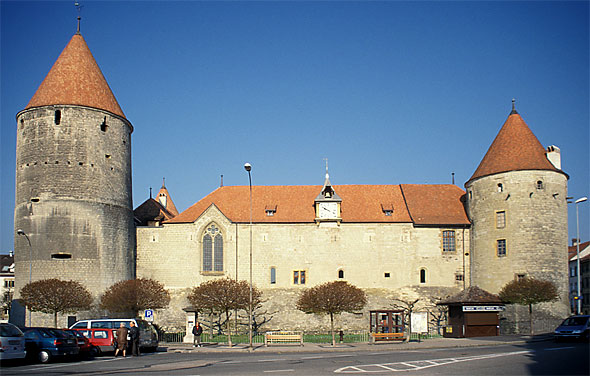
Champvent Castle
Champvent Castle stands prominently on a hill overlooking the expansive valley of the Thièle River in the canton of Vaud, Switzerland. This fortress is among the best-preserved medieval castles in the region, retaining much of its original character from the High Medieval period. Constructed around 1250, it exemplifies the architectural and military innovations introduced to the area by the Dukes of Savoy during the 13th century.
The castle's design is distinctive for its rectangular enclosure fortified by four circular corner towers, a layout inspired by French fortified castles that were widely adopted in French-speaking Switzerland. This architectural plan has its roots in Byzantine military architecture and was introduced to Western Europe during the time of the Crusades. Typically, such castles were built on flat terrain to facilitate the regular geometric layout. However, Champvent Castle is uniquely perched on elevated ground, an exception that highlights the builder's commitment to contemporary stylistic trends.
Architectural features and layout
The castle's rectangular enceinte encloses a central courtyard, with the residential buildings abutting the inner side of the curtain walls. Originally, the fortress included a gatehouse defended by an oriel with machicolations, allowing defenders to target attackers directly below the walls. One of the round towers was later converted into a dungeon, reflecting evolving defensive and residential needs over time.
The curtain walls and towers were constructed with thick stone masonry, designed to withstand sieges and artillery of the period. The castle's elevated position provided strategic oversight of the valley, enhancing its defensive capabilities.
Historical background and ownership
The earliest records of a seigneury at Champvent date back to around 1100. The village itself is mentioned in early 12th-century manuscripts and likely belonged to the kings of Upper Burgundy. The lords of Grandson were established in the region before the 12th century and founded a significant seigneury encompassing Champvent and several surrounding villages such as Mathod, Suscévaz, Essert, Orges, Vugelles-la-Mothe, Vuiteboeuf, Sainte-Croix, and Bullet.
At the start of the 13th century, Ebal IV, Lord of Grandson and La Sarraz, divided his properties among his heirs. Champvent returned to his son Henri de Grandson, who is credited with building the castle around 1250. The seigneury expanded due to the Grandson family's active colonization efforts in the Vaudois Jura region.
Champvent remained under the Grandson family's control until 1336. Subsequently, the castle and lordship passed to the Duchy of Burgundy. In 1476, during the Burgundian Wars, the castle was burned following the Battle of Grandson. After 1536, the fortress was rebuilt and became private property, marking a transition from a military stronghold to a noble residence.
Cultural and architectural significance
Champvent Castle is a prime example of medieval military architecture in the Vaud region, showcasing the influence of French and Byzantine design principles. Its preservation offers valuable insights into the defensive strategies and residential arrangements of 13th-century noble fortresses.
The castle's layout, with round towers at each corner and a rectangular curtain wall, reflects a deliberate adoption of contemporary architectural fashions, despite the challenging topography. This adherence to style over pure practicality underscores the importance of symbolic and aesthetic considerations in medieval castle construction.
Restoration and current condition
Today, Champvent Castle is well-preserved, retaining much of its original structure and medieval character. Over the centuries, the interior buildings have undergone modifications to accommodate changing tastes and living standards, yet the fortress's core defensive features remain intact.
The castle is a significant heritage site in the canton of Vaud, attracting visitors interested in medieval history, architecture, and the legacy of the noble families who shaped the region.
Visitor information and accessibility
Champvent Castle's elevated location offers spectacular views of the Thièle valley and surrounding Jura landscapes. Visitors can explore the castle's courtyard, towers, and defensive walls, gaining a tangible sense of medieval fortification design.
While specific visiting hours and ticket prices vary, the castle is generally accessible to the public during designated times, often with guided tours available to provide historical context and architectural insights.
Frequently asked questions
- When was Champvent Castle built?
Champvent Castle was constructed around 1250 by Henri de Grandson during the High Medieval period. - What architectural style does Champvent Castle represent?
The castle features a French-inspired fortified design with Byzantine influences, typical of 13th-century Western European crusader architecture. - Is Champvent Castle open to visitors?
Yes, the castle is open to the public, often with guided tours and special events, though visiting hours may vary seasonally. - What is unique about Champvent Castle's location?
Unlike most castles with similar layouts built on flat terrain, Champvent Castle is uniquely situated on a hill, combining strategic elevation with a regular rectangular plan. - Who were the original owners of Champvent Castle?
The castle was built and owned by the Grandson family, a powerful noble house in the Vaud region during the 12th and 13th centuries. - What happened to the castle during the Burgundian Wars?
It was burned in 1476 after the Battle of Grandson but was rebuilt after 1536 and transitioned into private ownership.
Frequently asked questions (FAQ)
- How do I get to Champvent Castle?
- Champvent Castle is easily accessible by car and public transport. If you're traveling by train, the nearest station is Yverdon-les-Bains, from where you can take a bus or taxi to the castle. Parking is available on-site for visitors arriving by car.
- What is the historical significance of Champvent Castle?
- Champvent Castle dates back to the 13th century and is an important example of medieval architecture in Switzerland. It served as a strategic fortress and residence for the local nobility, playing a significant role in the region's history. The castle's well-preserved structure allows visitors to explore its rich past.
- When was Champvent Castle built?
- Champvent Castle was constructed in the early 13th century, with its first mention in historical records occurring in 1250. Over the centuries, it underwent various renovations and expansions, reflecting the architectural styles of different periods. Today, it stands as a testament to Switzerland's medieval heritage.
- Can I take a guided tour of Champvent Castle?
- Yes, guided tours are available at Champvent Castle, providing visitors with in-depth knowledge about its history and architecture. These tours are typically conducted in multiple languages and are a great way to enhance your visit. It is advisable to check the schedule in advance and book your spot.
- Why is Champvent Castle a popular tourist destination?
- Champvent Castle attracts visitors due to its stunning architecture, picturesque setting, and rich historical significance. The castle offers breathtaking views of the surrounding landscape, making it a perfect spot for photography. Additionally, its proximity to other attractions in the region enhances its appeal.
- Is it possible to host events at Champvent Castle?
- Yes, Champvent Castle can be rented for special events such as weddings, corporate gatherings, and private parties. The castle’s unique ambiance and historical charm make it an ideal venue for memorable occasions. Interested parties should contact the castle management for more information on availability and pricing.
- What are the opening hours of Champvent Castle?
- Champvent Castle is generally open to the public from April to October, with specific opening hours that may vary by season. It is recommended to check the official website for the most current hours before your visit. Special hours may apply for holidays and events.
- What are the ticket prices for visiting Champvent Castle?
- Entrance to Champvent Castle typically requires a small fee, with discounts available for children, seniors, and groups. Tickets can be purchased on-site or in advance through the castle's official website. Pricing may vary depending on the time of year or any special exhibitions taking place.
- When is the best time to visit Champvent Castle?
- The best time to visit Champvent Castle is during the spring and summer months when the weather is pleasant and the surrounding landscape is in full bloom. These seasons also coincide with the castle's extended opening hours and various events. Autumn can be beautiful as well, thanks to the colorful foliage.
- Are there any nearby attractions to visit along with Champvent Castle?
- Yes, there are several attractions near Champvent Castle, including the picturesque town of Yverdon-les-Bains and its thermal baths. Nature lovers can explore the nearby Jura mountains or Lake Neuchâtel for outdoor activities. The region is rich in history, with other castles and historical sites within a short drive.
Information
Loading map...
Visitor reviews
No reviews yet. Been here? Write the first review and help other travelers!
Write the first reviewVisited this castle? Share your experience
Your review helps other travelers and adds first-hand knowledge to our encyclopedia.