Yoshinogari site
Yoshinogari archaeological site is a significant and extensive Yayoi period settlement located in the town of Yoshinogari and the city of Kanzaki within Saga Prefecture on the island of Kyūshū, Japan. This site represents one of the most important archaeological discoveries in Japan, providing invaluable insights into the social, political, and cultural life of the Yayoi people who inhabited the region from the late 4th century BC through the early centuries AD.
Historical context and dating
The Yayoi period marks a transformative era in Japanese prehistory, characterized by the introduction of wet-rice agriculture, metalworking, and new pottery styles. Yoshinogari is dated primarily to between the 3rd century BC and the 3rd century AD, with recent advances in AMS radiocarbon dating pushing the earliest occupation to before 400 BC. This makes Yoshinogari one of the earliest and most extensive Yayoi settlements, shedding light on the transition from the preceding Jomon period hunter-gatherer culture to a more complex agrarian society.
Archaeological features and layout
The site covers approximately 400,000 square meters and reveals a complex settlement structure with multiple moated villages, large watchtowers, defensive walls, and burial mounds. The presence of moats and palisades suggests a need for defense and social stratification. Excavations have uncovered numerous pit dwellings, raised-floor buildings, and storage facilities, indicating a well-organized community with advanced agricultural practices.
Fortifications and watchtowers
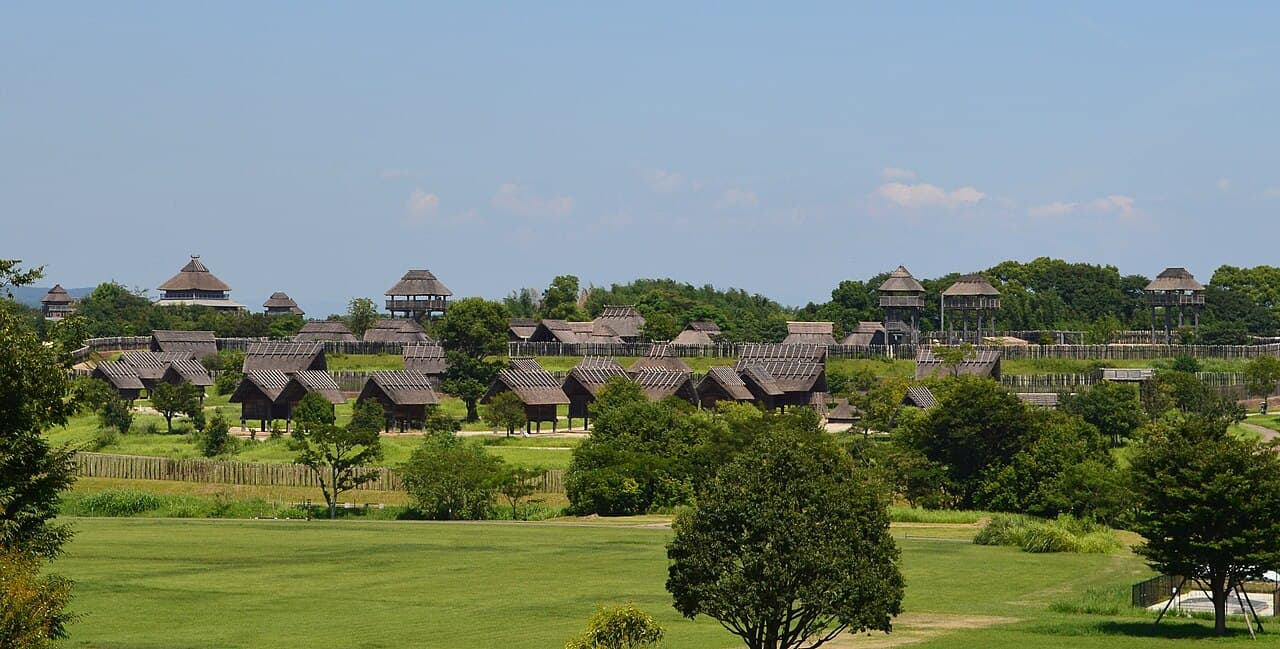
One of the most striking features of Yoshinogari is its extensive fortifications, including multiple concentric moats and wooden palisades. Several large watchtowers have been reconstructed based on archaeological evidence, providing a glimpse into the defensive strategies employed by the settlement's inhabitants. These watchtowers likely served both as lookout points and symbols of power.
Burial mounds and ritual areas
The site also contains numerous burial mounds (kofun) of varying sizes, which reflect the hierarchical nature of Yayoi society. Grave goods found within these mounds, such as bronze weapons, jade ornaments, and pottery, indicate the presence of elite classes and complex social structures. Ritual areas suggest the importance of religious and ceremonial activities in the community.
Significance in Japanese archaeology
Yoshinogari has been pivotal in understanding the Yayoi period's cultural and technological developments. It provides evidence of early rice cultivation, metallurgy, and social organization. The site challenges earlier assumptions about the simplicity of Yayoi settlements and reveals a sophisticated society with defensive architecture and social stratification.
Preservation and public access
Today, Yoshinogari is preserved as an archaeological park open to the public. Visitors can explore reconstructed watchtowers, moats, and pit dwellings, gaining an immersive experience of Yayoi life. The site includes a museum with artifacts and educational exhibits that contextualize the findings and highlight the site's importance in Japanese history.
Archaeological research and ongoing discoveries
Continuous excavations at Yoshinogari have expanded knowledge of Yayoi culture and its regional variations. The site remains a focus of scholarly research, contributing to broader debates about early Japanese state formation and cultural exchange with the Asian mainland.
Frequently asked questions (FAQ)
- What is the best time to visit Yoshinogari archaeological site?
- The best time to visit Yoshinogari is during spring and autumn when the weather is mild and pleasant, making outdoor exploration more comfortable.
- Can I access reconstructed buildings at Yoshinogari?
- Yes, visitors can enter several reconstructed watchtowers and pit dwellings to experience the layout and architecture of the Yayoi period settlement.
- How do I get to Yoshinogari site from major cities?
- Yoshinogari is accessible by train and bus from major cities like Fukuoka and Saga. The nearest train station is Yoshinogari-Kōen Station, which is within walking distance of the site.
- Is there a museum at the Yoshinogari site?
- Yes, the site features a museum that displays artifacts excavated from the site and provides educational exhibits about Yayoi culture and history.
- What makes Yoshinogari significant in Japanese history?
- Yoshinogari is significant as one of the largest and earliest Yayoi period settlements, showing advanced social organization, defensive architecture, and early rice cultivation.

Information
Loading map...
Visitor reviews
No reviews yet. Been here? Write the first review and help other travelers!
Write the first reviewVisited this castle? Share your experience
Your review helps other travelers and adds first-hand knowledge to our encyclopedia.