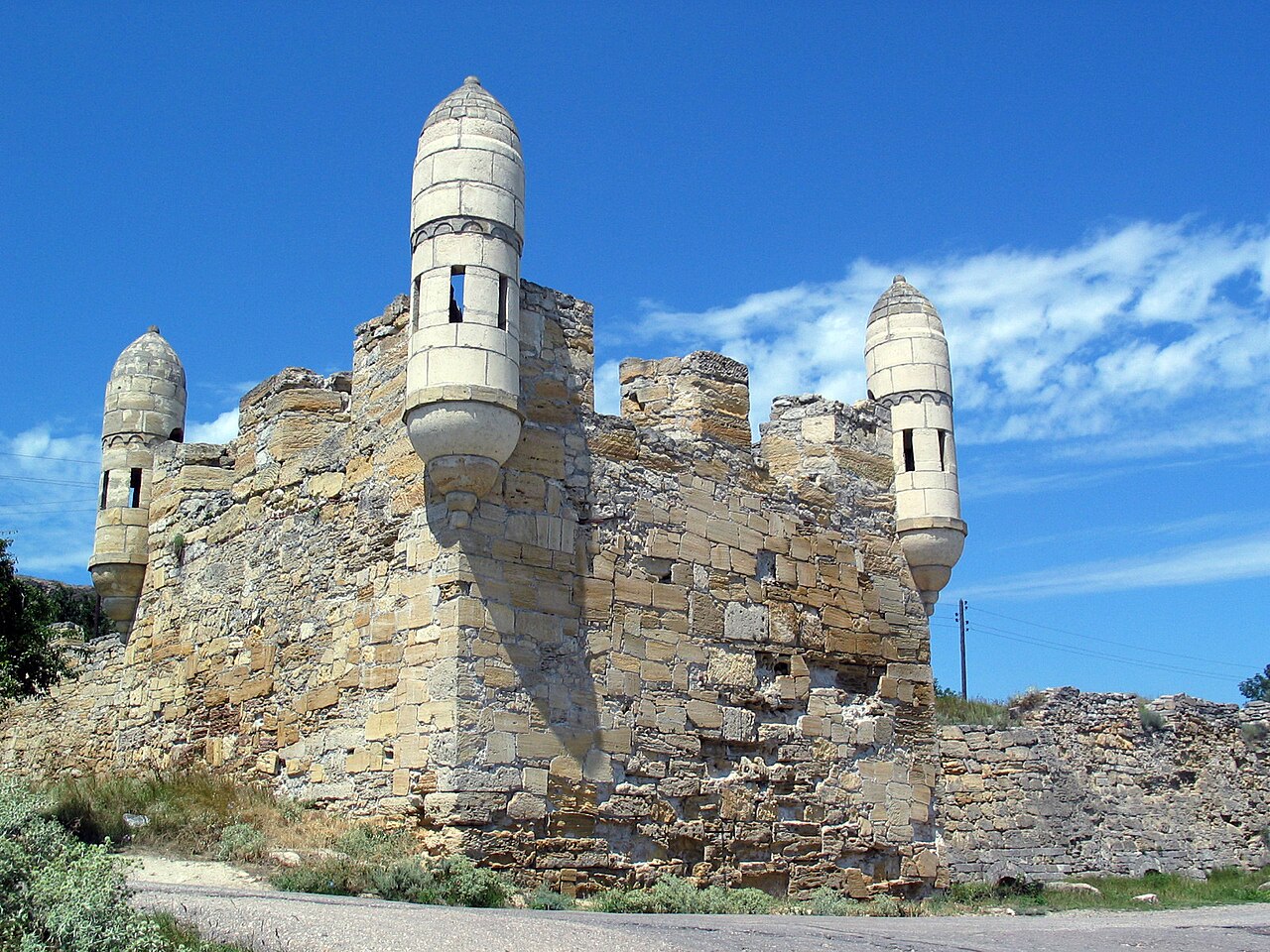
Yeni-Kale is a historically significant fortress located in the municipality of Kerch, Russia, strategically positioned on the shore of the Kerch Strait. Constructed between 1699 and 1706 by the Ottoman Empire, the fortress was designed under the supervision of Goloppo, an Italian convert to Islam, with contributions from several French engineers. This collaboration resulted in a robust military installation tailored to control naval passage between the Sea of Azov and the Black Sea.
The site of Yeni-Kale has been of strategic importance since antiquity. Originally, it hosted the ancient Greek settlement known as Parthenion. Across the strait to the east lay Achilleon, a smaller town famed for its temple dedicated to the hero Achilles. This location's value was recognized through successive eras, including the medieval period when it became a Genoese colony from the 13th century. Control shifted to the Ottomans at the end of the 15th century, who then fortified the area with Yeni-Kale to assert dominance over the crucial maritime corridor.
Architectural design and strategic features
Yeni-Kale is characterized by its irregular pentagonal layout, adapted to the rugged terrain of the site, which covers approximately 2.5 hectares. The fortress is built on multiple levels to accommodate the steep hillside, a typical feature of a hill castle. At each corner of the pentagon, there are five half-bastions, projecting outward from the main defensive walls. These bastions were engineered to provide flanking fire along the walls, enhancing the fortress's defensive capabilities against attackers.
The fortress walls were constructed to withstand prolonged sieges and heavy artillery bombardment, reflecting the military architectural advances of the late 17th and early 18th centuries. The defensive perimeter includes a moat on three sides, leaving the seaward side open to the Kerch Strait. This moat added an additional barrier to any land-based assault.
Internal structures and facilities
Within the fortress walls, several key structures supported the garrison and administrative functions. These included two gunpowder magazines for ammunition storage, an arsenal for weapons and military equipment, and residential buildings for soldiers and officers. A water reservoir was also constructed to secure water supplies.
Religious and social facilities were integral to the fortress's design. A mosque served the spiritual needs of the Ottoman garrison and inhabitants, while a bathhouse reflected the cultural importance of hygiene and social interaction in Ottoman life. The bathhouse would have been a vital feature for maintaining morale and health among the troops.
Water supply engineering
One of the fortress's major challenges was its limited access to fresh water. The single well inside the walls was insufficient for the needs of the garrison and residents. To overcome this, an underground ceramic aqueduct was constructed, channeling water from a spring several kilometers away near the modern-day area of Glazovka. This sophisticated engineering solution was crucial for the fortress's sustainability during sieges and daily operations.
Historical context and military significance
Yeni-Kale was primarily built to control the narrowest part of the Kerch Strait, a vital maritime route linking the Sea of Azov with the Black Sea. Its powerful artillery installations were intended to prevent Russian naval forces from passing through, thereby securing Ottoman dominance in the region.
The fortress served as the residence for the local Turkish pasha and housed a garrison composed of approximately 800 Ottoman soldiers and 300 Crimean Tatars. A notable aspect of its function under Ottoman rule was the operation of a large slave market within its walls, which diminished after the fortress came under Russian control.
During the Russo-Turkish War of 1768–1774, Russian forces advanced on Yeni-Kale and captured it in 1771 without resistance, as the Turkish defenders, including the fortress commander Abaza Pasha, retreated. The subsequent Treaty of Küçük Kaynarca in 1774 formalized the cession of Yeni-Kale and the city of Kerch to the Russian Empire.
By 1821, the fortress was part of the Kerch-Yenikale district within the Taurida Governorate under Russian administration. Military records from 1818 describe Yeni-Kale as well-armed, with 52 cannons, 10 mortars, and 7 howitzers, and barracks sufficient for 770 soldiers. However, its strategic importance declined in the 19th century.
Later use and decline
In 1835, the fortress was repurposed to house a military hospital, which operated until 1880. After this period, Yeni-Kale was abandoned as a military installation. The fortress gradually fell into ruin, reflecting the shifting geopolitical landscape and advances in military technology that rendered such fortifications obsolete.
In the 20th century, archaeological excavations and restoration efforts were undertaken to preserve parts of Yeni-Kale. Despite these efforts, the site remains largely in ruins, offering a tangible link to the complex history of Ottoman, Genoese, and Russian control in the region.
Current condition and preservation challenges
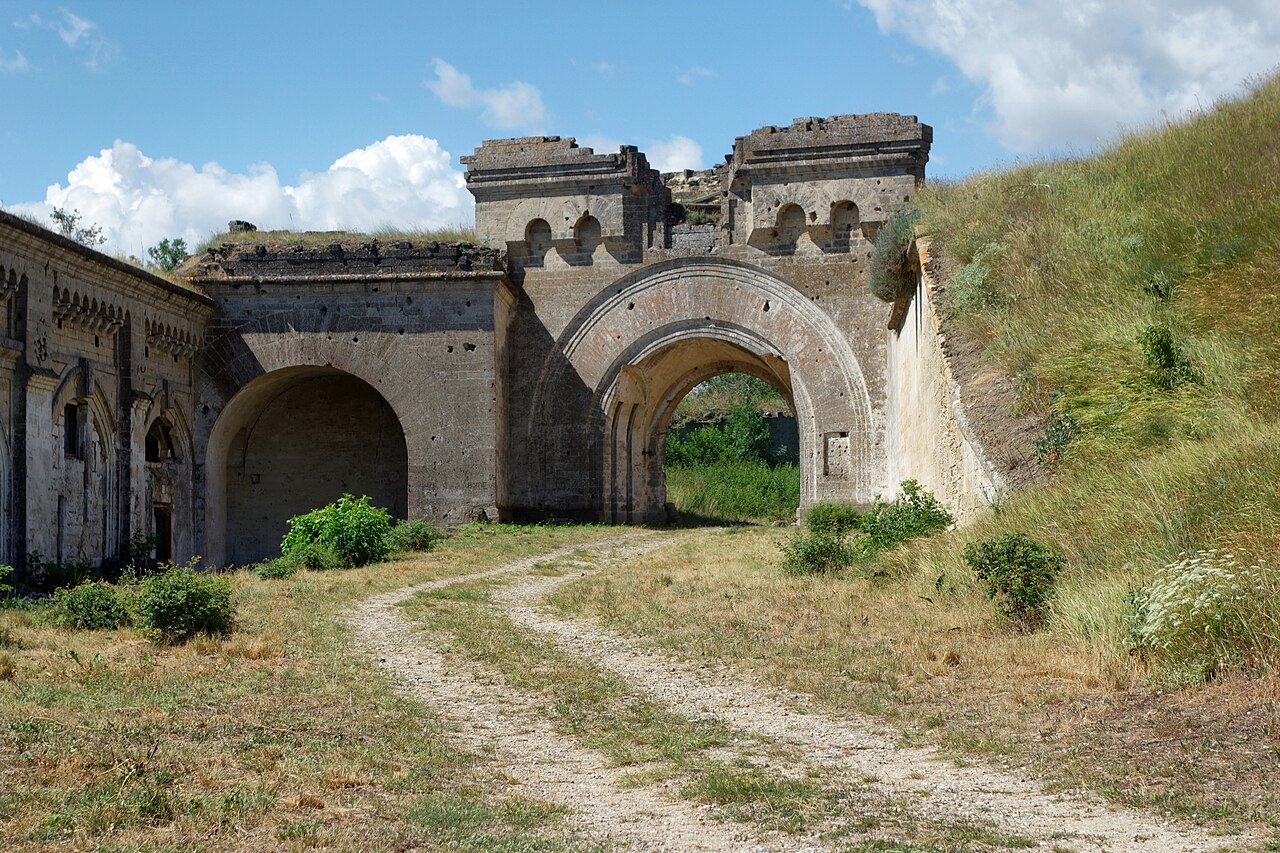
Today, some of the best-preserved elements of Yeni-Kale include its main gates, several sections of the outer walls, and particularly the half-bastion facing the coast. The fortress's ruins provide valuable insight into Ottoman military architecture and the strategic importance of the Kerch Strait.
A modern single-track railway runs through the fortress grounds, connecting the city of Kerch to the nearby ferry terminal. The vibrations from passing trains pose a threat to the fragile ruins. Plans to redirect rail traffic through the Crimean Bridge aim to close the line passing through Yeni-Kale, reducing damage and aiding preservation efforts.
Yeni-Kale stands as a testament to the region's layered history, from ancient Greek settlements through medieval Genoese control to Ottoman and Russian imperial ambitions. Its architectural features and strategic location continue to attract historians, archaeologists, and visitors interested in the military and cultural history of the Black Sea region.
Frequently asked questions (FAQ)
- What is the historical significance of Yeni-Kale fortress?
- Yeni-Kale fortress was built by the Ottoman Empire between 1699 and 1706 to control the Kerch Strait, a key maritime route between the Sea of Azov and the Black Sea. It played a strategic military role in regional conflicts, including the Russo-Turkish War, before being ceded to Russia in 1774.
- Can visitors explore the ruins of Yeni-Kale today?
- Yes, visitors can explore the ruins of Yeni-Kale, including its main gates, outer walls, and half-bastions. However, the site is fragile due to its age and proximity to a railway, so care should be taken when visiting.
- How was water supplied to Yeni-Kale fortress?
- Due to limited fresh water inside the fortress, an underground ceramic aqueduct was built to channel water from a source several kilometers away near modern Glazovka. This engineering feat was vital for sustaining the garrison during sieges.
- Why was Yeni-Kale built in its specific location?
- Yeni-Kale was constructed at the narrowest point of the Kerch Strait to control naval passage between the Sea of Azov and the Black Sea, providing strategic military advantage to the Ottoman Empire.
- What architectural features make Yeni-Kale unique?
- Yeni-Kale features an irregular pentagonal layout with five half-bastions at its corners, adapted to steep terrain. Its robust walls, moat on three sides, and internal structures like gunpowder magazines and a mosque reflect advanced Ottoman military architecture.
Information
Architect
Goloppo
Loading map...
Visitor reviews
No reviews yet. Been here? Write the first review and help other travelers!
Write the first reviewVisited this castle? Share your experience
Your review helps other travelers and adds first-hand knowledge to our encyclopedia.