Wynn's Castle
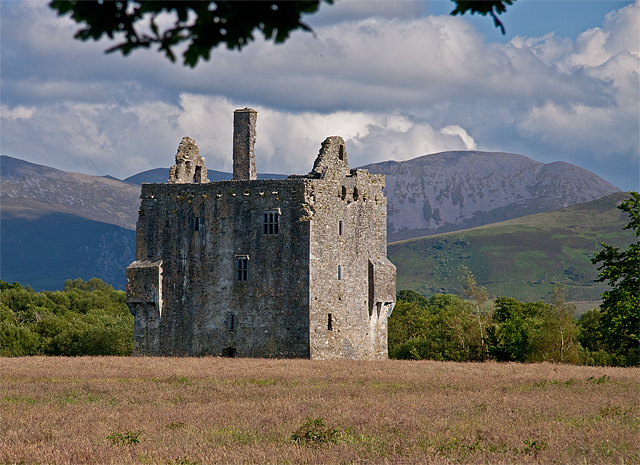
Wynn's Castle, also known as Wynne's Folly, Headley Towers, or Glenbeigh Towers Castle, is a notable castellated mansion ruin located near the town of Glenbeigh in County Kerry, Ireland. This imposing structure stands adjacent to the N70 road, famously known as the Ring of Kerry, making it a visible landmark despite its private ownership and restricted access.
The castle was commissioned in 1867 by Charles Allanson-Winn, 4th Baron Headley, and designed by the distinguished architect Edward William Godwin. Godwin was known for his work in the Gothic Revival and eclectic Victorian styles, and Wynn's Castle exemplifies the castellated mansion architectural trend of the late 19th century. The building was intended as a grand residence, incorporating elements reminiscent of medieval castles, including battlements, towers, and crenellated parapets, which gave it a fortress-like appearance despite its domestic purpose.
Architectural design and construction challenges
The design of Wynn's Castle reflected the Victorian fascination with medieval architecture, combining aesthetic grandeur with the practical needs of a country estate. The castle's layout featured multiple towers and turrets, expansive windows, and elaborate stonework. However, the construction proved to be financially burdensome. Funded primarily through rents collected from tenants on Lord Headley's estate, the escalating costs led to increased rents, which in turn caused widespread hardship among the tenant farmers.
The economic strain was severe enough that hundreds of tenants were evicted when they could no longer meet the higher rent demands. This harsh response to financing the castle's construction contributed to the eventual financial ruin of the 4th Baron Headley. Shortly after the completion of Wynn's Castle, Lord Headley became insolvent and was forced to abandon the property, leaving the grand mansion unfinished in terms of its intended use and maintenance.
Historical significance and military use
Despite its short-lived residential use, Wynn's Castle played a role during World War I. The British Military Command leased the castle and its surrounding grounds as a training center for reservists. This military use underscores the strategic value of the castle's location and its robust construction, which lent itself to adaptation for wartime purposes.
However, the castle's military chapter ended violently in 1921 during the Irish War of Independence. Republican forces targeted Wynn's Castle, setting it ablaze as part of their campaign against symbols of British rule and landlordism. The fire devastated the structure, reducing it to the ruin that remains today. The castle was never restored or rebuilt, leaving it as a poignant reminder of the turbulent history of the region.
Current status and visitor information
Today, Wynn's Castle stands as a ruined castellated mansion on private farmland. While the site is not accessible to the public due to its location on private property, it remains visible from the nearby public road, allowing visitors and travelers on the Ring of Kerry to view its striking silhouette against the landscape.
The castle's ruins contribute to the cultural and historical tapestry of County Kerry, attracting interest from historians, architectural enthusiasts, and tourists alike. Its story reflects broader themes in Irish history, including the impact of landlordism, the socio-economic struggles of tenant farmers, and the violent conflicts of the early 20th century.
Architectural legacy and cultural impact
Wynn's Castle is an example of a 19th-century castellated mansion that blends the romanticism of medieval architecture with Victorian-era ambitions. Although it never fulfilled its role as a noble residence for the Headley family, the castle's design by Edward William Godwin remains a testament to the era's architectural trends.
The castle's fate also serves as a case study in the consequences of estate management and the socio-political tensions in Ireland during the late 19th and early 20th centuries. The eviction of tenants during its construction highlights the harsh realities faced by many rural Irish communities under landlord rule.
As a ruin, Wynn's Castle continues to inspire interest and speculation, symbolizing both the grandeur and the downfall of aristocratic ambitions in Ireland. Its presence enriches the landscape of County Kerry and offers a tangible connection to the region's complex history.
Frequently asked questions (FAQ)
- How do I visit Wynn's Castle?
- Wynn's Castle is located on private farmland and is not accessible to the public. However, it can be easily viewed from the nearby N70 road, also known as the Ring of Kerry.
- What is the historical significance of Wynn's Castle?
- Wynn's Castle was built in 1867 as a castellated mansion for the 4th Baron Headley. It later served as a British military training center during World War I and was burned down in 1921 during the Irish War of Independence.
- Who was the architect of Wynn's Castle?
- The castle was designed by Edward William Godwin, a noted architect known for his work in the Gothic Revival style during the Victorian era.
- Why was Wynn's Castle never rebuilt?
- After being burned down by Republican forces in 1921, Wynn's Castle was left in ruins and never restored due to the financial insolvency of its owner and the political climate of the time.
- Is Wynn's Castle visible from public roads?
- Yes, Wynn's Castle can be seen from the N70 road near Glenbeigh, allowing visitors to view the ruins without entering private property.
Information
Architect
Edward William Godwin
Current owner
Private owner
Address
Near N70 road (Ring of Kerry), Glenbeigh, County Kerry, Ireland
Loading map...
Visitor reviews
No reviews yet. Been here? Write the first review and help other travelers!
Write the first reviewVisited this castle? Share your experience
Your review helps other travelers and adds first-hand knowledge to our encyclopedia.