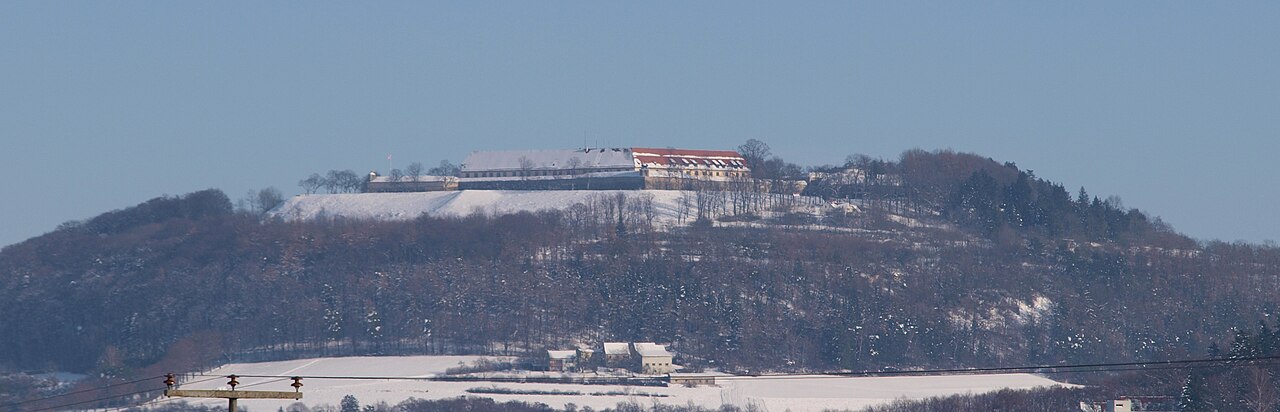
Wülzburg Fortress
Wülzburg fortress stands prominently on the highest point of the southern Frankenalb plateau, at an elevation of 640 meters. This Renaissance fortress is distinguished by its imposing structure and unique location, surrounded by a dry moat carved into the rock. The site has a long history, originally hosting a Benedictine monastery from the 11th century until the Reformation, when the monastery was dissolved and the property came under civil administration in 1537.
In 1588, Margrave Georg Friedrich the Elder of Brandenburg-Ansbach commissioned the construction of the fortress, designing it as a pentagonal bastioned fortress in the modern Italian fortification style. This design was part of the Renaissance military architectural innovations aimed at resisting artillery siege tactics. The fortress was strategically placed in the southern part of the Margrave's territory, near the imperial city of Weißenburg. Its presence was a constant source of tension for the citizens of Weißenburg, especially during the Thirty Years' War.
The fortress in the Thirty Years' War
During the Thirty Years' War (1618–1648), the fortress played a significant military role. In 1631, the fortress was surrendered without combat to General Johann Tserclaes, Count of Tilly, a commander of the imperial forces. The Margrave's family had taken refuge inside before the handover. For the remainder of the war, the fortress remained under control of the imperial troops or their allies. Despite enduring multiple blockades, the fortress never fell in battle. However, its occupation brought devastation to the nearby town of Weißenburg during periods when enemy forces held the fortress.
Post-war reconstruction and later history
The original castle structure suffered extensive damage from a major fire during the war and was subsequently rebuilt after the conflict ended. In 1791, the fortress became part of the Prussian territory, and later in 1802, it was transferred to Bavarian control. By 1867, its military importance had diminished, and the fortress lost its formal status as a defensive stronghold. In 1882, the Bavarian king sold most of the fortress to the town of Weißenburg, retaining only the south wing.
Use as prison and refugee camp
Throughout the 19th and 20th centuries, Wülzburg fortress served various non-military functions, including as a prison and a refugee camp. Notably, during World War I, the future French president Charles de Gaulle was imprisoned here in 1918. After World War II, the fortress underwent renovation and was repurposed to house a school, reflecting its transition from military to civilian use.
Architectural features and significance
The fortress is an excellent example of Renaissance military architecture, featuring a pentagonal layout with five bastions designed to provide overlapping fields of fire. The dry moat surrounding the fortress, cut directly into the rock, adds to its defensive capabilities. The design follows the principles of the Italian bastioned fortification style, which was revolutionary in the late 16th century for its adaptation to gunpowder artillery.
Within the fortress grounds, the castle chapel holds historical importance, housing the remarkable tombstone of Abbot Wilhelm, who died in 1449. This artifact connects the site to its earlier monastic history.
Location and strategic importance
Situated near the imperial city of Weißenburg in Bavaria, Germany, Wülzburg fortress occupies a commanding position on the Frankenalb ridge. Its elevation and fortifications allowed control over the surrounding region, making it a key military asset through various historical periods. The fortress's proximity to Weißenburg made it a symbol of power and a source of anxiety for the city's inhabitants, especially during times of conflict.
Current status and access
Today, Wülzburg fortress is well preserved and has been adapted for educational use. Its historical and architectural significance attracts visitors interested in Renaissance fortifications and German history. The fortress's robust structure and distinctive design continue to offer insight into late 16th-century military engineering and the region's turbulent past.
Frequently asked questions (FAQ)
- How do I get to Wülzburg Fortress?
- Wülzburg Fortress is located in Weissenburg, Germany, and can be accessed via public transportation or by car. The nearest train station is Weissenburg, from where local buses or a short taxi ride can take you to the fortress. Be sure to check local transport schedules for the most convenient routes.
- What is the historical significance of Wülzburg Fortress?
- Wülzburg Fortress was built in the 16th century and served as a strategic military stronghold during various conflicts in the region. It is an excellent example of Renaissance military architecture and has played a crucial role in the history of Bavaria. The fortress is also known for its unique design and well-preserved structures that attract history enthusiasts.
- When was Wülzburg Fortress constructed?
- Construction of Wülzburg Fortress began in 1568 and was completed in 1604. The fortress was designed by the famous architect Georg Tullius as a response to the evolving needs of military defense during that era. Over the years, it has undergone various renovations to maintain its structural integrity.
- Can I take a guided tour of Wülzburg Fortress?
- Yes, guided tours are available at Wülzburg Fortress, allowing visitors to gain deeper insights into its history and architecture. The tours are conducted in multiple languages and cover significant areas of the fortress. Be sure to check the fortress's official website for tour schedules and availability.
- Why is Wülzburg Fortress considered an architectural marvel?
- Wülzburg Fortress is celebrated for its Renaissance architecture, featuring impressive bastions and a unique layout that reflects the military strategies of its time. The intricate design incorporates both functionality and aesthetics, making it a fascinating subject for architecture enthusiasts. Its well-preserved state allows visitors to appreciate the craftsmanship and historical context of the period.
- Is it possible to access Wülzburg Fortress with a wheelchair?
- Wülzburg Fortress has made efforts to improve accessibility for all visitors, including those with mobility challenges. While some areas may present difficulties due to the fortress's historic nature, there are designated paths and ramps available. It is advisable to contact the fortress staff in advance to ensure a smooth visit.
- What are the ticket prices for Wülzburg Fortress?
- Ticket prices for Wülzburg Fortress are generally affordable, with discounts available for students, seniors, and families. Children under a certain age may enter for free, making it a great family destination. Check the fortress's official website for the most current pricing information and any special promotional offers.
- What are the opening hours of Wülzburg Fortress?
- Wülzburg Fortress typically opens its doors to visitors from March to October, with varying hours depending on the season. During peak tourist season, it may stay open longer to accommodate more visitors. It is recommended to verify the current opening hours on the official website before your visit.
- What nearby attractions can I visit while at Wülzburg Fortress?
- When visiting Wülzburg Fortress, you can also explore the charming town of Weissenburg, known for its historical buildings and beautiful parks. Nearby attractions include the local museums and the picturesque hiking trails that offer stunning views of the surrounding landscape. Make sure to allocate some time to fully enjoy the area!
Loading map...
Visitor reviews
No reviews yet. Been here? Write the first review and help other travelers!
Write the first reviewVisited this castle? Share your experience
Your review helps other travelers and adds first-hand knowledge to our encyclopedia.