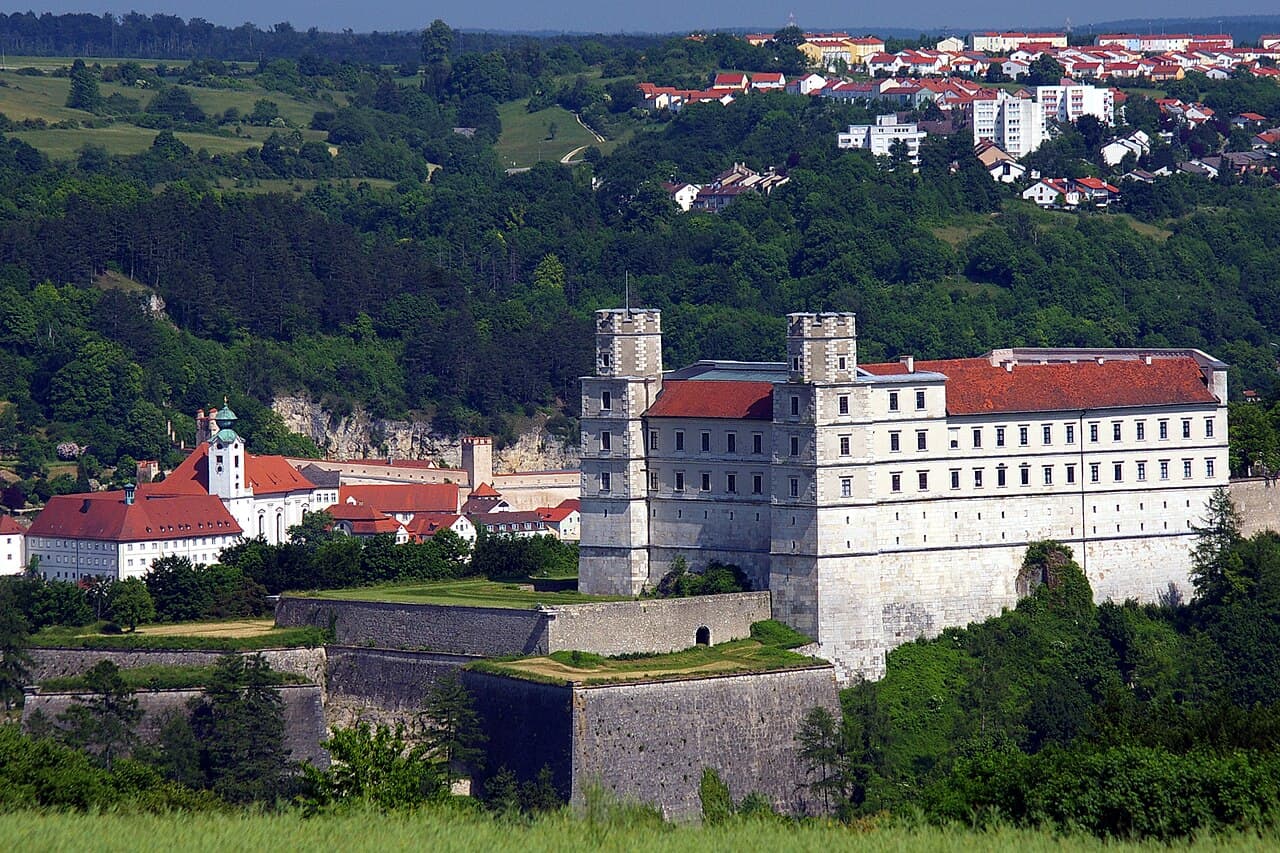
Willibaldsburg
Willibaldsburg castle stands as a monumental example of a late medieval hill castle with a rich history spanning several centuries. Located in Eichstätt, Upper Bavaria, this extensive fortress was originally constructed around 1353 and served as the principal residence and administrative seat of the prince-bishops of Eichstätt until the mid-18th century. Perched atop the elongated ridge of the Willibaldsberg, 464 meters above sea level, the castle commands a strategic vantage point overlooking the Altmühl valley. Its natural defenses are enhanced by the sharp bend of the Altmühl river, which wraps protectively around the hill, making it an ideal location for a fortified palace.
The castle's origins trace back even earlier to the early medieval period, with initial fortifications dating from around 1070. These earliest structures included a large stone house, a defensive tower, and a chapel, all enclosed within curtain walls and moats. The site bears the name of Saint Willibald, the first bishop of Eichstätt, who lived circa 700 to 787, highlighting the site's ecclesiastical significance from its inception.
Medieval origins and episcopal expansion
During the mid-14th century, the castle underwent significant expansion under Bishop Berthold von Zollern, following the extinction of the Counts of Hirschberg in 1305. This period marked the transformation of Willibaldsburg from a modest fortified residence into a formidable episcopal stronghold. The prince-bishops assumed military and administrative control over the diocese, necessitating extensive fortifications and residential enhancements.
Throughout the late 14th and 15th centuries, the castle was further fortified and expanded. Bishop Frederick IV of Oettingen added an outer ward known as a zwinger and constructed a large summer hall to accommodate the growing needs of the episcopal court. Subsequent bishops, including Albrecht II von Hohenrechberg and Martin von Schaumberg, continued to enlarge the complex, adding the Schaumbergbau, a distinctive three-winged residential building that became a key architectural feature of the castle.
Renaissance transformation and architectural advancements
At the dawn of the 17th century, Bishop Johann Konrad von Gemmingen initiated a major transformation of Willibaldsburg, converting it into a Renaissance summer palace inspired by contemporary Italian architectural trends. He commissioned the renowned master builder Elias Holl to design a new south wing and a striking two-tower facade. This period also saw the establishment of the Eichstätter Garten, a botanical garden immortalized in the famous 1613 publication Hortus Eystettensis, which documented the extensive plant collections cultivated under Gemmingen's patronage.
The Renaissance enhancements were completed by Bishop Johann Christoph von Westerstetten, who added five modern bastions and a large outer bailey, reflecting advances in military architecture designed to withstand artillery assaults. These bastions, including the notable "Half Moon" bastion constructed in 1658, replaced older medieval defenses and exemplify the adaptation of the fortress to early modern warfare.
Sieges, war damage, and later uses
The castle's strategic importance was underscored during the Thirty Years' War, when it was captured by Swedish forces in the spring of 1633. Bavarian troops recaptured Willibaldsburg later that same year in October. Following the conflict, Bishop Marquard II Schenk von Castell undertook repairs and modernized the defenses by installing gun casemates within the bastions to accommodate artillery.
In 1725, the prince-bishops relocated their residence to a new city palace near the Eichstätt cathedral, leading to Willibaldsburg's decline as a primary residence. The castle was repurposed for various administrative functions, later serving as a hospital and prison. After the secularization of the bishopric in 1806, the Bavarian state sold the castle to private owners. This period saw partial demolition and loss of much of the original interior furnishings.
19th and 20th century restoration and modern function
The Bavarian state reacquired Willibaldsburg in 1829 and commenced provisional repairs. Notably, the iconic onion-shaped towers were lowered and crowned with crenellations, altering the castle's silhouette. Subsequently, the castle served as barracks for the Bavarian Army's 3rd Royal Bavarian Infantry Battalion. Ownership fluctuated between the town of Eichstätt and the Bavarian state, with conservation efforts intensifying after the state regained control in 1900.
From 1926 to 1934, part of the castle was occupied by the Congregation of Oblates of St. Francis de Sales. After World War II, Willibaldsburg provided shelter for refugees from eastern Germany until 1955. Since 1962, the castle has been managed by the Bavarian Administration of State-Owned Palaces, Gardens and Lakes, which has overseen extensive renovations and the establishment of museums within the complex.
Architectural features and layout
Willibaldsburg extends approximately 420 meters along the ridge, making it one of the largest castle complexes in Bavaria. The castle's layout is characterized by a series of defensive and residential structures arranged along the natural topography.
Outer bailey and entrance
The outer bailey lies to the east and is approached through a gate marked by a simple portal topped with a statue of St. Willibald. Two artillery bastions constructed around 1612 guard this entrance, although the original drawbridge no longer exists. Visitors pass through a 63-meter-long gate hall featuring a high barrel vault, leading into the inner courtyard.
Inner courtyard and residential wings
The inner courtyard, now used as a parking area, was formed after 19th-century demolitions. Remnants of the Schaumbergbau are still visible, including the Gothic Dirnitz, a five-bay hall with cross vaults supported by a central round pillar. Beneath lies a two-aisled vaulted cellar, with additional cellar rooms beneath the courtyard.
The Gemmingenbau, or New Castle, encloses a late Renaissance courtyard with three wings. Designed by Elias Holl, this building's exterior rises four stories high and includes two square corner towers topped with octagonal crenellated parapets featuring half-windows. The upper floors of the south and west wings were removed in 1826, reducing the original five-story height.
Bastions and defensive works
The western bastions, constructed under Bishop Marquard II Schenk von Castell in the 17th century, replaced older medieval defenses. The "Half Moon" bastion, added in 1658, functioned as a ravelin or lunette positioned in front of the western front, enhancing the castle's artillery defenses.
Well and underground features
A deep well on the site measures 3.25 meters in diameter and reaches a depth of 76.5 meters. Excavations in 1977 cleared debris revealing an old bucket and a halberd, offering insights into the castle's medieval past.
Current use and cultural significance
Today, Willibaldsburg houses the Jura Museum, which displays an extensive collection of fossils, including the famous Eichstätt Archaeopteryx, a key specimen in the study of prehistoric life. The Museum of Prehistory and Early History exhibits artifacts from the Stone Age through the early Middle Ages, featuring Ice Age animal skeletons, Roman finds, and a detailed model of the Roman fort at Pfünz with over 400 painted pewter figures.
Part of the castle complex serves as a Bavarian state archive, preserving important regional documents. One of the two towers is open to visitors, offering panoramic views of the surrounding landscape, including the Altmühl valley and the town of Eichstätt.
Willibaldsburg remains a prominent cultural landmark, reflecting the layered history of ecclesiastical power, military architecture, and Renaissance artistry. Its extensive preservation and adaptive reuse as a museum and archive make it a vital destination for those interested in medieval and early modern German history.
Frequently asked questions (FAQ)
- How do I get to Willibaldsburg?
- Willibaldsburg is located in Eichstätt, Germany, and can be easily accessed by car or public transport. If you’re traveling by train, the Eichstätt Bahnhof is the nearest station, and from there, it’s a short walk or bus ride to the castle.
- What is the historical significance of Willibaldsburg?
- Willibaldsburg dates back to the 14th century and served as a residence for the bishops of Eichstätt. Its strategic location and impressive architecture reflect the power and influence of the ecclesiastical rulers during the Middle Ages.
- When was Willibaldsburg built?
- Construction of Willibaldsburg began in 1353 and continued over several years, with various additions made in subsequent centuries. The castle has undergone restorations that preserve its historical integrity while allowing visitors to appreciate its medieval charm.
- Can I take a guided tour of Willibaldsburg?
- Yes, guided tours of Willibaldsburg are available and provide an in-depth look at the castle's history, architecture, and artifacts. Tours are typically offered in multiple languages, ensuring that visitors from around the world can enjoy the experience.
- Why is Willibaldsburg known for its architecture?
- Willibaldsburg showcases a blend of Gothic and Renaissance architectural styles, making it a unique example of medieval fortifications. Its well-preserved towers, walls, and interior rooms provide insight into the construction techniques and design preferences of its era.
- Is it possible to visit Willibaldsburg year-round?
- Yes, Willibaldsburg is open to visitors throughout the year, though opening hours may vary with the seasons. It’s best to check the official website for the most current visiting times and any potential seasonal closures.
- What are the ticket prices for visiting Willibaldsburg?
- Ticket prices for Willibaldsburg are quite reasonable, with discounts available for children, students, and seniors. Admission fees help support the maintenance and preservation of the castle and its grounds.
- What is the best time to visit Willibaldsburg?
- The best time to visit Willibaldsburg is during the spring and early autumn months when the weather is mild and the gardens are in full bloom. Additionally, visiting during weekdays may help you avoid larger crowds, allowing for a more enjoyable experience.
- Are there any nearby attractions to visit while at Willibaldsburg?
- Yes, while visiting Willibaldsburg, you can explore the charming town of Eichstätt, which is rich in history and offers beautiful baroque architecture. Other nearby attractions include the Eichstätt Cathedral and the picturesque Altmühl Valley, perfect for outdoor enthusiasts.

Information
Website
Visit websiteSources & official resources
Verify the information above using these authoritative references.
Loading map...
Visitor reviews
No reviews yet. Been here? Write the first review and help other travelers!
Write the first reviewVisited this castle? Share your experience
Your review helps other travelers and adds first-hand knowledge to our encyclopedia.


