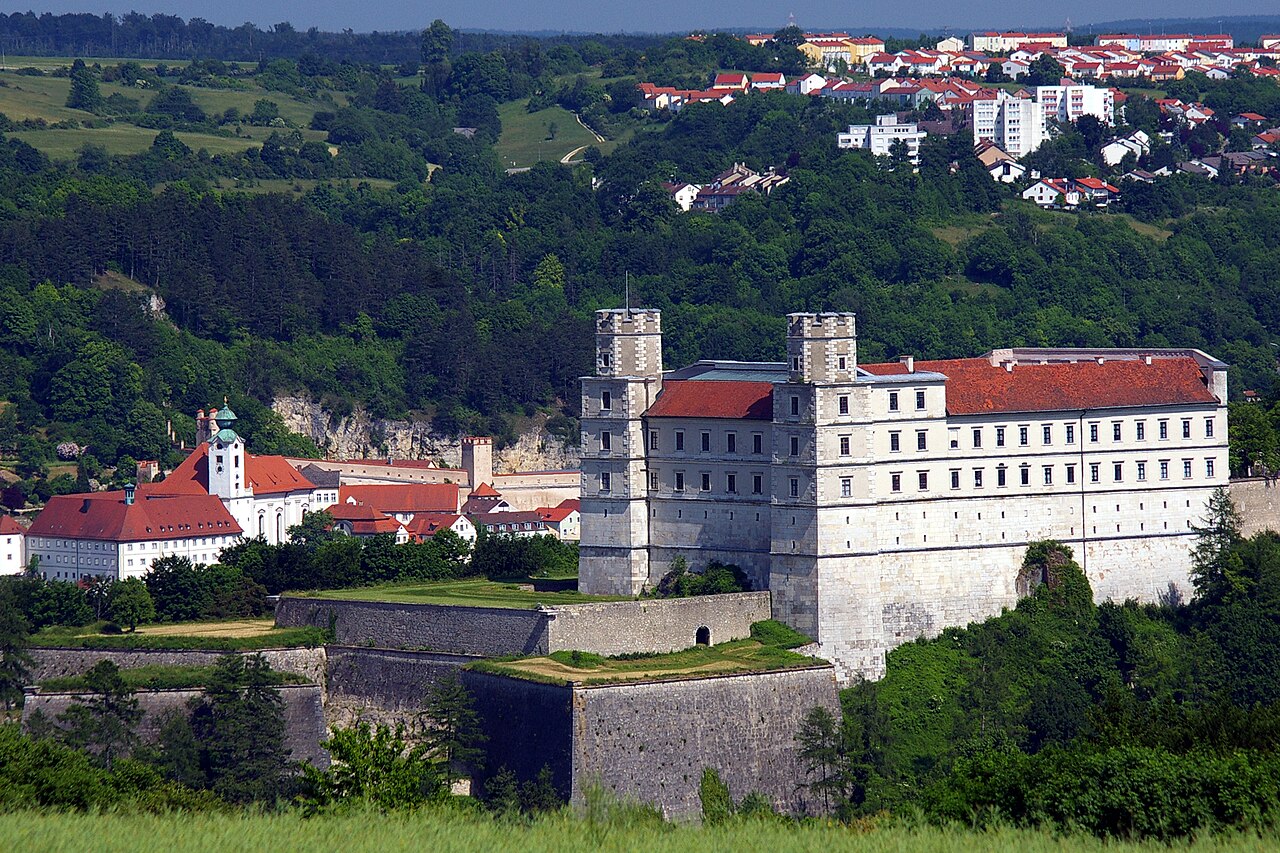
Willibaldsburg Castle
Willibaldsburg Castle, located on the Willibaldsberg hill overlooking the town of Eichstätt in Bavaria, Germany, is a significant example of a late medieval fortress that underwent extensive transformation during the Renaissance period. Originally constructed beginning in 1355, the castle served as the seat of the Prince-Bishops of Eichstätt and played a crucial role in the region's religious and political history.
Medieval origins and early construction
The initial construction of Willibaldsburg Castle commenced in the mid-14th century, marking it as a late medieval stronghold. Its strategic position on the Willibaldsberg hill provided natural defensive advantages, typical of hill castles of the era. The original fortress featured robust stone walls, defensive towers, and a keep designed to withstand sieges and assert the authority of the Prince-Bishops over the surrounding territories.
Renaissance transformation under martin von schaumberg and johann conrad von gemmingen
In the second half of the 16th century, significant expansions and renovations were undertaken under the direction of Prince-Bishop Martin von Schaumberg. These modifications reflected the changing needs of castle architecture, shifting from purely military functions to more comfortable and representative residential purposes. The castle's defensive elements were softened with the addition of Renaissance architectural features, including larger windows and more ornate facades.
The most notable phase of transformation occurred during the reign of Prince-Bishop Johann Conrad von Gemmingen (1595-1612). Under his patronage, the renowned architect Elias Holl was commissioned to convert the castle into an impressive Renaissance residence. This included crowning the castle's towers with distinctive onion domes, a characteristic feature of southern German Renaissance architecture. The renovations enhanced both the aesthetic appeal and the functional comfort of the castle, aligning it with contemporary aristocratic residences.
Hortus eystettensis and the bastion garden
One of the most remarkable contributions of Prince-Bishop Gemmingen was the establishment of the Hortus Eystettensis, a botanical garden that became famous throughout Europe. The garden was laid out with a diverse collection of plants and served both scientific and ornamental purposes. In 1613, the plant collection was documented in a series of detailed copperplate engravings by Basilius Besler, which remain a valuable record of early modern botanical knowledge.
In modern times, the Bastion Garden at Willibaldsburg Castle was opened in 1998 as a faithful reproduction of the original botanical garden. It showcases the variety of plants that were cultivated in the early 17th century, providing visitors with a glimpse into the castle's cultural and scientific heritage.
Architectural features and layout
The castle complex is characterized by its combination of medieval fortifications and Renaissance residential elements. The original stone walls and defensive towers remain prominent, while the later additions by Elias Holl introduced elegant arcades, ornate facades, and the signature onion-shaped domes topping the towers. The castle's layout includes a central courtyard surrounded by residential wings and fortified structures, reflecting its dual role as a defensive fortress and a princely residence.
Defensive structures
The castle's fortifications include thick curtain walls, bastions, and a gatehouse designed to control access. These features were typical of late medieval military architecture, adapted over time to accommodate the evolving needs of artillery and siege warfare. The castle's elevated position enhanced its defensive capabilities, allowing for extensive views over the Altmühl valley and the town below.
Historical significance and cultural heritage
Willibaldsburg Castle has been a symbol of ecclesiastical power in Eichstätt for centuries. Its association with the Prince-Bishops ties it closely to the religious and political history of the region. The castle also reflects the architectural transition from medieval fortress to Renaissance palace, illustrating broader trends in European castle development during the 16th and early 17th centuries.
The botanical garden, both in its original form and as the modern Bastion Garden, highlights the castle's role in the early scientific study of plants and the cultural importance of horticulture among the aristocracy. Today, the castle serves as a museum and cultural venue, preserving its architectural heritage and offering insights into the history of Eichstätt and the surrounding region.
Visiting willibaldsburg castle today
Visitors to Willibaldsburg Castle can explore its well-preserved structures, including the Renaissance residential wings, the medieval fortifications, and the Bastion Garden. The castle houses several museums, including collections of archaeology, natural history, and religious art, making it a multifaceted cultural destination.
The castle's elevated location provides panoramic views of Eichstätt and the Altmühl valley, enhancing the visitor experience. The Bastion Garden, open seasonally, offers a unique botanical attraction that connects contemporary visitors with the castle's historic past.
Frequently asked questions (FAQ)
- How do I get to Willibaldsburg Castle?
- Willibaldsburg Castle is located in Eichstätt, Germany, and is easily accessible by public transport. You can take a train to Eichstätt and then a short walk or bus ride will lead you to the castle, which is situated on a hill with stunning views of the surrounding area.
- What is the historical significance of Willibaldsburg Castle?
- Willibaldsburg Castle was built in the 14th century and served as a residence for the bishops of Eichstätt. The castle has played a vital role in the history of the region, reflecting the power and influence of the ecclesiastical rulers during the Middle Ages.
- When was Willibaldsburg Castle constructed?
- Construction of Willibaldsburg Castle began in 1350 and was completed in the late 14th century. Over the years, it has undergone various renovations and restorations, preserving its historical architecture.
- Can I visit Willibaldsburg Castle year-round?
- Yes, Willibaldsburg Castle is open to visitors throughout the year, although the opening hours may vary seasonally. It is advisable to check the official website for the most current information on visiting hours before planning your trip.
- Why is Willibaldsburg Castle a popular tourist destination?
- Willibaldsburg Castle is popular for its impressive architecture, rich history, and stunning panoramic views of the Altmühltal valley. Visitors enjoy exploring the castle's museum, gardens, and historical exhibits that showcase the region's heritage.
- Is it possible to access Willibaldsburg Castle with limited mobility?
- Willibaldsburg Castle has made efforts to accommodate visitors with limited mobility, but due to its hilltop location and historical structure, some areas may be challenging to navigate. It is advisable to contact the castle administration in advance to inquire about specific accessibility options.
- What are the ticket prices for visiting Willibaldsburg Castle?
- Ticket prices for Willibaldsburg Castle are generally quite affordable, with discounts available for students, seniors, and groups. Children under a certain age may enter for free, but it's best to check the official site for the latest pricing information.
- What is the best time to visit Willibaldsburg Castle?
- The best time to visit Willibaldsburg Castle is during the spring and early autumn when the weather is mild and the surrounding landscapes are vibrant. Additionally, these seasons tend to have fewer crowds, allowing for a more enjoyable experience.
- Are there any nearby attractions to visit along with Willibaldsburg Castle?
- Yes, nearby attractions include the historic town of Eichstätt itself, known for its charming architecture and the Baroque Cathedral. Additionally, the Altmühltal Nature Park offers opportunities for hiking and exploring the beautiful natural scenery surrounding the castle.
Information
Loading map...
Visitor reviews
No reviews yet. Been here? Write the first review and help other travelers!
Write the first reviewVisited this castle? Share your experience
Your review helps other travelers and adds first-hand knowledge to our encyclopedia.