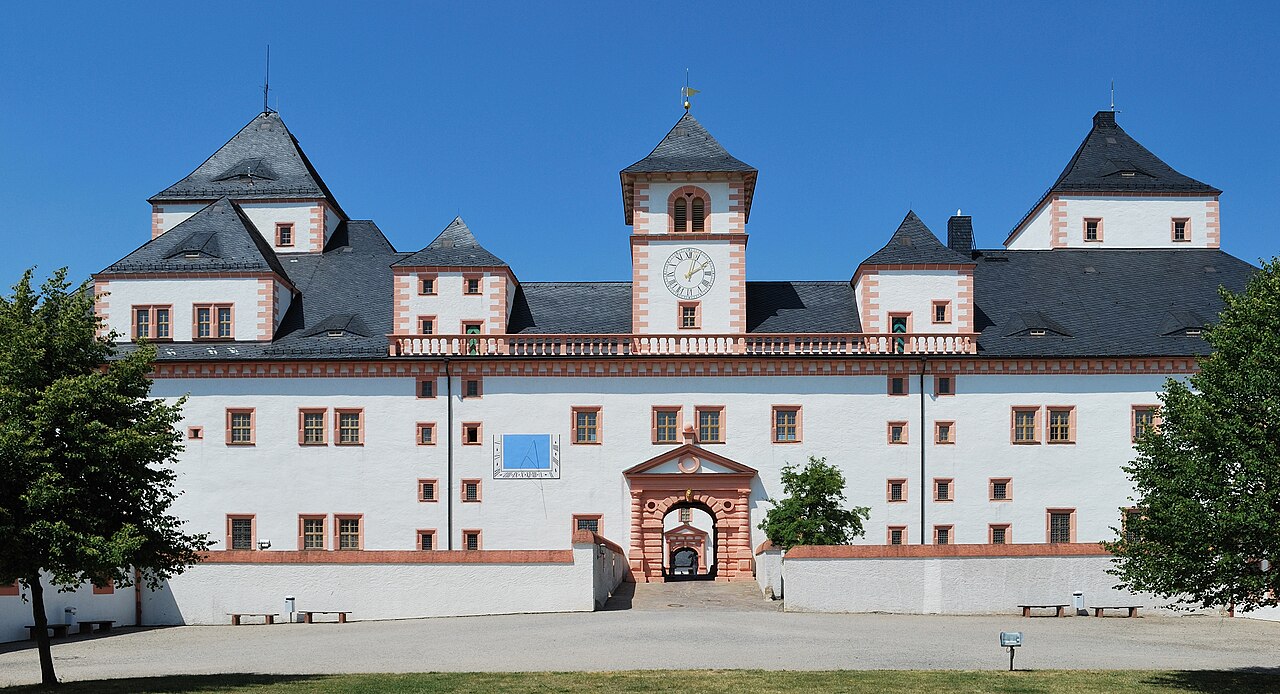
Wildeck Castle
Wildeck Castle, located in Zschopau, Saxony, Germany, is a remarkable example of a high medieval hill castle that evolved significantly over the centuries. Originally constructed in the 12th century, the castle's earliest surviving element is its imposing keep, known as the Dicker Heinrich or "Fat Henry." This massive bergfried stands sentinel above the River Zschopau, emphasizing the castle's strategic and defensive position on a rocky spur.
The castle underwent a major transformation during the Renaissance period in the mid-16th century, when Prince Elector Moritz of Saxony commissioned its redesign between 1545 and 1547. This reconstruction converted the medieval fortress into an elegant hunting lodge, reflecting the tastes and functions of the Saxon nobility of the time. The renovation introduced distinctive architectural features, including the slender staircase tower called Schlanke Margarete or "Skinny Margaret," noted for its graceful curved roof hood and prominent gables, which contrast with the robust bergfried.
Architectural features and layout
The castle's layout today forms an irregular triangular plan, with a narrow wing enclosing the central courtyard. The side of the castle facing the river is dominated by the bergfried Dicker Heinrich, a typical feature of hill castles designed to provide both defense and a lookout point. The opposite side facing the town is fortified by a solid wall, enhancing the castle's defensive capabilities.
The Renaissance remodeling introduced elegant living spaces and decorative elements. Notable interiors include the Blue and White Parlour and the Red and Green Halls, which showcase the refined style and color schemes typical of the period. These rooms have been carefully restored and are open to visitors, offering insight into the castle's dual role as a fortress and a noble residence.
Towers and defensive structures
The two main towers, Dicker Heinrich and Schlanke Margarete, are architectural highlights. The bergfried is a massive defensive tower, characteristic of high medieval castles, while the slender staircase tower adds a Renaissance elegance to the silhouette. The castle walls and battlements, though modified over time, retain elements of their original medieval fortifications.
Historical significance and ownership
Wildeck Castle's history is closely tied to the regional rulers of Saxony. Initially the seat of local dukes, it later became associated with the Prince Electors of Saxony and eventually served as a hunting residence for the King of Saxony. The castle's function shifted over time, reflecting changes in political power and social customs.
From the 16th century through the early 20th century, Wildeck Castle was central to the administration of hunting in the region. It housed various hunting authorities and served as a symbolic and practical center for the management of royal hunting grounds. According to historical records, the castle once contained an extensive collection of hunting trophies, including 112 horns and antlers, though this collection no longer exists.
Later uses and adaptations
In the 19th century, the castle was expanded to accommodate administrative functions. The eastern wing was extended to house the Expedition of the Kingly Court, and later, the district court occupied part of the premises. The western wing was also enlarged in 1855 to include a prison with an adjoining courtyard, reflecting the castle's evolving role in local governance and justice.
Restoration and current status
Wildeck Castle was transferred to municipal ownership in 1994 and has since undergone extensive restoration to preserve its historic fabric and architectural integrity. The restoration efforts have revived the castle's Renaissance interiors and structural features, allowing visitors to experience its historical ambiance.
Today, the castle offers guided tours that highlight its rich history, architectural evolution, and cultural significance. Visitors can explore the beautifully restored rooms, enjoy panoramic views from the towers, and appreciate the castle's commanding position above the River Zschopau. The baroque garden and the refurbished castle walkway, adorned with scented roses, fruit trees, and sculptures, provide a tranquil setting for guests to relax and reflect on the castle's heritage.
Visitor experience and cultural importance
Wildeck Castle stands as a testament to the layered history of Saxony, embodying the transition from medieval fortress to Renaissance hunting lodge and later administrative center. Its architectural features and preserved interiors offer valuable insights into the lifestyles of Saxon nobility and the region's political history.
The castle's prominent location and well-maintained grounds make it a popular destination for tourists interested in history, architecture, and nature. Its restoration has ensured that Wildeck Castle remains a vibrant cultural landmark, contributing to the understanding and appreciation of Saxony's medieval and Renaissance heritage.
Frequently asked questions (FAQ)
- What are the opening hours of Wildeck Castle?
- Wildeck Castle is typically open to visitors during regular daytime hours, often from 10:00 to 16:00 daily, but it is advisable to check the official website or local tourist information for current times and any seasonal variations.
- Can I take guided tours of Wildeck Castle?
- Yes, guided tours are available at Wildeck Castle, providing detailed insights into its history, architecture, and cultural significance. These tours help visitors fully appreciate the castle's transformation from a medieval fortress to a Renaissance hunting lodge.
- Is Wildeck Castle accessible for visitors with limited mobility?
- While efforts have been made to improve accessibility, some areas of Wildeck Castle, especially the older towers and steep staircases, may present challenges for visitors with limited mobility. It is recommended to inquire in advance about specific accommodations.
- When was Wildeck Castle originally built and who built it?
- Wildeck Castle was originally built in the 12th century as a medieval fortress. The exact original builder is not definitively known, but it was established by local Saxon nobility to control the strategic location above the River Zschopau.
- What architectural styles are prominent in Wildeck Castle?
- The castle prominently features <strong>high medieval defensive architecture</strong> in its original keep and walls, combined with <strong>Renaissance</strong> style elements introduced during the 16th-century redesign when it was converted into a hunting lodge.
Information
Sources & official resources
Verify the information above using these authoritative references.
Loading map...
Visitor reviews
No reviews yet. Been here? Write the first review and help other travelers!
Write the first reviewVisited this castle? Share your experience
Your review helps other travelers and adds first-hand knowledge to our encyclopedia.