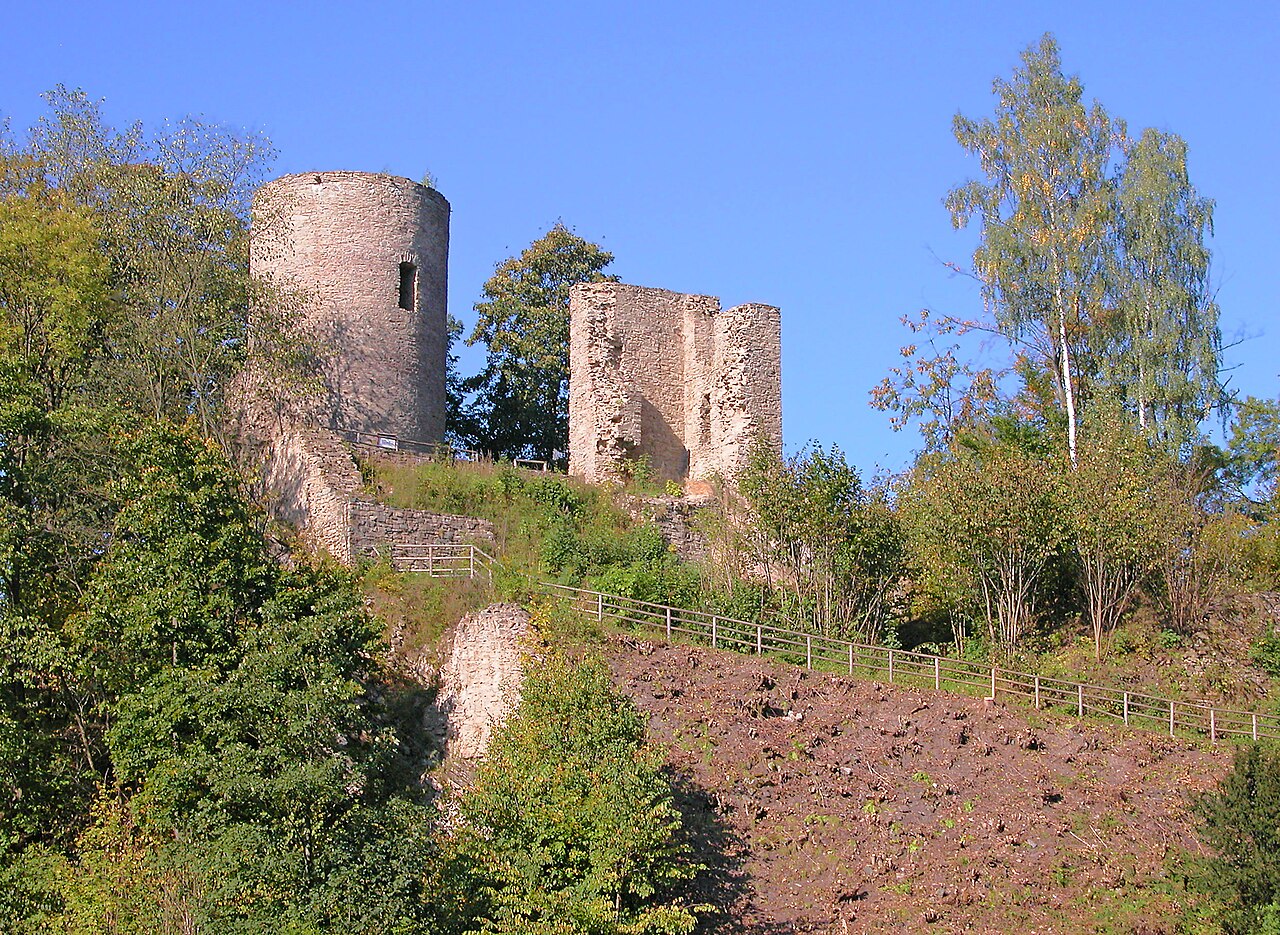
Rauenstein Castle
Rauenstein Castle is a historic fortress located in Pockau-Lengefeld, Germany, strategically positioned to guard the crossing over the River Flöha along the important medieval route from Freiberg to Annaberg. Its role as a protective stronghold highlights its significance in controlling regional traffic and trade during the High Medieval period.
The castle is first documented in written records in 1323, though archaeological evidence suggests its construction dates back to around 1200. This places Rauenstein among the early stone castles of the region, built during a time when fortifications were evolving from wooden motte-and-bailey structures to more durable stone keeps and curtain walls. The initial builders and lords were the Schellenbergers, a noble family whose influence shaped the early history of the castle.
Architectural evolution and structural features
Originally designed as a hill castle, Rauenstein was constructed to take advantage of the natural terrain for defense. Its location on elevated ground overlooking the river crossing allowed defenders to monitor and control movement along the valley. The castle complex included typical medieval fortifications such as curtain walls, gatehouses, and defensive towers, although detailed architectural plans are limited due to later modifications and partial ruinous conditions.
Significant structural changes were made around 1630, reflecting the castle's adaptation to new military technologies and residential needs. One notable addition from this period is a road tunnel carved through the rock beneath the castle, which facilitated passage beneath the fortress and exemplifies the integration of infrastructure with defensive architecture. These modifications likely included reinforcement of walls and internal buildings to accommodate changing styles and functions.
Ownership and historical significance
After passing through several noble families, the castle came under the ownership of the Electorate of Saxony in 1567. This transfer marked a shift from a feudal noble residence to an administrative center within the Saxon territories. The castle's administrative district, or Amt, was assigned to the nearby town of Wolkenstein in 1596, indicating its integration into regional governance.
From 1651 to 1743, the castle was leased to the von Römer family, who were prominent due to their wealth from silver mining in the nearby Schneeberg area. Their tenure reflects the economic importance of mining in Saxony and the castle's role as a residence for affluent families connected to this industry.
In the 19th century, ownership passed to Christian August Hähnel in 1816, followed by his nephew Wolfgang, Freiherr von Herder (owner from 1843 to 1853), and later Wilhelm Freiherr von Herder. These owners were politically active, serving as members of the Saxon Landtag, Saxony's regional parliament. The last private owner before World War II was Gottfried Freiherr von Herder, who served as a German Conservative member of the Reichstag from 1893 to 1898.
20th century transformations and current status
Following the upheavals of World War II and the establishment of the Soviet occupation zone, Rauenstein Castle was confiscated as part of land reforms in 1945. It was repurposed as a children's convalescent home, reflecting the post-war need for social services and the adaptive reuse of historic buildings.
Since 1998, the castle has been privately owned. Due to its current private status and preservation concerns, it is only accessible for viewing from the outside. The castle remains a significant cultural landmark, representing centuries of regional history, architectural evolution, and shifting political landscapes.
Architectural style and condition
Rauenstein Castle exemplifies the High Medieval castle typology with later modifications reflecting early modern adaptations. While the original medieval structures have undergone changes, the castle retains elements characteristic of its initial construction period, including stone fortifications and defensive features. Its current condition is best described as partially preserved, with some areas restored or stabilized to prevent further decay.
Frequently asked questions (FAQ)
- How do I get to Rauenstein Castle?
- Rauenstein Castle is located in Pockau-Lengefeld, Germany, and can be accessed by car or public transport. If driving, there are parking facilities nearby, and for public transport, check local bus schedules for the best routes to the castle.
- What is the historical significance of Rauenstein Castle?
- Rauenstein Castle dates back to the 13th century and played a crucial role in the region's medieval history. It served as a noble residence and a strategic military stronghold, reflecting the architectural styles and historical events of its time.
- When was Rauenstein Castle built?
- Rauenstein Castle was constructed in the early 13th century, making it one of the significant historical landmarks in the area. Over the years, it has undergone various renovations, preserving its historical essence while adapting to modern needs.
- Can I visit Rauenstein Castle year-round?
- Yes, Rauenstein Castle is open to visitors throughout the year, although opening hours may vary by season. It's best to check the official website or contact local tourism information for the most accurate visiting hours.
- Why is Rauenstein Castle a popular tourist attraction?
- Rauenstein Castle attracts visitors due to its rich history, stunning architecture, and picturesque surroundings. The castle offers guided tours, which provide insight into its fascinating past and the chance to explore its beautiful grounds.
- Is it possible to host events at Rauenstein Castle?
- Yes, Rauenstein Castle can be rented for various events, including weddings and corporate gatherings. The unique setting and historical ambiance make it an ideal location for memorable occasions.
- What are the ticket prices for visiting Rauenstein Castle?
- Ticket prices for Rauenstein Castle are generally affordable, with discounts available for students and seniors. It's advisable to check the castle's official website for the latest pricing and any special promotions.
- What time of year is best to visit Rauenstein Castle?
- The best time to visit Rauenstein Castle is during the spring and early autumn months when the weather is pleasant, and the surrounding landscapes are in full bloom. Special events and festivals often occur during these seasons, enhancing the visitor experience.
- Are there any nearby attractions to visit along with Rauenstein Castle?
- Yes, there are several attractions near Rauenstein Castle, including the picturesque town of Pockau-Lengefeld and other historical sites in the Erzgebirge region. Visitors can enjoy hiking trails, local museums, and charming shops that showcase the area's cultural heritage.
Loading map...
Visitor reviews
No reviews yet. Been here? Write the first review and help other travelers!
Write the first reviewVisited this castle? Share your experience
Your review helps other travelers and adds first-hand knowledge to our encyclopedia.