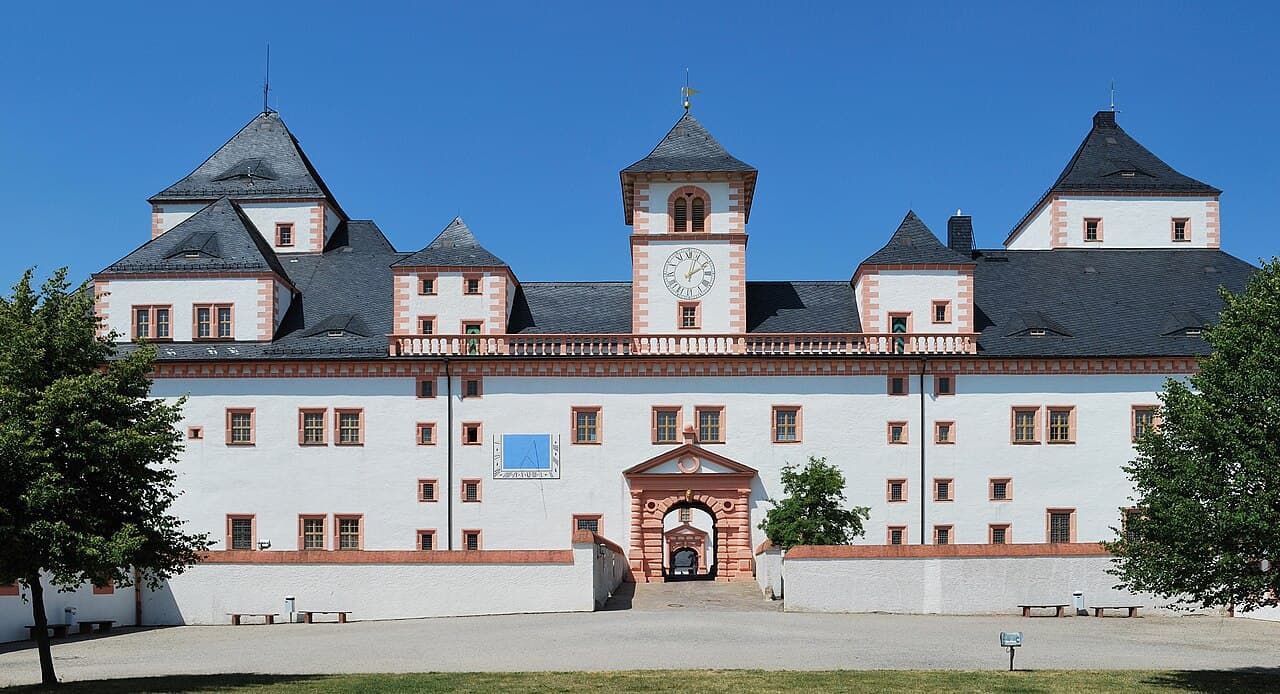
Augustusburg Hunting Lodge
The Augustusburg Hunting Lodge (Jagdschloss Augustusburg) stands as a remarkable example of Renaissance architecture nestled atop the Schellenberg hill on the northern edge of the Ore Mountains in Germany. Constructed between 1568 and 1572, this hill castle was commissioned by Elector Augustus of Saxony to serve as a prestigious residence for his hunting excursions and a potent symbol of his political dominance in Central Germany. The lodge's prominent location and distinctive architecture make it a notable landmark visible from afar.
Historical background and political significance
The origins of the site date back to the early 13th century when the von Schellenberg family established a medieval castle around 1210-1230. This original fortress was granted to the House of Wettin in 1324 following the Schellenberg Feud, marking a pivotal shift in regional power. The castle was fortified further in the late 14th century with the addition of an outer wall known as the Zwingermauer and a wellhouse to secure water supply.
However, the medieval castle suffered significant damage from fire and lightning strikes in 1528 and again in 1547, leading to its eventual dismantling in 1567. This cleared the way for the construction of the Renaissance hunting lodge.
Elector Augustus commissioned the new lodge not only as a luxurious retreat for hunting but as a statement of his authority following his victory in the Grumbach Brawl. By enforcing the imperial ban against his Ernestine rivals, including John Frederick the Middle and the outlawed knight Wilhelm von Grumbach, Augustus secured his supremacy over the Ernestines and expanded his territorial control to include the Ämter of Weida, Ziegenrück, and Arnshaugk. The thriving economy of the Electorate of Saxony under Augustus and his predecessor Moritz provided the necessary financial backing for this ambitious project.
Architectural design and construction
Design influences and architects
The architectural design of Augustusburg Hunting Lodge reflects a sophisticated blend of Renaissance ideals with local traditions. While the building was long attributed to Hieronymus Lotter, the Leipzig mayor and master builder, current scholarship suggests his role was primarily as chief architect overseeing execution rather than original design. The existence of a completed wooden model prior to his involvement indicates that the initial plans were likely developed under the supervision of Hans Irmscher at the court of Elector Augustus. Some architectural elements, such as the straight-flight Italian-style staircases and roof details, bear Lotter's influence, while parts of the north portal and the chapel are credited to Erhardt van der Meer, Lotter's senior clerk of works.
The Elector himself was deeply engaged in architectural matters, maintaining a library rich in architectural documents and pattern books, which likely inspired the lodge's unique design. The architecture diverges from typical Saxon palaces, embodying instead a theoretical and innovative approach to Renaissance style.
Construction phases and engineering feats
Construction began in 1568 under the supervision of Paul Widemann, the first clerk of works, who died the same year. Subsequently, Hieronymus Lotter took charge, followed by the Florentine architect Rochus Guerrini in 1571, after disputes over costs and progress. The hunting lodge was officially inaugurated on 30 January 1572, with interior work and towers completed shortly thereafter.
A remarkable engineering achievement accompanying the lodge's construction was the digging of a deep well between 1568 and 1577 by mining master Hans Planer. This well, reaching a depth of 130.6 meters, was designed to supply water to the elevated site and was the second deepest well in Saxony at the time.
Architectural features and layout
Structural composition
The lodge is laid out around a central courtyard in a quadrangular arrangement typical of Renaissance castles. It consists of four square corner buildings connected by three shallower wings, forming a roughly rectangular complex. A projecting chapel extends from the side facing the countryside, emphasizing the lodge's religious and ceremonial functions.
The buildings rise two stories above substantial stone foundations and cellars on the outer side. The exterior walls are smooth and understated, punctuated by simple rectangular windows, with decorative emphasis placed on two large entrance portals that provide visual grandeur.
Originally, the lodge featured an intricate roofline with dormer windows and tower-like structures above an open gallery near the roof eaves. This elaborate design was simplified between 1789 and 1801 by architect Christian Traugott Weinlig, though some elements such as parts of the southern roof balustrade and dormers were partially restored after World War II.
Interior design and notable rooms
Inside, much of the original floor plan and structural features remain intact. The two main floors are supported by vaults and retain 16th-century doors and several fireplaces. A particularly notable room is the "Hasenhaus" (Hare House), adorned with approximately 100 wall paintings depicting a whimsical "world turned upside down," where hares perform human activities such as hunting and judging, offering a rare glimpse into Renaissance-era humor and social commentary.
While wings that originally served as stables and economic buildings have lost much of their internal arrangements, some original ceilings, floors, and door elements survive, especially in the western stable building.
Castle church and artistic heritage
A prominent feature of the complex is the integrated castle church near the main entrance. This Protestant church spans from the ground floor to the roof ridge, making it the largest church of its kind within Saxony's castles. The altar painting, crafted by Lucas Cranach the Younger, vividly illustrates the Crucifixion and Resurrection and includes a depiction of Elector Augustus's family, which notably comprised fourteen children.
The church houses a historically significant organ built in 1572 by Hermann Raphael Rodensteen. Despite several rebuilds and restorations, the instrument retains much of its 18th-century character. Positioned on the second gallery above the altar, the organ's Rococo-style casing features a heart-shaped front flanked by two tower-like spires, adding to the church's artistic grandeur.
Later history and current use
During the 18th century, the lodge's role as a hunting residence diminished, and it transitioned through various functions, including administrative offices and a prison from 1790 to 1849. In the 20th century, it served diverse roles such as a youth hostel, museum, training school, and even a refugee camp in 1938. Under the Nazi regime, it operated as an external camp and training facility.
Today, the Augustusburg Hunting Lodge is part of the Montanregion Erzgebirge UNESCO World Heritage site, recognized for its cultural and historical significance. It houses several museums, including a motorcycle museum with over 175 exhibits, a hunting and ornithology museum, and formerly a carriage museum, which closed in early 2024. The castle's rich heritage and diverse museum offerings make it a compelling destination for visitors interested in history, architecture, and culture.
Notable landmarks and natural features
Near the castle's northeast corner stands a historic lime tree planted in 1421, one of the oldest documented trees in the region. This natural landmark adds to the site's historical ambiance and connects the present-day lodge with its medieval past.
Frequently asked questions (FAQ)
- How do I get to Augustusburg Hunting Lodge?
- Augustusburg Hunting Lodge is located on Schellenberg hill near the town of Augustusburg in Saxony, Germany. It is accessible by car and public transport, with parking available nearby and local bus connections from Augustusburg town center.
- What is the best time to visit Augustusburg Hunting Lodge?
- The lodge is open daily from 10:00 to 17:00, making spring through autumn ideal for visiting. The surrounding Ore Mountains offer beautiful seasonal scenery, enhancing the experience.
- Can I tour the castle church inside Augustusburg Hunting Lodge?
- Yes, visitors can explore the castle church, which is notable for its size and the altar painting by Lucas Cranach the Younger. The church is part of the guided tours and open during visiting hours.
- Is the hunting lodge accessible for visitors with mobility issues?
- While the lodge has some accessibility challenges due to its historic structure, efforts have been made to accommodate visitors with limited mobility. It is recommended to contact the site in advance for specific accessibility information.
- Are there any museums inside Augustusburg Hunting Lodge?
- Yes, the lodge houses several museums including a motorcycle museum with over 175 exhibits and a hunting and ornithology museum. The carriage museum closed in early 2024.
- What is the historical significance of Augustusburg Hunting Lodge?
- Built by Elector Augustus of Saxony after his victory in the Grumbach Brawl, the lodge symbolizes his political power and the flourishing Renaissance culture in Saxony. It also features unique architectural innovations and a rich artistic heritage.
Photo gallery

Information
Opening hours
10:00-17:00, daily
Ticket prices
€7 adult, €4 child
Current owner
State museum
Website
Visit websiteSources & official resources
Verify the information above using these authoritative references.
Loading map...
Visitor reviews
No reviews yet. Been here? Write the first review and help other travelers!
Write the first reviewVisited this castle? Share your experience
Your review helps other travelers and adds first-hand knowledge to our encyclopedia.



