Wik Castle
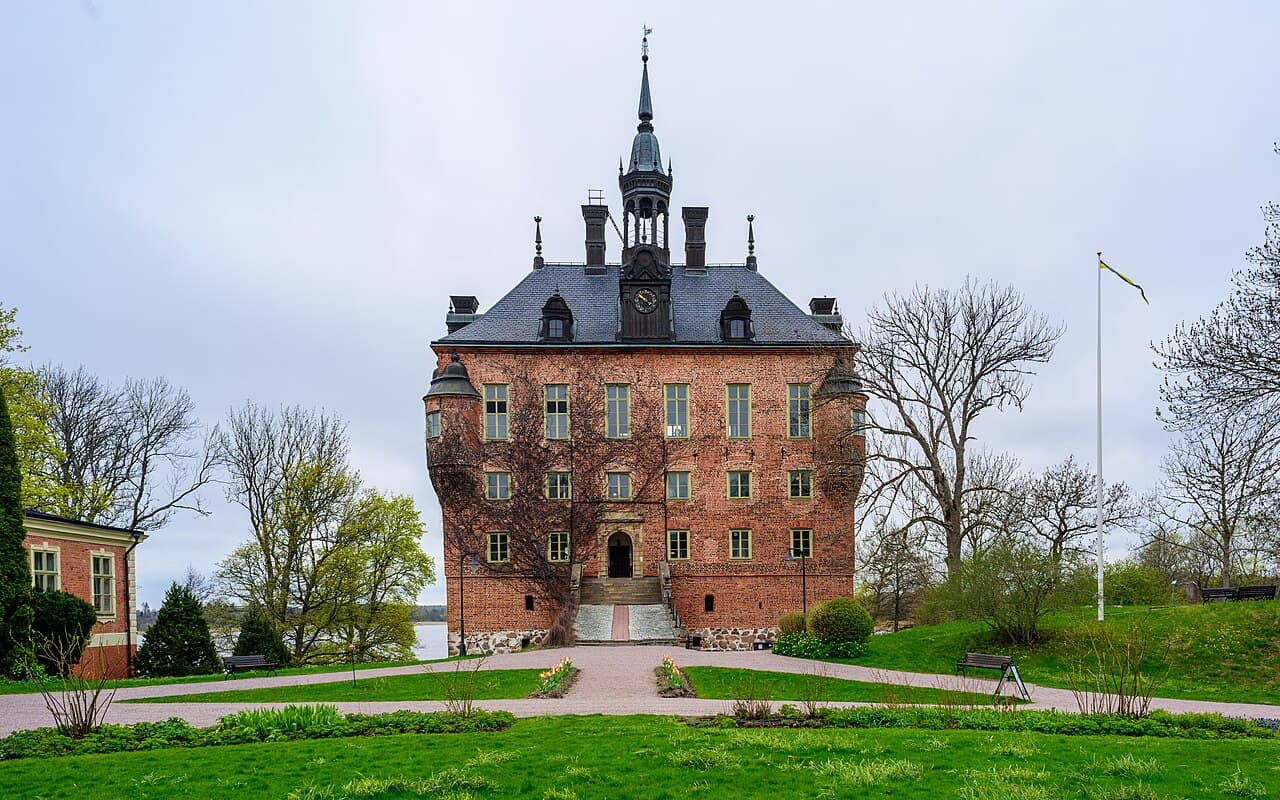
Wik Castle stands as one of the most well-preserved medieval castles in Sweden, prominently located near the northern shore of Lake Mälaren in the municipality of Uppsala. Its origins trace back to the late 13th century, with the estate first documented as the home of Ramborg Israelsdotter (And) and her husband Arvid Gustavsson (Sparre of Vik). The castle’s current imposing structure, featuring seven floors, was constructed around 1450 during the late medieval period. Built primarily of stone and brick, the fortress was designed as a large tower house with massive walls and surrounding moats, making it a formidable defensive stronghold in the Mälaren Valley.
Medieval origins and strategic importance
The initial construction phase of Wik Castle reflected the need for strong fortifications during a turbulent era in Scandinavian history. The castle’s defensive architecture typifies the late medieval style, with thick walls and a compact, vertical design that maximized protection. The site’s strategic location near Lake Mälaren allowed control over important waterways and trade routes, enhancing its military and economic significance.
Throughout the Middle Ages, Wik Castle was owned and expanded by several powerful noble families, including the Sparre, Bielke, Horn von Liewe, de Geer, and von Essen families. These lineages contributed to the castle’s development, adapting it to changing needs and tastes over centuries.
The siege by gustav vasa and military history
One of the most notable episodes in Wik Castle’s history occurred during the Swedish War of Liberation in 1521. The castle was besieged for over a year by Gustav Vasa, who later became the king of Sweden and a key figure in the country’s independence from Danish rule. Despite the prolonged siege, the castle’s defenders, led by Knut Nilsson (Sparre of Ellinge), successfully resisted, demonstrating the fortress’s impregnability and the effectiveness of its medieval fortifications.
17th-century transformation and architectural evolution
In the 17th century, Wik Castle underwent significant modifications that transformed its appearance and function. The castle was remodeled to reflect contemporary French architectural influences, shifting from a purely military fortress to a more comfortable and representational residence. This included the addition of wooden wings that expanded the living quarters and the creation of a landscaped park designed by architect Mathias Spihler around the 1670s. The park introduced formal gardens and leisure spaces, marking a departure from the castle’s original defensive purpose.
19th-century restoration and preservation efforts
During the 19th century, the castle’s exterior was restored under the direction of architect Fredrik Wilhelm Scholander between 1858 and 1860. Scholander’s work aimed to preserve the medieval character of Wik Castle while adapting it to the aesthetic preferences of the time. His restoration efforts helped maintain the castle’s structural integrity and enhanced its visual appeal, securing its status as a historical monument.
Ownership, cultural significance, and modern use
For over six centuries and 24 generations, Wik Castle remained in the hands of noble families until it was sold in 1912. In 1923, it was acquired by the Uppsala County Council, which repurposed the estate as a folk high school, thus integrating educational functions into the historic site. The castle is also notable as the birthplace of Svante Arrhenius, the Nobel Prize-winning chemist of 1903.
In the 1970s, the castle’s interiors hosted the ensemble Joculatores Upsalienses, who recorded medieval and Renaissance music there, highlighting Wik’s ongoing cultural relevance. Today, the castle is primarily used as a conference center with fifteen meeting rooms, including eight located within the medieval sections. Accommodation is provided in four hotel buildings on the estate, offering 86 to 88 beds. The surrounding grounds include a natural park with interpretive signage and recreational facilities such as a bathing area with piers.
Although Wik Castle is currently closed to the public, its designation as a Swedish national monument since 1982 underscores its importance as a heritage site that preserves a continuous narrative from its medieval origins to its modern adaptations.
Architectural features and castle complex
The core of Wik Castle is its medieval tower house, characterized by thick stone and brick walls, narrow windows for defense, and a vertical layout that rises to seven floors. The original defensive features include moats and battlements, which contributed to its reputation as an impregnable fortress during the Middle Ages.
The later additions of wooden wings in the 17th century introduced more spacious residential areas, reflecting the shift towards comfort and status display. The castle complex also contains several ancillary buildings that supported the estate’s operations, though detailed information on these structures is limited.
The landscaped park designed by Mathias Spihler complements the castle’s architecture by providing a formal garden setting, which was fashionable among European nobility in the 17th century. This park includes walking paths and leisure areas that enhance the estate’s aesthetic and recreational value.
Preservation and current condition
Wik Castle is classified as a well-preserved medieval castle, retaining much of its original fabric alongside later modifications. The 19th-century restoration has ensured the survival of key architectural elements, while modern use as a conference center has allowed the castle to remain functional without compromising its historical integrity.
Visitor information
While the castle is currently closed to the public, its grounds and park can be appreciated from the outside. The estate’s use for conferences and cultural events helps maintain its upkeep and promotes awareness of Sweden’s medieval heritage.
Frequently asked questions (FAQ)
- What is the historical significance of Wik Castle?
- Wik Castle is a well-preserved medieval fortress that played a key role during the Swedish War of Liberation, notably enduring a year-long siege by Gustav Vasa in 1521.
- Can I visit Wik Castle and its grounds?
- The castle itself is currently closed to the public, but visitors can view the castle grounds and landscaped park from outside. It is primarily used for conferences and cultural events.
- What architectural styles are represented in Wik Castle?
- Wik Castle features a blend of late medieval defensive architecture with 17th-century French-inspired modifications and 19th-century restoration elements.
- When was Wik Castle originally built?
- The main structure of Wik Castle was built around 1450 during the late medieval period, evolving from earlier medieval estate origins.
- Who owns Wik Castle today?
- Wik Castle is currently owned by the Uppsala County Council and is used primarily as a conference center.
- Are there any notable figures associated with Wik Castle?
- Yes, Wik Castle was the birthplace of Nobel laureate Svante Arrhenius and has been connected to several noble families over centuries.
Photo gallery

Information
Sources & official resources
Verify the information above using these authoritative references.
Loading map...
Visitor reviews
No reviews yet. Been here? Write the first review and help other travelers!
Write the first reviewVisited this castle? Share your experience
Your review helps other travelers and adds first-hand knowledge to our encyclopedia.