Skokloster Castle
Skokloster Castle stands as a remarkable example of Baroque architecture in Sweden, built between 1654 and 1676 during the country's Age of Greatness. Commissioned by the influential military commander and nobleman Count Carl Gustaf Wrangel, the castle was designed by the eminent architect Nicodemus Tessin the Elder. Situated on the Skohalvön peninsula by Lake Mälaren, the castle exemplifies the grandeur and ambition of 17th-century Swedish nobility.
The castle's construction halted abruptly upon Wrangel's death in 1676, leaving the grand banquet hall unfinished. This incomplete state offers a unique glimpse into 17th-century building techniques, preserved with original tools and materials. Ownership passed through the Wrangel, Brahe, and later the von Essen families, until the Swedish government acquired it in 1967. Since then, Skokloster has been maintained as a museum, showcasing its exceptional collections and architecture.
Architectural design and layout
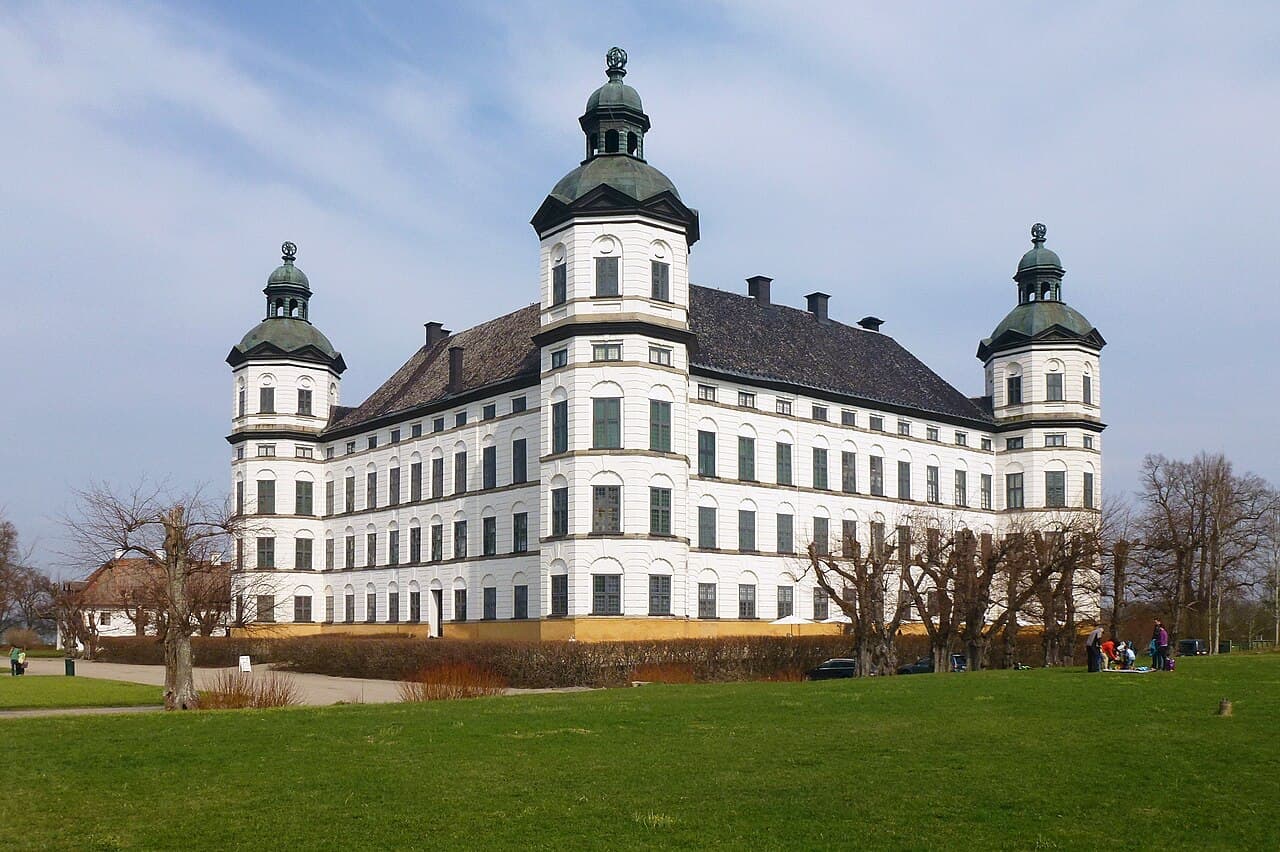
The castle follows a precise square plan measuring approximately 44.5 meters on each side, with four wings enclosing a central courtyard. The courtyard features patterned stone paving and a water drainage system directing runoff to a central well. The structure's walls are constructed of brick on a granite foundation, with thickness varying from one meter at the base to about half a meter in the attic, demonstrating sophisticated engineering for stability.
Each wing rises three stories, with large windows arranged in eleven axes per side, allowing ample natural light. At the corners are distinctive five-story octagonal towers capped with copper-clad spires, lanterns, and decorative globes, inspired by the Ujazdów Palace in Warsaw. These towers remain unique in Swedish architecture. The roof is covered with black glazed tiles originally imported from Holland, supplemented in restoration by handmade Polish tiles.
Interior spaces and decoration
Inside, the castle houses seventy-seven rooms serving various functions. The cellar was dedicated to storage, while the ground floor contained kitchens, staff quarters, and additional storage. The noble residence occupied the second floor, featuring lavish suites used by the Wrangel and Brahe families. The King's Hall is a highlight, adorned with a polychrome stucco ceiling depicting mythological scenes painted by Hans Zauch in the 1660s. The hall also includes a finely carved wooden fireplace by Markus Hebel, a tiled stove with relief decorations by Hindrich Thim, and a rare Baroque chandelier from 1672 crafted by Melchior Jung.
The third floor contains guest rooms and the unfinished banquet hall, which spans 325 square meters with a ceiling height of 15 meters. The hall's roof structure is notable for its exposed massive pine trusses and copper tile waterproofing, a construction technique unique in Sweden. Woodwork such as doors, windows, and fireplaces were crafted by Stockholm workshops and transported to the site. Windowpanes were imported from Pommern, carefully cut and set in lead supports.
Skokloster features twenty-one carved wooden fireplaces, twelve attributed to Markus Hebel, with painted decorations by Johan Malchow. Several ceramic tile stoves, or kakelugnar, built between 1669 and 1674, remain functional today. The castle's inner courtyard is surrounded by an arcade gallery providing sheltered walkways, and external decoration is restrained, limited to the Wrangel family coat of arms and a gilded wooden trophy crown carved by Hebel in 1657 facing the lake.
Historical context and ownership
Skokloster Castle was constructed during a period when Sweden was a dominant European power, known as the Swedish Age of Greatness. Count Carl Gustaf Wrangel, a leading military figure and statesman, initiated the project to reflect his status and the nation's ambitions. The castle's location on the shores of Lake Mälaren was strategically chosen for its natural beauty and defensive advantages.
Following Wrangel's death, the castle passed to the Brahe family through marriage. The Brahes used Skokloster primarily as a summer residence and did not complete the interiors, leaving the banquet hall in its halted state. In the 20th century, the property was inherited by the von Essen family, who resided there until selling it to the Swedish government in 1967.
Since becoming a state-owned museum, Skokloster has undergone careful restoration using period-appropriate materials and techniques to preserve its authenticity. The castle offers a rare, intact example of 17th-century aristocratic life and architecture. Its unfinished banquet hall is unique in Europe as a preserved historical construction site.
Collections and cultural significance
Skokloster Castle houses one of the world's most significant collections of 17th-century military weapons, originating from Wrangel's personal armory and expanded by later aristocratic bequests, including those from Carl Gustaf Bielke. The collection includes muskets, pistols, swords—including rare Japanese samurai swords—small cannons, pikes, and crossbows. Exotic items such as a 16th-century Eskimo canoe and snake skins add to the collection's uniqueness.
The castle's library is another highlight, containing an extensive range of books from the 17th and 18th centuries, reflecting the intellectual interests of its noble owners. The portrait gallery features around 600 paintings, including works by notable artists such as David Klöcker Ehrenstrahl, Matthäus Merian, Abraham Wuchters, and the Italian master Giuseppe Arcimboldo. One of the most famous paintings is Arcimboldo's Vertumnus, depicting Holy Roman Emperor Rudolf II as the Roman god of the seasons, created using fruits and vegetables. This painting was stolen in Prague in the 17th century and later acquired by Skokloster.
The castle also preserves the original scale model made by architect Nicodemus Tessin the Elder in 1657, used to present the design to Count Wrangel. This model remains a valuable artifact illustrating the castle's architectural vision.
Garden and surrounding features
Skokloster's Baroque garden was only partially completed but includes a formal parterre and alleys lined with linden trees dating back to the late 17th century. Plans for a two-story lakeside pavilion and harbor, designed by architects Jean de la Vallée and Mathias Spihler, were never realized.
Nearby stands a medieval church that was once part of a 13th-century Cistercian nunnery. This church houses the Wrangel family burial chapel, connecting the castle to the region's earlier religious history and adding depth to its cultural heritage.
Preservation and visitor experience
Since its acquisition by the Swedish government, Skokloster Castle has been meticulously preserved as a museum. Restoration efforts have focused on maintaining original materials and construction methods, ensuring the castle's authenticity. The lack of modern heating has contributed to the remarkable preservation of textiles and furniture, likely due to the region's slow seasonal temperature changes.
Visitors to Skokloster can explore its extensive collections, including the armory, library, portrait gallery, and the unfinished banquet hall. The castle offers a unique opportunity to experience a 17th-century aristocratic residence with interiors largely unchanged since their creation. Guided tours provide insights into the castle's history, architecture, and notable artifacts.
Ongoing conservation projects ensure that Skokloster remains a vital cultural landmark, preserving the legacy of Sweden's Baroque era and its noble heritage for future generations.
Frequently asked questions (FAQ)
- When was Skokloster Castle built and by whom?
- Skokloster Castle was built between 1654 and 1676 by Count Carl Gustaf Wrangel, a prominent Swedish military leader.
- What architectural style characterizes Skokloster Castle?
- The castle is designed in the Baroque style, featuring distinctive octagonal towers and a square layout with a central courtyard.
- Can visitors see the unfinished banquet hall?
- Yes, the unfinished banquet hall is open to visitors and offers a unique glimpse into 17th-century construction techniques.
- What notable collections are housed in Skokloster Castle?
- The castle houses one of the world's largest collections of 17th-century military weapons, as well as a significant portrait gallery and library.
- How has the castle been preserved so well?
- The castle's preservation is attributed to the use of original materials and the region's slow seasonal temperature changes, despite the absence of modern heating.
- Is Skokloster Castle accessible year-round?
- The castle is generally open to visitors during the warmer months; specific opening times can vary, so checking ahead is recommended.
Photo gallery

Information
Sources & official resources
Verify the information above using these authoritative references.
Loading map...
Visitor reviews
No reviews yet. Been here? Write the first review and help other travelers!
Write the first reviewVisited this castle? Share your experience
Your review helps other travelers and adds first-hand knowledge to our encyclopedia.