Wijnendale Castle
Wijnendale Castle, known locally as Kasteel Wijnendale, is a historic hill castle located northwest of the city of Torhout in the province of West Flanders, Belgium. Founded at the end of the 11th century by Robert I, Count of Flanders, it originally served as a strategic military base. Over the centuries, the castle evolved from a fortified stronghold into a noble residence and hunting lodge, reflecting the shifting political and social landscapes of medieval and early modern Flanders.
Early history and medieval significance
The first construction of Wijnendale Castle was commissioned by Robert the Frisian, Count of Flanders, at the close of the 11th century. Its location on a natural hill in a dense forested area provided a strong defensive position, vital for controlling the surrounding territory. The castle is first mentioned in the 1127 diary of Galbert of Bruges, highlighting its early military importance.
During the 12th and 13th centuries, Wijnendale became a favored residence of the Counts of Flanders, especially Philip I, Count of Flanders. The castle was not only a military bastion but also a center for diplomacy and administration. In 1297, it hosted the signing of a treaty between Guy, Count of Flanders, and King Edward I of England, underscoring its role in international politics.
In 1298, ownership passed to the Counts of Namur, a cadet branch of the Dampierre family. The castle endured sieges in 1302 and 1325 during regional conflicts but was rebuilt after each assault. It remained a noble residence until the mid-14th century and is believed to have been the childhood home of Blanche of Namur, future Queen of Sweden.
Transition to burgundian and cleves ownership
After a period of decline, the castle was sold in 1407 to John the Fearless, Duke of Burgundy. In 1410, it was given as part of the dowry to Adolf IV, Duke of Cleves, through his marriage to Marie of Burgundy, daughter of John the Fearless. This transfer marked the castle's integration into the influential House of Cleves.
In 1463, Wijnendale passed to the Lords of Ravenstein, a junior branch of the Cleves family. Under Adolph of Cleves, Lord of Ravenstein, and his son Philip of Cleves-Ravenstein, the castle was transformed from a fortress into an elegant mansion and hunting lodge. Notably, Marie of Burgundy and her son Philip the Handsome were frequent guests. The castle was the site of Marie's tragic death in 1482 after a horse-riding accident in the nearby forest.
Renaissance and early modern challenges
By 1528, the castle returned to the Dukes of Cleves. It hosted prominent figures such as Emperor Charles V and Mary of Hungary, Governor of the Habsburg Netherlands. Despite its importance, the Dukes gradually lost interest in their Flemish estates during the 16th century. The castle suffered damage in 1578 when Protestants set fire to parts of it during religious conflicts, including the destruction of the donjon (main tower).
The death of Duke John William of Cleves in 1609 without heirs triggered the War of the Jülich Succession, with Wijnendale becoming a contested asset. In 1614, it was granted to Wolfgang Wilhelm, Count Palatine of Neuburg. Throughout the 17th century, the castle endured multiple attacks and occupations, especially during the wars of Louis XIV. In 1690, French troops blew up parts of the castle, including the bridge, chapel, and prison.
Reconstruction efforts around 1700 by Johann Wilhelm, Elector Palatine restored the castle, including a new brick access bridge. The nearby Battle of Wijnendale in 1708, part of the War of Spanish Succession, caused widespread devastation in the area but spared the castle from major damage. During the 17th and 18th centuries, the castle served as the residence of the lordship's governor, with the Palatinate-Neuburg dukes managing it primarily as a source of income.
French revolution and 19th-century restoration
The French Revolutionary invasion in 1792 ended feudal control, and the castle was confiscated by the French state. It was reportedly used as an inn before suffering severe damage from Napoleonic troops in 1811, leaving it in ruins. In 1825, a Walloon industrial group acquired the estate, clearing much of the surrounding forest for mining purposes, but later went bankrupt.
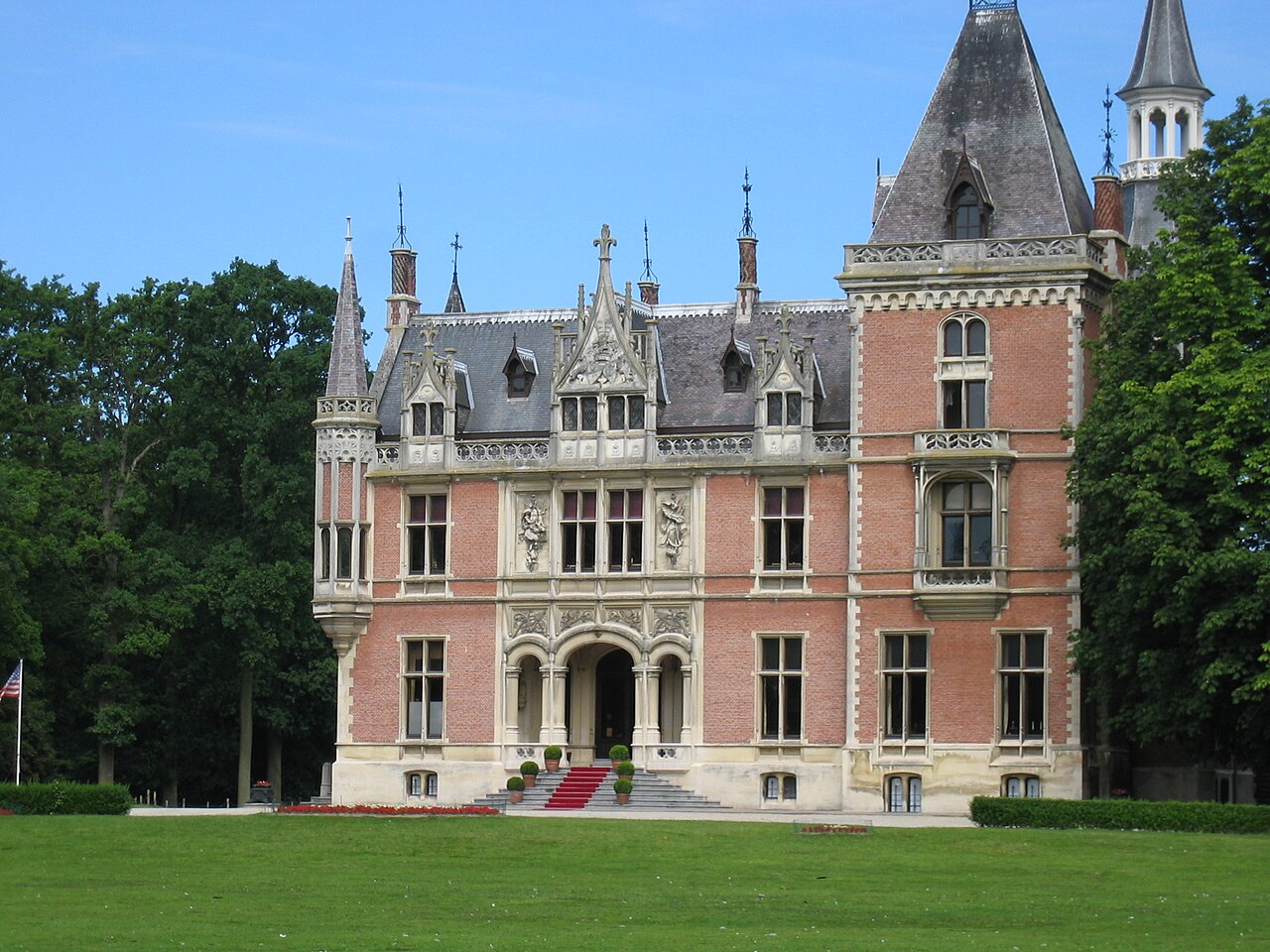
In 1833, banker Josse-Pierre Matthieu purchased Wijnendale Castle and its domain. Between 1837 and 1852, he undertook extensive rebuilding, preserving the late medieval northern wing. His son, Joseph Louis Matthieu, further remodeled the castle in 1877, hiring architect Félix Laureys to create a romanticized medieval-style residence. This renovation added two tall towers and a militaristic gatehouse inspired by 17th-century designs, giving the castle its present neo-Gothic appearance.
20th century and modern-day significance
On 25 May 1940, during the Nazi invasion of Belgium, King Leopold III held a crucial meeting with his government ministers at Wijnendale Castle. This event was pivotal in the post-war Royal Question concerning the king's wartime conduct. The castle remains privately owned by the Matthieu family, who adopted the name Matthieu de Wynendaele in 1953.
Today, the castle is partly a private residence and partly a museum open to the public during summer months. The 15th-century northern wing remains inhabited, while other sections showcase the castle's rich history through carefully preserved rooms and exhibitions. The surrounding estate, including the forest and village landscape, is protected as a cultural heritage site since the 1980s.
Architectural features and layout
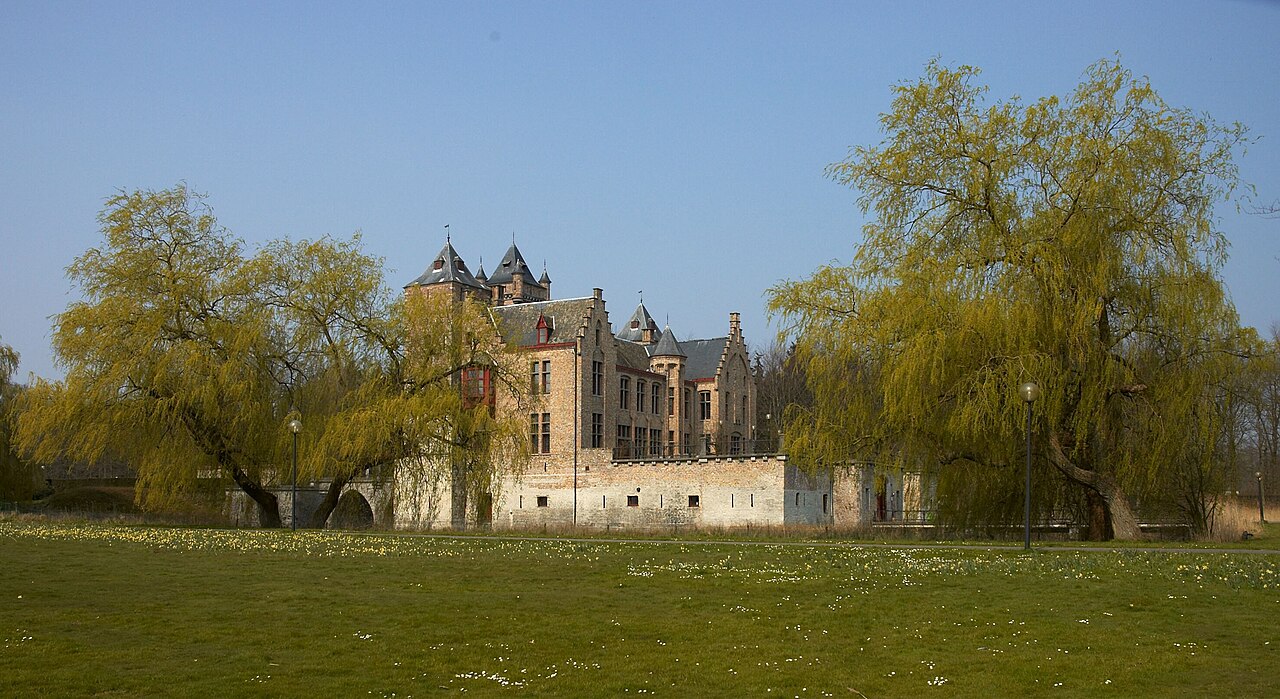
Wijnendale Castle is classified as a hill castle, strategically positioned on elevated terrain surrounded historically by dense forests. The castle complex includes a water-filled moat, typical of medieval defensive architecture, although much of the current structure reflects 19th-century restoration efforts.
The oldest surviving part is the 15th-century northern wing, constructed with gray stone and featuring traditional medieval masonry. The 19th-century renovations introduced neo-Gothic elements, including two prominent towers flanking the main building and a gatehouse with a militaristic design inspired by 17th-century fortifications.
The castle grounds contain additional historic features such as a chapel, rebuilt after destruction in the late 17th century, a brick access bridge, and remnants of an icehouse and greenhouses dating from the 19th century. The surrounding forest once served as a hunting ground and remains integral to the castle's heritage landscape.
Visiting wijnendale castle
Visitors to Wijnendale Castle can explore the museum wing, which offers a glimpse into the castle's layered history through period rooms and exhibitions. The castle is accessible from Torhout city center and is surrounded by scenic woodland ideal for hiking and historical tours.
The castle opens to the public during the summer months, with guided tours available to enrich understanding of its architectural evolution and historical significance. The Matthieu family residence is private, but the museum provides a comprehensive view of the castle's noble past and its role in Belgian history.
Frequently asked questions
- When was Wijnendale Castle originally built? The castle was founded at the end of the 11th century by Robert I, Count of Flanders, as a military stronghold.
- What architectural styles are present at Wijnendale Castle? The castle combines medieval stone masonry in its 15th-century northern wing with 19th-century neo-Gothic restoration features.
- Can visitors tour Wijnendale Castle? Yes, part of the castle operates as a museum open to the public during summer months, showcasing historical rooms and artifacts.
- Who owns Wijnendale Castle today? The castle remains private property of the Matthieu de Wynendaele family, descendants of the 19th-century restorers.
- What historical events took place at Wijnendale Castle? It hosted treaty signings, noble residences, and a key WWII meeting involving King Leopold III and his ministers.
- Is Wijnendale Castle protected as a heritage site? Yes, the castle and its surrounding estate have been protected as a cultural landscape and monument since the 1980s.
Frequently asked questions (FAQ)
- When was Wijnendale Castle originally built?
- The castle was founded at the end of the 11th century by Robert I, Count of Flanders, as a military stronghold.
- What architectural styles are present at Wijnendale Castle?
- The castle combines medieval stone masonry in its 15th-century northern wing with 19th-century neo-Gothic restoration features.
- Can visitors tour Wijnendale Castle?
- Yes, part of the castle operates as a museum open to the public during summer months, showcasing historical rooms and artifacts.
- Who owns Wijnendale Castle today?
- The castle remains private property of the Matthieu de Wynendaele family, descendants of the 19th-century restorers.
- What historical events took place at Wijnendale Castle?
- It hosted treaty signings, noble residences, and a key WWII meeting involving King Leopold III and his ministers.
- Is Wijnendale Castle protected as a heritage site?
- Yes, the castle and its surrounding estate have been protected as a cultural landscape and monument since the 1980s.
Information
Opening hours
Summer months, guided tours available
Ticket prices
€5 adult, €3 child
Current owner
Private owner
Website
Visit websiteSources & official resources
Verify the information above using these authoritative references.
Loading map...
Visitor reviews
No reviews yet. Been here? Write the first review and help other travelers!
Write the first reviewVisited this castle? Share your experience
Your review helps other travelers and adds first-hand knowledge to our encyclopedia.