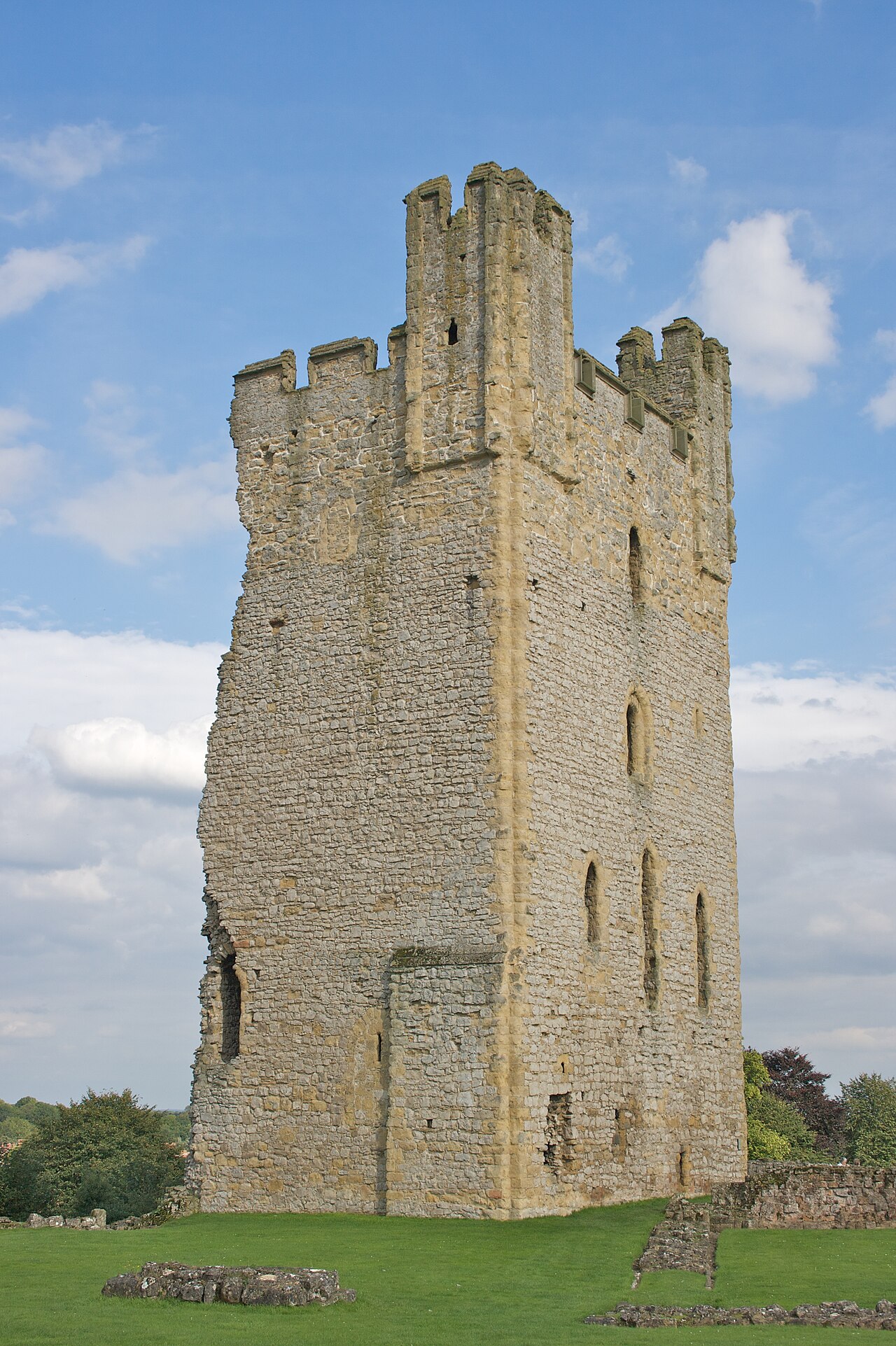
Whorlton Castle
Whorlton Castle stands as a significant example of Norman military architecture in North Yorkshire, England. Originally constructed in the early 12th century by the de Meynell family, this motte-and-bailey castle was strategically positioned on a small hill overlooking the Tees Valley and an important medieval road between Thirsk and Stokesley. Its location on the western edge of the North York Moors provided commanding views and a defensive advantage against Saxon incursions and local unrest during the turbulent High Medieval period.
The estate was first recorded in the Domesday Book of 1086 as belonging to Robert, Count of Mortain, half-brother to William the Conqueror. The initial fortification was a wooden structure set atop a large earthen motte approximately 60 by 50 meters in size, surrounded by a wide ditch and outer bank. This early castle typified the Norman approach to rapid fortification using earth and timber before stone structures were erected.
Norman origins and early medieval development
The original motte-and-bailey design at Whorlton Castle featured a large motte encircled by a deep dry ditch up to 20 meters wide and 5 meters deep, with an outer bank rising to 2.5 meters. The bailey, or enclosed courtyard, lay adjacent to the motte and was protected by a moat and palisade. This configuration was typical for Norman castles built to establish control over newly conquered territories.
The Meynell family, who inherited the estate after Robert of Mortain, are credited with constructing this initial fortification in the 12th century. The castle's primary function was military and administrative, serving as a local stronghold to oversee the surrounding lands and control the key roadway.
Medieval decline and 14th-century rebuilding
By the mid-14th century, records from 1343 indicate that the original earth and timber castle had fallen into ruin. However, the site remained important enough to warrant substantial rebuilding. Lord Darcy of Knayth undertook a major reconstruction project that involved leveling the motte and replacing the timber defenses with stone structures, including a prominent stone gatehouse and a tower house.
The gatehouse, which survives today as the most intact part of the castle, was built using finely cut ashlar sandstone. It features two large segmental-arched entrances facing east and west, narrow cross-shaped windows for defense and light, and heraldic shields carved above the main entrance representing the Darcy, Meynell, and Gray families. The gatehouse was equipped with portcullises operated by winches, with grooves still visible in the walls.
Internally, the gatehouse contained vaulted passageways, guardrooms within the thick walls, and a great hall on the upper floor with fireplaces, indicating its dual defensive and residential function. Access to the upper levels was via a spiral staircase housed in a projecting tower on the northwest side.
The Darcy and Strangeways families
The Darcy family retained ownership of Whorlton Castle until 1418, when it passed to Elizabeth Darcy and her husband Sir James Strangeways. The Strangeways family held the castle through the 15th and early 16th centuries. During this period, the castle saw continued use, though by the early 1600s it was described as old and partly in decay.
Later modifications and decline
In the late 16th or early 17th century, the Lennox family, who acquired the castle through royal grant from King Henry VIII, added a two-storey residential building adjoining the northwest end of the gatehouse. This structure is documented in a 1725 sketch but no longer survives, with only the roofline outline visible on the gatehouse walls today.
The castle's ownership passed through several hands, including the Bruce family in the 17th century and later James Emerson in the 19th century, who removed stone from the site for local building projects. By the 20th century, the castle was recognized for its historic value and was designated a Grade I listed building in 1928.
Architectural remains and landscape features
Today, Whorlton Castle's most prominent surviving feature is the mid-14th-century gatehouse, a sandstone structure measuring approximately 18 by 10 meters with walls up to 8.5 meters high. The gatehouse remains roofless but retains much of its original form, including the entrances, windows, heraldic carvings, and internal vaulted chambers.
On the western side of the bailey, remnants of the original stone keep survive primarily as vaulted Norman cellars measuring up to nine by four meters. These underground chambers were historically repurposed as pigsties and remain accessible despite overgrowth.
The castle is surrounded by earthworks, including the large motte with its encompassing ditch and outer bank, medieval plough marks in the surrounding fields, and two late medieval ornamental gardens enclosed by low banks. A large rectangular pond nearby may have served as a fish pond, though its exact purpose remains uncertain. To the south, the remains of a deer park highlight the site's connection to medieval hunting traditions.
Conservation and heritage status
Whorlton Castle, along with the deserted medieval village of Whorlton, is a scheduled ancient monument, reflecting its archaeological and historical significance. Despite conservation efforts, the gatehouse remains on the Heritage at Risk Register due to weathering and vandalism. Repairs carried out in the 1960s by the Ministry of Works helped stabilize the structure, though plans for residential conversion have not been realized.
The castle's enduring presence offers valuable insight into Norman military architecture, medieval noble residences, and the evolution of fortifications from timber to stone. It remains an important cultural landmark in the region, attracting historians, archaeologists, and visitors interested in England's medieval heritage.
Frequently asked questions (FAQ)
- What is the historical significance of Whorlton Castle?
- Whorlton Castle is a medieval fortress dating back to the 12th century, serving as a stronghold for the de Percy family. Its ruins offer a glimpse into the feudal history of England and the architectural styles of the period, making it an important site for those interested in the medieval era.
- When was Whorlton Castle built?
- Construction of Whorlton Castle began in the 12th century, around the year 1170. It was established during a time of Norman expansion in England and has since become a notable example of early medieval defensive architecture.
- Can I visit Whorlton Castle?
- Yes, Whorlton Castle is open to visitors. While the site is primarily in ruins, it offers a unique opportunity to explore its historical remnants and enjoy the surrounding natural beauty.
- What are the opening hours for Whorlton Castle?
- Whorlton Castle is generally open to the public year-round, but specific opening hours may vary seasonally. It is advisable to check the local tourism website for the most current visiting times before planning your trip.
- Is it possible to access Whorlton Castle with mobility aids?
- Access to Whorlton Castle can be challenging due to uneven terrain and the nature of the ruins. Visitors with mobility aids should prepare for some difficulties, but there are areas around the castle that can be enjoyed with careful navigation.
- What is the best time to visit Whorlton Castle?
- The best time to visit Whorlton Castle is during the spring and early autumn months when the weather is mild and the surrounding countryside is in full bloom. This allows for a more pleasant experience while exploring the ruins and enjoying the scenic views.
- Are there any nearby attractions to visit?
- Yes, there are several attractions near Whorlton Castle, including the picturesque village of Whorlton and the stunning North York Moors National Park. These locations offer additional opportunities for hiking, sightseeing, and enjoying the natural landscape.
- What are the ticket prices for visiting Whorlton Castle?
- Whorlton Castle is a free-to-visit site, allowing everyone to explore its historical ruins without an admission fee. However, donations to support the preservation of the castle and its grounds are always appreciated.
Information
Loading map...
Visitor reviews
No reviews yet. Been here? Write the first review and help other travelers!
Write the first reviewVisited this castle? Share your experience
Your review helps other travelers and adds first-hand knowledge to our encyclopedia.