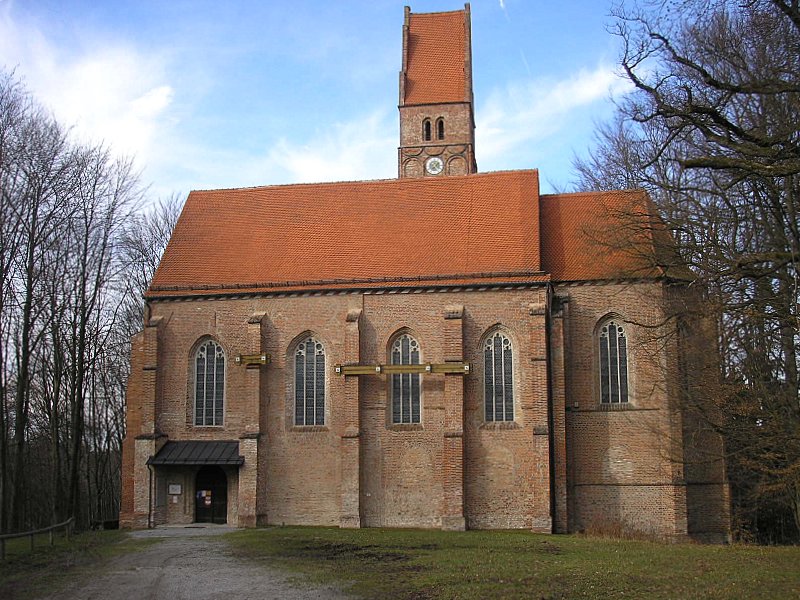
Wasserschloss Sandizell
Wasserschloss Sandizell stands as a remarkable example of a Renaissance water castle in the municipality of Schrobenhausen, Bavaria, Germany. Its origins stretch back over a thousand years, initially documented in the year 1007 as a property belonging to the Benedictine nunnery of Neuburg an der Donau. This early medieval estate served as an economic holding for the religious community, marking the site’s longstanding significance in regional history.
By the mid-15th century, specifically in 1464, the estate had evolved into a fortified manor or Hofmark, controlled by the noble Sandizell family. This status granted the family local jurisdiction and a measure of military authority, reflecting the feudal structures of the time. Around 1580, the manor underwent a significant transformation into a three-winged Renaissance castle, aligning with contemporary architectural trends that emphasized symmetry, proportion, and the integration of defensive and residential functions.
Architectural evolution and features
Renaissance origins and layout
The original Renaissance structure of Wasserschloss Sandizell was composed of three wings—east, west, and south—arranged around a central courtyard. The south wing was particularly notable for its four-bay bridge, which provided a grand entrance leading visitors to the main hall. This design combined elements of fortification with the aesthetic and functional demands of a noble residence. The castle’s designation as a Wasserschloss, or water castle, is due to its surrounding water-filled moat, which served both defensive purposes and enhanced the estate’s picturesque setting.
Destruction and restoration
The castle’s history was marked by significant turmoil during the Thirty Years’ War (1618–1648). In this conflict, Swedish troops set fire to the complex, resulting in the destruction of most of the Renaissance buildings. Only the eastern wing of the original structure survived the devastation, becoming the foundation for later restoration efforts.
Between 1749 and 1755, the castle underwent a comprehensive rebuilding led by architect Johann Puchtler from Neuburg. This renovation introduced important features such as a two-story chapel integrated into the center of the southern wing, underscoring the importance of religious devotion and family legacy. Additionally, a gate tower was constructed in 1763, enhancing the castle’s fortified appearance despite its primarily residential role in this period.
Historical significance and notable events
The war of the spanish succession
Wasserschloss Sandizell holds a notable place in European military history. In 1704, during the War of the Spanish Succession, the castle served as the venue for a war council convened by two of the era’s most prominent commanders: Eugene of Savoy and John Churchill, Duke of Marlborough. This meeting preceded the decisive Battle of Blenheim (also known as the Battle of Höchstädt), which marked a turning point in the conflict and altered the balance of power in Europe.
Continuity of noble ownership
The castle has remained inhabited and cared for throughout its history. Presently, ownership is divided between two parties: the western half is held by Nikolaus Count of and to Sandizell, a direct descendant of the original noble family, while the eastern section was acquired and restored by the Jaeck family in 1970. This division reflects both the preservation of heritage and adaptive reuse, with parts of the castle occasionally rented for events, blending private residence with limited public accessibility.
Adjacent hofmarkkirche and artistic heritage
Next to the castle lies the Hofmarkkirche, or parish church of St. Peter, constructed beginning in 1735 with its tower completed in 1756 by court architect Leonhard Matthäus Giessl. The church is closely linked to the castle, connected via a passage to the castle park. It serves as the burial site of the Sandizell family, reinforcing the intertwined spiritual and noble presence in the area.
Inside the church, visitors can admire the high altar crafted by Egid Quirin Asam, a masterpiece of Baroque art. The funerary monuments of the Sandizell counts further emphasize the church’s role as a site of family remembrance and regional heritage.
Landscape and archaeological importance
The castle is surrounded by a moat filled with water, a defining characteristic of a Wasserschloss. The grounds include a castle park redesigned in the 1870s as an English-style landscape garden, which, although private and not open to the public, contributes to the estate’s historic ambiance.
Archaeological investigations have confirmed the site’s significance, uncovering medieval and early modern remains that are protected as cultural heritage. The castle itself is officially listed as a protected monument, ensuring ongoing conservation of its historic fabric and associated archaeological findings.
Architectural style and classification
Wasserschloss Sandizell is best classified as a hill castle due to its elevated position and defensive moat. Its primary architectural style is Renaissance, evident in its original three-winged layout and proportional design. The subsequent 18th-century renovations introduced Baroque elements, especially visible in the chapel and gate tower, blending styles while preserving the castle’s historic character.
Today, the castle stands as a well-preserved and partially restored monument, reflecting centuries of architectural evolution, noble lineage, and historical events that shaped the region.
Frequently asked questions (FAQ)
- When was Wasserschloss Sandizell originally built?
- Wasserschloss Sandizell was first recorded in 1007 as a property of a Benedictine nunnery, with significant construction phases in 1464 and around 1580.
- What architectural style characterizes Wasserschloss Sandizell?
- The castle primarily exhibits Renaissance architecture from its 16th-century expansion, with later Baroque additions from the 18th century.
- Is Wasserschloss Sandizell open to the public?
- The castle is privately owned and partially used for events, so public access is limited and usually by special arrangement.
- What historical events are associated with Wasserschloss Sandizell?
- The castle hosted a war council in 1704 during the War of the Spanish Succession involving Eugene of Savoy and John Churchill, Duke of Marlborough.
- What are the notable features of the adjacent Hofmarkkirche?
- The Hofmarkkirche of St. Peter features a Baroque high altar by Egid Quirin Asam and serves as the burial site of the Sandizell family.
Information
Architect
Johann Puchtler
Current owner
Nikolaus Count of and to Sandizell, Jaeck family
Website
Visit websiteSources & official resources
Verify the information above using these authoritative references.
Loading map...
Visitor reviews
No reviews yet. Been here? Write the first review and help other travelers!
Write the first reviewVisited this castle? Share your experience
Your review helps other travelers and adds first-hand knowledge to our encyclopedia.