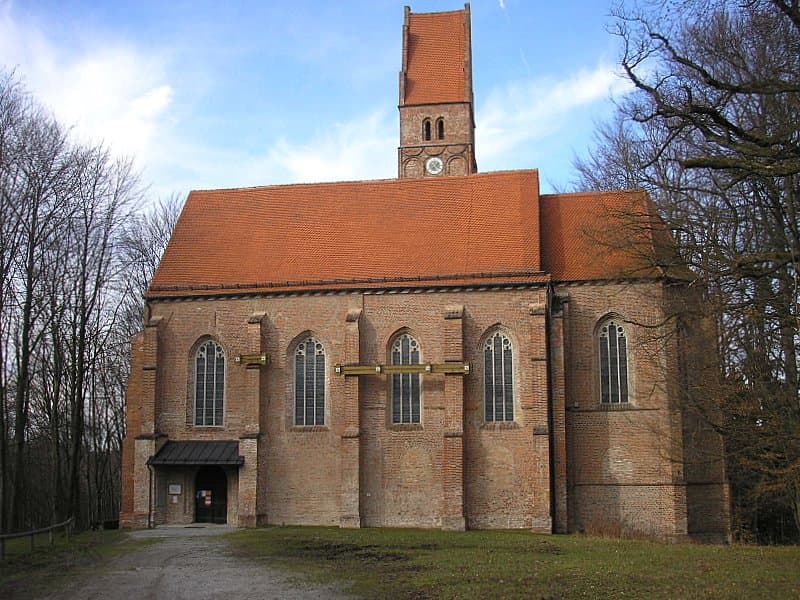
Burg Wittelsbach
Wittelsbach Castle (German: Burg Wittelsbach) holds a significant place in German medieval history as the ancestral seat of the House of Wittelsbach, a dynasty that later provided Electors and Kings of Bavaria as well as Electors of the Palatinate. Situated near Aichach in Bavarian Swabia, the castle's origins trace back to the 10th century, making it a notable example of an early medieval hill castle.
Historical background and significance
The castle was first documented around the year 1000 AD, with its name appearing as "Witilinesbac" in a document issued by Emperor Henry V in 1115. This document identifies the castle as the place of origin of Otto IV, Count of Scheyern. By 1119, Otto IV had relocated to Wittelsbach Castle, transforming his previous residence into the Scheyern Abbey. This move marked the beginning of the castle's prominence as the power base for the Counts of Scheyern, who from 1120 onward held the title of Counts Palatine of Wittelsbach.
The castle thus became the ancestral seat of the Wittelsbach family, a dynasty that played a central role in Bavarian and German history for centuries. The family's rise to prominence was closely linked to this castle, which served as a symbol of their territorial and political power in the region.
Architecture and archaeological findings
As a hill castle, Wittelsbach Castle was strategically positioned to command the surrounding landscape, typical of early medieval fortifications designed for defense and control. Although no substantial architectural remains survive today, archaeological excavations conducted between 1978 and 1980 revealed important insights into the castle's structure and fate.
Contrary to local tradition, which holds that the castle was destroyed in 1209 following the murder of King Philip of Swabia by Count Otto of Wittelsbach, the excavations found no evidence of a violent or sudden destruction. Instead, the findings suggest that the castle was gradually abandoned and that its stone walls were later quarried for building materials. This indicates a peaceful decline rather than a catastrophic end.
Later developments and legacy
In the 15th century, a Gothic church dedicated to the Beatae Mariae Virginis was constructed on the former castle site. This church remains standing and became the focal point for the development of the village of Oberwittelsbach (Upper Wittelsbach). The church's presence marks the transition of the site from a military stronghold to a religious and community center.
In 1834, the Wittelsbach family commemorated their ancestral seat by erecting a monument at the castle's former location. The surrounding area, now part of the Aichach-Friedberg district, is often referred to as Wittelsbacher country in honor of the family's historical influence.
Nearby, in the village of Unterwittelsbach (Lower Wittelsbach), a castle built in 1537 on the site of an older medieval fortress was acquired in 1838 by Duke Maximilian Joseph in Bavaria, father of Empress Elisabeth of Austria. This castle remained in the hands of the junior ducal branch of the Wittelsbach family until 1955 and now operates as a museum dedicated to Empress Elisabeth, further extending the family's cultural heritage in the region.
Cultural and historical importance
Wittelsbach Castle's role as the founding seat of one of Germany's most influential noble families underscores its importance in the medieval political landscape. The castle's connection to key historical figures and events, including the Counts Palatine and the controversial murder of King Philip of Swabia, situates it within the broader narrative of German and Bavarian history.
Although the castle itself no longer stands, its legacy is preserved through the church on its site, the nearby museum, and the enduring name of the Wittelsbacher country. These elements together maintain the memory of the castle's significance and the dynasty it birthed.
Frequently asked questions (FAQ)
- When was Wittelsbach Castle first mentioned in historical records?
- Wittelsbach Castle was first mentioned around the year 1000, with its name appearing in a 1115 document by Emperor Henry V.
- What led to the abandonment of Wittelsbach Castle?
- Archaeological evidence suggests the castle was gradually abandoned and its stones quarried, rather than destroyed violently as local tradition claims.
- What stands on the site of Wittelsbach Castle today?
- A Gothic church dedicated to Beatae Mariae Virginis, built in the 15th century, now stands on the former castle site and is the center of the village Oberwittelsbach.
- Is there a museum related to the Wittelsbach family nearby?
- Yes, in Unterwittelsbach, a nearby village, a castle built in 1537 now houses a museum dedicated to Empress Elisabeth of Austria, a member of the Wittelsbach family.
Photo gallery

Photo by No machine-readable author provided. Dark Avenger~commonswiki assumed (based on copyright claims).•CC BY-SA 3.0
Information
Loading map...
Visitor reviews
No reviews yet. Been here? Write the first review and help other travelers!
Write the first reviewVisited this castle? Share your experience
Your review helps other travelers and adds first-hand knowledge to our encyclopedia.


