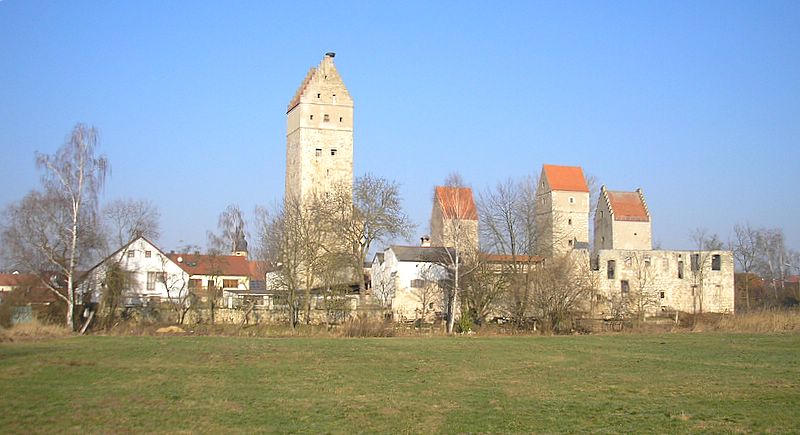
Schloss Neuburg
Schloss Neuburg stands as a remarkable testament to the layered history of Bavaria, Germany, tracing its origins back to a late Roman imperial fortress known as Venaxamodurum. Located on the western edge of the city hill in Neuburg an der Donau, this hill castle site evolved through centuries of political, religious, and architectural transformation. Its strategic position overlooking the Danube River made it a pivotal military and administrative center from Roman times through the medieval period and into the Renaissance.
The site’s initial fortification by the Romans laid the groundwork for subsequent medieval and Renaissance developments. Following the decline of Roman authority, the Agilolfing dynasty established an early medieval castle here, marking the location’s transition from imperial military outpost to a noble residence. By the late 8th century, under Bishop Simpert of Augsburg (778–809), Schloss Neuburg had gained ecclesiastical significance as the seat of a bishopric, underscoring its dual role in religious and secular governance.
Medieval origins and Wittelsbach ownership
During the 10th century, control of the castle passed to the Counts of Scheyern, ancestors of the Wittelsbach family, who were instrumental in shaping Bavarian history. By 1247, the Wittelsbach dukes firmly held Neuburg, intermittently using it as a residence. The castle’s medieval form was primarily a fortified stronghold designed for defense and administration, featuring typical elements such as thick curtain walls and a commanding position on the hill.
Renaissance transformation under the Palatinate-Neuburg dukes
The castle’s most significant architectural evolution occurred after the Landshut War of Succession (1503–1505), which led to the creation of the Duchy of Palatinate-Neuburg with Neuburg as its capital. Beginning in 1527, Count Palatine Ottheinrich initiated an ambitious program to convert the medieval fortress into a Renaissance palace. This transformation reflected the Renaissance ideals of harmony, proportion, and decorative richness, moving away from purely military architecture toward a representation of ducal power and cultural sophistication.
Despite financial difficulties culminating in Ottheinrich’s bankruptcy in 1544, construction and decoration continued under his successor, Wolfgang of Zweibrücken. The palace became renowned for its sgraffito façade decorations added in 1562, illustrating biblical themes such as the story of Joseph and his brothers. These artworks served as allegories for righteous rulership and the resilience of the Protestant faith, reflecting the religious shifts of the period.
The castle chapel: a pioneering Protestant interior
One of Schloss Neuburg’s most historically significant features is its castle chapel, constructed in 1543 following Ottheinrich’s conversion to Lutheranism. Consecrated by the Reformer Andreas Osiander, it is among the earliest surviving Protestant church interiors worldwide. The chapel’s decoration includes an innovative Lutheran iconographic program painted by Hans Bocksberger the Elder, a Salzburg artist, and features a remarkable stone retable depicting the crucifixion, completed in 1542. The interior retains its original wooden coffered ceiling extending into the roof framework and Italian-influenced frescoes that emphasize Protestant theological themes.
Architectural layout and notable features
The palace complex is arranged around a central courtyard, with distinct wings reflecting various phases of construction and stylistic influences. The Ottheinrichbau or west wing, named after its founder, houses the castle chapel and features the famous sgraffito decoration on its courtyard façade. The north wing, built between 1534 and 1538, contained baths, dining halls, and residential apartments, originally including a large open terrace likely used as a garden space. This wing’s Knights’ Hall preserves original furnishings from 1575, including a wooden coffered ceiling and wall paneling by Hans Pihel.
The east wing was remodeled in the Baroque style in 1665 under Duke Philipp Wilhelm, who added two round towers. These towers later accommodated notable residents such as Duchess Amalie and King Max I. Other features of the complex include a 16th-century hall framing the courtyard, a courtroom on the west wing’s ground floor, a decorative shell grotto, and collections of hunting trophies, all contributing to the palace’s rich interior character.
Roofing and exterior elements
The castle’s roofing, dating from circa 1590 to 1600, is distinguished by its gabled design with ornate volutes and dormer windows, exemplifying late Renaissance architectural detailing. Outside the city walls, a formal courtyard garden was established in 1529, complemented by the nearby hunting lodge Grünau, constructed in 1530, highlighting the ducal lifestyle and leisure pursuits.
Later history and adaptive reuse
Schloss Neuburg remained a ducal residence until the early 19th century, after which its function diversified significantly. In 1866, the castle was converted into a military hospital and subsequently served as barracks until 1919. Following secularization, it housed the state archive until 1989. Despite the loss of much original furnishings due to auctions and a devastating fire in 1945, the castle’s architectural fabric and decorative elements have largely survived.
Today, Schloss Neuburg operates as a museum complex preserving its archaeological, historical, and art collections, including notable Flemish Baroque paintings. Its layered history from a Roman military site to a Renaissance ducal palace and beyond makes it a significant cultural landmark in Bavaria.
Preservation and significance
Schloss Neuburg is a well-preserved hill castle that offers invaluable insights into the architectural and political history of Bavaria. Its Renaissance features, especially the pioneering Protestant chapel and extensive sgraffito decorations, distinguish it among German castles. The complex’s evolution reflects broader European historical currents, including religious reform, dynastic politics, and changing military technologies.
Visitors today can explore the castle’s richly decorated interiors, courtyard, and gardens, experiencing a site that embodies centuries of Bavarian heritage and artistic achievement.
Frequently asked questions (FAQ)
- What is the historical significance of Schloss Neuburg?
- Schloss Neuburg, originally built in the 16th century, served as a residence for the Dukes of Bavaria. Its well-preserved architecture reflects the Renaissance style and showcases the region's rich history and cultural heritage.
- When was Schloss Neuburg constructed?
- Construction of Schloss Neuburg began in 1564 and continued over several decades, with significant additions made until the 18th century. The castle has been a prominent landmark in Neuburg an der Donau since its completion.
- What are the opening hours for Schloss Neuburg?
- Schloss Neuburg is typically open to visitors from 10 AM to 5 PM daily, but hours may vary depending on the season. It is advisable to check the official website for any special hours or holiday closures before planning your visit.
- Can I take guided tours of Schloss Neuburg?
- Yes, guided tours are available at Schloss Neuburg, allowing visitors to explore its rich history and architecture in detail. Reservations are recommended, especially during peak tourist seasons, to ensure availability.
- Is Schloss Neuburg accessible for visitors with disabilities?
- Yes, Schloss Neuburg strives to be accessible for all visitors. There are facilities and services in place to assist those with mobility challenges, including ramps and designated parking spaces.
- What is the best time to visit Schloss Neuburg?
- The best time to visit Schloss Neuburg is during the spring and fall months when the weather is mild and the surrounding gardens are in bloom. Additionally, visiting during weekdays can help you avoid larger crowds.
- Are there any nearby attractions to visit while at Schloss Neuburg?
- Yes, nearby attractions include the picturesque Danube River and the charming town of Neuburg an der Donau, which features additional historical sites and beautiful landscapes. Visitors can also explore local museums and enjoy outdoor activities in the area.
- How much do tickets cost for Schloss Neuburg?
- Ticket prices for Schloss Neuburg vary, with discounts available for students, seniors, and families. It is best to check the official website for the most current pricing and any special promotions.
Information
Website
Visit websiteSources & official resources
Verify the information above using these authoritative references.
Loading map...
Visitor reviews
No reviews yet. Been here? Write the first review and help other travelers!
Write the first reviewVisited this castle? Share your experience
Your review helps other travelers and adds first-hand knowledge to our encyclopedia.