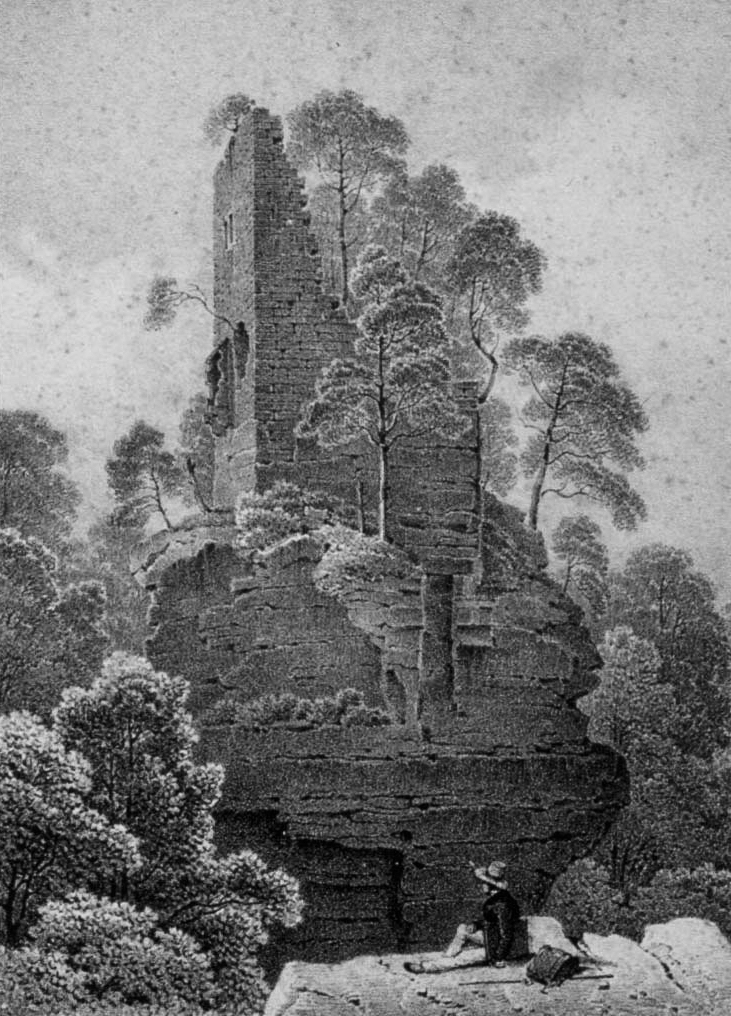
Wasenbourg Castle
Wasenbourg Castle, also known as Château du Wasenbourg, is a remarkable high medieval hill castle nestled in the woods northwest of Niederbronn-les-Bains in the Bas-Rhin department, part of the historic Northern Alsace region in France. Perched atop the Reisberg hill at an elevation of 432 meters, it commands sweeping views over the Falkensteinerbach valley and the surrounding Vosges landscape. The castle's strategic location and rich history make it a significant cultural landmark, blending Roman heritage with medieval military architecture.
The site of Wasenbourg Castle has a deep historical lineage dating back to Roman times. Around 90 AD, the Romans established a specula—a watchtower or military observatory—on the sandstone outcrop called Wachfels, manned by a unit from the 8th Legion stationed at Argentoratum (modern Strasbourg). Archaeological evidence, including a bas-relief and inscriptions dedicated to the god Mercury, confirm the presence of a Roman temple here, indicating the site's dual use for military surveillance and religious worship. The Roman occupation ended in the mid-5th century following the Hun invasions, after which the site was abandoned.
By the 8th century, documents mention a fortification known as "Fasenburg," likely a wooden structure built upon the ruins of the Roman temple. This early medieval fortification marked the continuity of the site's defensive importance. The current stone castle, however, was constructed or significantly rebuilt in 1273 under the auspices of the Bishop of Strasbourg, possibly Conrad de Lichtenberg, to secure the entrance to the Falkensteinerbach valley and to serve as a stronghold for the Bishopric's territorial interests.
Historical evolution and ownership
Throughout its history, Wasenbourg Castle was closely linked to the noble families of the region. Initially, it was given as a fief to the Lords of Lichtenberg, who managed the castle and its surrounding lands. In 1378, the castle was mortgaged several times to various families, reflecting the complex feudal politics of the time. Ownership passed through inheritance and marriage to the Counts of Zweibrücken-Bitsch in 1480, and later to the Counts of Hanau-Lichtenberg in 1570.
The castle endured significant damage during the German Peasants' War of 1525, after which it fell into disrepair. By 1592, it was described as a ruin, and although it survived the Thirty Years' War (1618-1648) relatively intact, it was ultimately dismantled in 1677 by the troops of King Louis XIV of France as part of his policy to neutralize border fortifications.
Wasenbourg also holds cultural significance, having been visited by the famed German writer Johann Wolfgang von Goethe around 1770, an event commemorated by a plaque at the castle entrance. Its status was further recognized in the late 19th century when the Alsace-Lorraine state acquired the ruins in 1890 and declared it a historic monument in 1898.
Architectural features and layout
Wasenbourg Castle is architecturally distinctive for its lack of a traditional central keep. Instead, its primary defensive feature is an imposing shield wall, measuring approximately 18 meters in height, 14 meters in length, and 3 to 3.7 meters in thickness. This massive wall, which replaced a keep, includes an internal stairway and overlooks a deep defensive ditch, providing formidable protection against attackers.
The castle's layout includes an outer courtyard that once housed stables and an inner courtyard containing servant quarters and storage facilities. Access to the knights' hall is gained through a pointed, arched gate from the inner courtyard. The hall itself features a large fireplace wall with a restored chimney and two carved sandstone benches positioned before Gothic windows. Above the ceiling supports is a sculpted head, likely representing the master mason or architect responsible for the castle's construction.
A particularly notable architectural element is the Gothic bay window in the knights' hall, dating from around 1280. This window is carved from a single block of sandstone and comprises nine lancet-shaped stained-glass panels topped by seven openwork rose windows, an exceptional example of medieval craftsmanship. The window faces towards Niederbronn-les-Bains and was restored in 1909 to preserve its intricate design.
Additional features include an oriel window projecting from the east wall and a main entrance adorned with a pointed arch door enriched by a Gothic frieze and topped with a sculpted head, reinforcing the castle's medieval decorative motifs. Nearby, three large monolithic pillars with faint Latin inscriptions stand close to the Wachfels rock; these pillars were relocated during early 20th-century excavations and are remnants of the medieval castle rather than the earlier Roman temple.
Archaeological discoveries and preservation
Extensive archaeological work at Wasenbourg has unveiled artifacts spanning its Roman and medieval phases. Roman-era finds include reliefs of Mercury and pottery shards, confirming the site's ancient religious and military significance. Medieval discoveries encompass glazed stove tiles, a small rattle, an iron ladle, a coin from Strasbourg, and the circular base of a millstone or grain silo dating to the 15th or 16th century, illustrating the castle's continued occupation and adaptation over time.
The site is also notable for its diverse vegetation, combining native Vosges sandstone flora with introduced species such as large-leaved linden, goosefoot, dioecious nettle, periwinkle, primrose, and persicaria. Some of these plants are believed to have been cultivated since medieval times, contributing to the castle's living heritage and presenting ongoing challenges for conservation efforts.
Visiting Wasenbourg Castle today
Today, Wasenbourg Castle is freely accessible to visitors, though reaching it requires a hike of at least 45 minutes through wooded terrain. The effort is rewarded with the opportunity to explore one of the most well-preserved ruins in the Northern Vosges and to appreciate its unique architectural features and panoramic views. Preservation and consolidation work in recent decades have helped maintain the site, but natural overgrowth and weathering continue to pose challenges.
Visitors can explore the castle's courtyards, admire the Gothic architectural details, and reflect on the site's rich history spanning from Roman times through the medieval period to modern heritage conservation. The castle's lack of a keep, replaced by its massive shield wall, and its exceptional Gothic bay window make it an outstanding example of medieval military architecture in the Alsace region.
Frequently asked questions (FAQ)
- What is the historical significance of Wasenbourg Castle?
- Wasenbourg Castle is a remarkable example of medieval architecture and played a crucial role in the region's defense during the Middle Ages. Built in the 12th century, it served as a stronghold for various noble families and offers insights into the feudal system of the time. Today, it stands as a testament to the rich history of Alsace.
- When is the best time to visit Wasenbourg Castle?
- The best time to visit Wasenbourg Castle is during the spring and early autumn months when the weather is typically mild and pleasant. This allows for an enjoyable exploration of the castle grounds and the surrounding scenic landscapes. Additionally, visiting during these seasons can help you avoid the summer tourist crowds.
- Can I access Wasenbourg Castle by public transport?
- Yes, Wasenbourg Castle can be accessed by public transport, although the service may be limited. Visitors can take a train to a nearby town and then use local buses or taxis to reach the castle. It's advisable to check the local transport schedules in advance for the best route.
- What are the opening hours of Wasenbourg Castle?
- Wasenbourg Castle is generally open to visitors from 10 AM to 6 PM, but hours may vary based on the season and special events. It is recommended to check the official website or local tourist information for the most accurate and up-to-date opening hours before your visit. Guided tours may also be available at specific times.
- Are there any ticket prices for visiting Wasenbourg Castle?
- Visiting Wasenbourg Castle typically requires a small entrance fee, which helps maintain the site and support its preservation. Discounts may be available for children, students, and seniors. Be sure to check for any special promotions or free entry days that might be offered throughout the year.
- Is it possible to take guided tours of Wasenbourg Castle?
- Yes, guided tours of Wasenbourg Castle are available and can greatly enhance your experience. These tours provide in-depth information about the castle's history, architecture, and significance. It's advisable to book in advance, especially during peak tourist seasons.
- What nearby attractions can I visit while at Wasenbourg Castle?
- While visiting Wasenbourg Castle, you can explore other nearby attractions such as the picturesque village of Dambach-la-Ville and the beautiful hiking trails in the Vosges Mountains. The Alsace wine route is also close by, offering opportunities for wine tasting and enjoying the region's culinary delights.
- How do I get to Wasenbourg Castle from the D1062 road?
- To reach Wasenbourg Castle from the D1062 road, look for signs indicating the direction to the castle and follow the access roads. The castle is located a short distance from the main road, making it relatively easy to find. Parking facilities are available nearby, allowing for convenient access to the site.
Information
Website
Visit websiteSources & official resources
Verify the information above using these authoritative references.
Loading map...
Visitor reviews
No reviews yet. Been here? Write the first review and help other travelers!
Write the first reviewVisited this castle? Share your experience
Your review helps other travelers and adds first-hand knowledge to our encyclopedia.