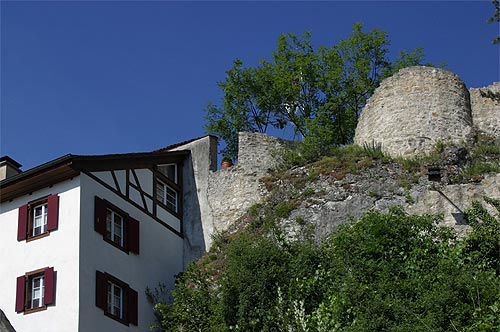
Wartenberg Castle Ruins
The Wartenberg castle ruins near Muttenz, Switzerland, represent a significant archaeological and historical site featuring three distinct medieval castle complexes atop the Wartenberg hill. This location has been a strategic settlement area since prehistoric times, with archaeological evidence indicating human presence as far back as the New Stone Age (around 2000 BC). During the Bronze Age (1800-800 BC), the site hosted a fortified settlement, underscoring its long-standing importance in regional defense and habitation.
The early medieval origins and front Wartenberg castle
The earliest medieval structure, known as the front Wartenberg castle, was constructed in the 10th century, likely by the Burgundians who established a king’s castle on the northernmost spur of the hill. This castle is the largest and most prominent of the three ruins and reflects early medieval fortification techniques. The front castle served as a defensive stronghold and a symbol of territorial control during the early medieval period.
The middle and rear Wartenberg castles: development through the high and late medieval periods
Following the front castle, the middle Wartenberg castle was built in the late 12th century, attributed to the Homberg dynasty. This castle is first documented when it passed into the possession of the wealthy Basel family zer Sunnen in 1301, who acquired it along with the front castle. The rear Wartenberg castle, likely constructed in the 13th century, also by the Homberg family, is first mentioned in 1306 when it was sold to the Habsburg-Laufenburg family. These castles illustrate the architectural evolution from early medieval fortifications to more complex structures characteristic of the high and late medieval periods.
Ownership transitions and feudal rights
Throughout the late medieval era, the castle complex changed hands multiple times. The Strassburg diocese initially controlled the front castle before transferring it to the Homburg line of the Count of Frohburg. Later, the counts of Habsburg-Laufenburg obtained feudal rights over the front castle, while the Münch family from Münchenstein held rights over the middle castle. The rear castle's feudal rights shifted among several noble families, including the Eptingen-Madeln and the Sevogel family of Basel. In 1515, the city of Basel purchased the front and middle Wartenberg castles, marking a significant shift from feudal to municipal control.
Architectural features and castle complex layout
The Wartenberg castle ruins are situated on a hilltop, providing commanding views over the surrounding landscape, a typical strategic choice for medieval fortifications. The front castle features remnants of robust defensive walls and foundations that suggest a sizable fortified complex. The middle castle and rear castle are smaller but incorporate typical medieval defensive elements such as curtain walls, gatehouses, and residential quarters. The three castles together form a unique multi-phase hill castle complex, illustrating the development of fortification styles and feudal power structures over several centuries.
Archaeological significance
Excavations at the site have uncovered artifacts from different periods, highlighting continuous human activity from prehistoric times through the medieval era. The findings include remnants of Bronze Age fortifications and early medieval masonry, providing valuable insights into construction techniques and settlement patterns in this part of Switzerland. The site's layered history makes it a rich resource for understanding the region's cultural and political evolution.
Modern status and public access
Since 1856, the entire Wartenberg castle complex has been owned by the civil community of Muttenz. Today, the ruins are accessible to the public and are a popular destination for visitors interested in history, archaeology, and medieval architecture. The site offers walking trails and informational signage that help visitors appreciate the castle's historical context and architectural features. Preservation efforts focus on maintaining the ruins as a cultural heritage site while allowing safe public access.
Visiting information and cultural importance
The Wartenberg castle ruins provide a tangible connection to Switzerland's early medieval past and the shifting dynamics of feudal power in the region. Visitors can explore the remains of all three castles, gaining insight into the architectural evolution from the 10th to the 13th centuries. The site also serves as an educational resource, illustrating the continuity of human settlement and defensive strategies from prehistoric times through the medieval period.
Frequently asked questions (FAQ)
- What is the historical significance of Wartenberg Castle Ruins?
- Wartenberg Castle Ruins, located in Muttenz, Switzerland, dates back to the 13th century and served as a strategic fortification. The castle played an important role in regional defense and has witnessed various historical events, contributing to its rich heritage.
- When was Wartenberg Castle built?
- Wartenberg Castle was constructed in the early 1200s, making it one of the older fortifications in the region. Its architectural style reflects the medieval period, showcasing the importance of castles in Swiss history.
- Can I visit Wartenberg Castle Ruins?
- Yes, Wartenberg Castle Ruins is open to visitors year-round. You can explore the ruins and enjoy the panoramic views of the surrounding area, making it a popular destination for both history enthusiasts and nature lovers.
- What are the opening hours for Wartenberg Castle Ruins?
- The ruins are accessible to the public at all times, allowing visitors to enjoy the site at their convenience. However, it's recommended to visit during daylight hours for safety and the best experience.
- Is it possible to access Wartenberg Castle Ruins by public transport?
- Yes, Wartenberg Castle Ruins can be reached via public transport. There are local bus services that connect Muttenz with nearby towns, and from there, it's a short hike to the castle.
- What is the best time to visit Wartenberg Castle Ruins?
- The best time to visit Wartenberg Castle Ruins is during the spring and early autumn months when the weather is pleasant and the landscape is vibrant. These seasons provide excellent conditions for hiking and exploring the ruins.
- Are there any nearby attractions to visit after Wartenberg Castle?
- Yes, nearby attractions include the charming town of Muttenz, which features beautiful architecture and local shops. Additionally, the Basel Zoo and the Rhine River are within a short distance, making for a full day of exploration.
- Is there an entrance fee to visit Wartenberg Castle Ruins?
- No, there is no entrance fee to visit Wartenberg Castle Ruins. The site is open to the public and free to explore, allowing everyone to appreciate its historical significance without any cost.
Loading map...
Visitor reviews
No reviews yet. Been here? Write the first review and help other travelers!
Write the first reviewVisited this castle? Share your experience
Your review helps other travelers and adds first-hand knowledge to our encyclopedia.