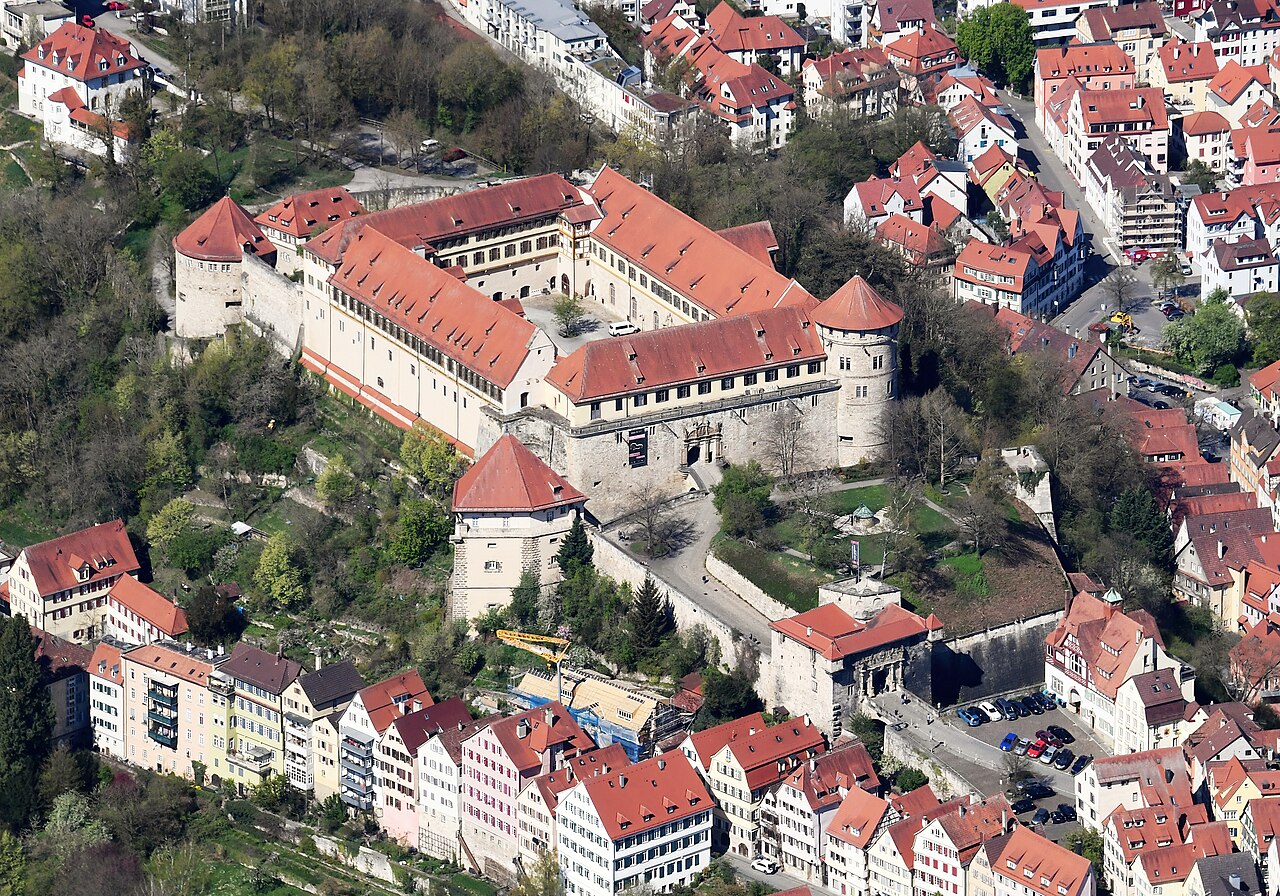
Waldenbuch Castle

Waldenbuch Castle: hunting lodge of the dukes of Württemberg
Waldenbuch, Germany
Late Medieval (14th–15th c.)

Waldenbuch Castle is a historically significant site located in the town of Waldenbuch, Germany. Originally established in the 14th century, the castle's core was first documented in 1381. It served as a fortified residence during the late medieval period, reflecting the architectural and social functions of castles in that era.

The origins and medieval structure

The initial structure of Waldenbuch Castle was a typical late medieval fortress designed for defense and residence. The castle's location in the region of Baden-Württemberg placed it within the sphere of influence of the powerful dukes of Württemberg. The medieval castle likely featured characteristic elements such as thick stone walls, a keep or main tower, and defensive battlements to protect against attacks. Its strategic position would have allowed control over the surrounding territory and served as a noble residence.

Duke Christoph's transformation into a hunting lodge

Between 1562 and 1566, Duke Christoph of Württemberg undertook significant renovations to convert the medieval fortress into a more comfortable and functional hunting lodge. This transformation reflected the changing needs and tastes of the nobility during the Renaissance period, emphasizing leisure and status rather than purely military defense.

The renovation included the construction of a rectangular two-storey building, which became the centerpiece of the castle complex. This structure was designed to accommodate the duke and his guests during hunting expeditions, providing living quarters, reception rooms, and spaces for dining and entertainment. The architectural style of this phase blended functional residential features with Renaissance influences, although the overall style remained restrained compared to more lavish palaces of the period.

Architectural features and layout

Waldenbuch Castle's layout reflects its dual role as a fortified site and a hunting retreat. The rectangular building constructed by Duke Christoph is complemented by remnants of the original medieval fortifications. The castle complex likely included a courtyard surrounded by service buildings and stables necessary for hunting parties. Defensive elements such as walls and possibly a moat would have been adapted or preserved to maintain security.

The castle's interiors, while modified for comfort, retained elements typical of noble residences, including wood-paneled rooms, fireplaces, and decorative ceilings. The hunting lodge function influenced the decoration, with motifs related to hunting and nature appearing in the furnishings and artwork.

The museum of everyday culture

Today, Waldenbuch Castle serves as the home of the museum of everyday culture (Museum Alltagskultur), which showcases the daily life and traditions of the region's inhabitants over several centuries. The museum's exhibits include household items, clothing, tools, and artworks that illustrate the social history of the area.

The castle's adaptation as a museum has preserved its historical architecture while providing visitors with educational insights into both the castle's past and the broader cultural heritage of Baden-Württemberg. The museum hosts regular exhibitions, workshops, and cultural events, making the castle an important center for heritage and community engagement.

Preservation and current status

Waldenbuch Castle is well preserved and maintained as a cultural monument. Its preservation allows visitors to experience the architectural evolution from a late medieval fortress to a Renaissance hunting lodge. The castle's location in the town of Waldenbuch makes it accessible for tourists interested in history, architecture, and regional culture.

The castle's management ensures ongoing conservation efforts to protect its structural integrity and historical features. It stands as a testament to the region's noble history and the adaptive reuse of historic buildings for modern cultural purposes.

Frequently asked questions (FAQ)

How do I get to Waldenbuch Castle?
Waldenbuch Castle is located in the charming town of Waldenbuch, Germany, which is easily accessible by car and public transportation. The nearest train station is in Böblingen, from where you can take a bus to Waldenbuch. Once in the town, the castle is a short walk from the center.
What is the historical significance of Waldenbuch Castle?
Waldenbuch Castle dates back to the 13th century and served as a residence for the Counts of Waldenbuch. It played a vital role in regional politics and has witnessed various historical events over the centuries. Today, it stands as a testament to the area's rich history and cultural heritage.
When was Waldenbuch Castle built?
Construction of Waldenbuch Castle began in the early 13th century, with significant expansions and renovations occurring over the years. The castle has undergone various architectural changes, reflecting different styles and periods. Its enduring structure showcases the evolution of medieval architecture in Germany.
Can I visit Waldenbuch Castle?
Yes, Waldenbuch Castle is open to visitors throughout the year. Guests can explore its beautiful grounds and, depending on the season, may have the opportunity to enter the castle for guided tours. It's advisable to check the official website for specific visiting hours and any special events.
Is it possible to take guided tours of the castle?
Yes, guided tours of Waldenbuch Castle are available, allowing visitors to learn about its history, architecture, and notable figures associated with it. Tours are conducted by knowledgeable guides who provide insights into the castle's past and the surrounding area. Reservations are recommended, especially during peak tourist seasons.
What are the opening hours for Waldenbuch Castle?
Waldenbuch Castle typically opens to visitors from 10 AM to 5 PM during the week and has extended hours on weekends. However, these hours may vary seasonally or due to special events, so it's best to check the castle's official website for the most current information. Planning your visit ahead of time ensures you won't miss out on exploring this historic site.
What are the ticket prices for visiting Waldenbuch Castle?
Admission prices for Waldenbuch Castle are quite affordable, with discounts available for students, seniors, and children. Group bookings may also receive a reduced rate. Always check the castle's official website for the latest pricing details and any special offers or events that might affect ticket prices.
What is the best time to visit Waldenbuch Castle?
The best time to visit Waldenbuch Castle is during the spring and fall when the weather is mild, and the gardens are in full bloom. Summer can be busy with tourists, while winter offers a quieter experience, albeit with colder temperatures. Each season offers a unique perspective on the castle's beauty and surroundings.
Are there any nearby attractions to visit?
Yes, there are several nearby attractions worth exploring, including the picturesque town of Waldenbuch itself, known for its charming streets and local shops. You can also visit the nearby Schönbuch Nature Park for hiking and outdoor activities. Additionally, the city of Stuttgart is just a short drive away, offering more cultural and historical sites.

Information

Sources & official resources

Verify the information above using these authoritative references.

Loading map...

Visitor reviews

No reviews yet. Been here? Write the first review and help other travelers!

Write the first review

Visited this castle? Share your experience

Your review helps other travelers and adds first-hand knowledge to our encyclopedia.

Write a review

(5/5)

0/2000 characters

Your review will be visible after admin approval

Nearby castles

13.8 km

Burg Müneck

Germany, Germany

Burg Müneck is a notable medieval hill castle situated in the municipality of Ammerbuch, Germany. Constructed during the 11th and 12th centuries by the lords of Müneck, a junior branch of the lords of Hailfingen, this fortress served as a strategic stronghold in the region. The builders were ministeriales, unfree knights who administered lands on behalf of the powerful counts palatine of Tübingen, a prominent noble family of southwestern Germany. The earliest surviving written record dates from 1259, when Knight Hugo von Müneck identified himself as a ministerialis to Count Rudolf of Tübingen. This document, concerning the sale of a farm to the nearby Kirchberg monastery, confirms the castle’s active role in regional affairs during the High medieval period. Subsequent references throughout the late 13th century mention family members such as Heinrich von Müneck around 1286, illustrating the family’s sustained influence. The castle's name, appearing in various spellings with the suffix "-eck," reflects its placement on a prominent rocky outcrop or promontory, a typical naming convention for castles situated on elevated terrain. Historical context and decline By the early 14th century, the lords of Müneck began to divest their holdings, selling lands, serfs, and farms in neighboring villages such as Entringen and Breitenholz. These transactions involved local monasteries and noble families including the Herter von Dußlingen and their kin, the lords of Hailfingen. This gradual reduction of assets suggests a decline in the family’s independent power and resources. The Müneck lineage fades from historical records by the late 14th century, with Albrecht von Müneck recorded as a canon, indicating a shift from secular lordship to ecclesiastical roles. Following this period, the castle was abandoned and fell into ruin. Over time, stones from the castle were quarried for other building projects in the region. Location and strategic importance Burg Müneck was strategically positioned on a hill reaching 543.1 meters above sea level, on the southern edge of the Schönbuch forest. This location provided commanding views over the village of Breitenholz and the surrounding landscape. The site’s elevation and natural topography offered significant defensive advantages and visual communication with neighboring castles, indicating its role within a broader network of fortifications in medieval southwestern Germany. Architectural features and remains Today, the castle’s physical remains are limited to earthworks that outline the perimeter of the original fortification. A deep ditch, carved into the bedrock and exceeding ten meters in depth on the northern and eastern sides, served as a formidable moat. This moat was complemented by a raised rampart or embankment, designed to impede attackers and enhance the castle’s defense. On the southern and western sides, an additional outer rampart created multiple layers of protection, reflecting a sophisticated defensive design adapted to the terrain. The plateau enclosed by these earthworks corresponds approximately to the location of the castle’s main buildings. Although no standing walls or buildings survive, faint traces of a single wall foundation are discernible beneath the surface. Scattered dressed stones around the site indicate the former presence of constructed features. However, no inscriptions, decorative sculptures, or artifacts such as pottery or religious objects have been discovered among the ruins. Coat of arms and nomenclature The Müneck family’s coat of arms, preserved on seals from the early 14th century, features three or four pointed shapes oriented sideways within a shield. This emblem is closely associated with the castle’s identity. The castle’s name itself derives from the suffix "-eck," a common German term denoting a castle located on a projecting ridge or promontory, reflecting the site’s distinctive topography. Archaeological investigations and preservation In the 19th century, the ruined castle briefly came under state ownership before being acquired by the local municipality in 1823. Interest in the site’s history and layout was renewed in the early 20th century when Konrad Albert Koch conducted archaeological investigations in 1924. His findings, published in 1925, provided valuable insights into the castle’s structure and historical context. Currently, the site is classified as ruins with no standing structures but significant earthworks that reveal the castle’s original defensive design. The absence of above-ground remains means the site offers a valuable example of medieval fortification through landscape archaeology rather than architectural preservation.

Details
14.4 km
The 'Cradle of Biochemistry' — Germany castle

The 'Cradle of Biochemistry'

Tübingen, Germany

Hohentübingen Castle stands majestically atop the 372-meter high Spitzberg hill overlooking the historic city of Tübingen in Baden-Württemberg, Germany. This imposing renaissance castle with its four wings and distinctive round tower is not only an architectural landmark but also a cradle of scientific discovery, particularly in the field of biochemistry. The castle’s rich history, architectural evolution, and its unique role as a hub for early biochemical research make it a fascinating destination for visitors interested in both medieval heritage and scientific innovation. Historical background and architectural evolution The earliest documented mention of a castle on the site dates back to 1078, referring to a medieval fortress that served as the seat of the rulers of Tübingen. These rulers, elevated to the status of Counts Palatine in the 12th century, inhabited the castle until 1342 when it was sold to the Counts of Württemberg. Under Württemberg ownership, the castle's significance as a ducal residence began to wane in the 16th century as political and residential preferences shifted. The existing structure is predominantly a renaissance construction, characterized by its four wings arranged around a central courtyard and a prominent round tower. The castle’s architecture reflects the transition from medieval fortification to a more comfortable noble residence, incorporating elements typical of the renaissance period. Its robust walls, elegant façades, and strategic hilltop location underscore its role both as a defensive stronghold and a symbol of regional power. Hohentübingen castle as a center of academic and scientific advancement From the mid-18th century onwards, Hohentübingen Castle increasingly served academic purposes. The University of Tübingen began acquiring rooms within the castle, culminating in the transfer of full ownership in 1816 by King Wilhelm I of Württemberg. This marked a pivotal transformation of the castle from a noble residence to an academic institution. The castle housed the university’s extensive library collection of nearly 60,000 volumes in the hall of knights. Moreover, the castle’s old kitchen was repurposed as a chemistry laboratory, famously known as the "cradle of biochemistry". This laboratory was the site of groundbreaking research by Friedrich Miescher, who in 1869 isolated "nuclein" — the substance now understood to be nucleic acids RNA and DNA. This discovery laid the foundation for modern molecular biology and medicine. Further scientific use included an astronomical observatory located in the castle’s northeast tower, highlighting the castle’s multifunctional role in advancing knowledge across disciplines. The schlosslabor and museum collections The Schlosslabor within the castle's old kitchen remains a unique collection of 19th-century scientific apparatuses, chemical compounds, and related objects that document the early history of biochemistry. The centerpiece of this collection is the original test tube containing a sample of pure nuclein extracted by Miescher, a priceless relic of scientific heritage. Today, the castle serves as a museum housing a diverse range of collections from the university’s departments of Cultural Studies and Archaeology. Visitors can explore exhibits spanning prehistory, classical archaeology, Egyptology, ancient oriental studies, numismatics, and ethnology. The museum also features a replica collection of famous Greek and Roman sculptures, providing a comprehensive cultural and historical experience. The castle’s east and north wings, along with the pentagonal museum tower, display these collections. A tunnel behind the courtyard fountain leads visitors through the west wing to the Schänzle (a small entrenchment), offering views of the castle’s western moats, colloquially known as the "rabbit hole". Architectural features and preservation Hohentübingen Castle exemplifies renaissance architecture with its harmonious four-winged layout and defensive round tower. The castle’s hilltop position provided strategic advantage and commanding views over Tübingen and the surrounding landscape. The castle underwent a thorough renovation between 1979 and 1994, ensuring the preservation of its structural integrity and adapting its interiors for modern museum and academic use. Today, it stands as a well-preserved monument that bridges medieval fortification, renaissance elegance, and scientific heritage. Visiting hohentübingen castle Visitors to Hohentübingen Castle can enjoy a rich cultural experience combining architectural grandeur with scientific history. The museum’s extensive permanent exhibitions and special displays provide insight into the castle’s multifaceted past and its role in pioneering biochemical research. The castle’s location on Spitzberg hill offers scenic views of the city of Tübingen and the Neckar valley, making it a favored destination for tourists and scholars alike. Frequently asked questions about hohentübingen castle What is the significance of the "cradle of biochemistry" at Hohentübingen Castle? It refers to the castle’s old kitchen where Friedrich Miescher isolated nuclein in 1869, marking a foundational moment in molecular biology. When was Hohentübingen Castle built? The castle's origins date back to at least 1078, with the current renaissance structure mainly developed during the 16th century. Can visitors see the original nuclein sample? Yes, the Schlosslabor exhibition includes the original test tube containing nuclein extracted by Miescher. Is the castle accessible year-round? Visiting hours vary seasonally; it is best to check the official museum website for current opening times. What other collections are housed in the castle museum? The museum features collections in archaeology, Egyptology, ethnology, numismatics, and a replica collection of classical sculptures. How is the castle preserved today? After extensive renovations from 1979 to 1994, the castle is well-preserved and functions as both a museum and university facility.

High Medieval (11th–13th c.)
Details
15.9 km

Stuttgart Old Castle

Stuttgart, Germany

Stuttgart Old Castle stands as a prominent historic landmark in the heart of Stuttgart, Germany. Originally established around 950 AD during the early medieval period, the castle’s origins are deeply connected to the founding of Stuttgart itself, which began as a settlement centered on horse breeding. The name "Stuotgarten," meaning "mare garden," reflects this equestrian heritage, as the castle was initially built to guard the stud farm and control vital trade routes passing through the Stuttgart valley. The castle evolved significantly over the centuries, transitioning from a defensive stronghold to a Renaissance palace and later becoming a cultural institution. Its strategic location near the Nesenbach stream and the Swiss Road made it a key site for regional power, particularly under the Counts and later Dukes of Württemberg, who made it their residence from the 14th century onward. Today, the Old Castle serves as the home of the Württemberg State Museum and remains a symbol of the city's medieval and Renaissance heritage. The early medieval origins and strategic importance The earliest archaeological evidence dates back to the late 12th or early 13th century, revealing a fortified structure built to secure the north-south trade route through the Stuttgart valley. This initial castle featured a double outer wall system with two moats, timber-framed buildings, and a defensive perimeter approximately 30 meters in diagonal length. Positioned to protect commerce and control movement, the castle played a vital administrative and military role during the Staufer (Hohenstaufen) period. Around 1300, a new fortress was constructed with significantly thicker walls, measuring about 3.6 meters in thickness, and deeper foundations that remain archaeologically unexcavated. This second castle was rotated approximately 45 degrees relative to the earlier structure to better defend against flooding from the Nesenbach stream. It became the principal residence of the Counts of Württemberg and housed their court chamber (Hofkammer) by the early 14th century. The site was enclosed by a deep and continuous moat, emphasizing its defensive and residential functions. The Renaissance transformation under Dukes Christoph and Ludwig Between 1553 and 1578, the Old Castle underwent a major conversion from a medieval fortress into a Renaissance palace under the direction of Dukes Christoph and Ludwig III. Architect Aberlin Tretsch and master builder Blasius Berwart led the remodeling, which included the construction of an archive building and the famous equestrian staircase around 1560. The palace church was consecrated in 1562, featuring a cross-shaped hall designed for Protestant worship, with an altar and pulpit centrally located for visibility. To mitigate flooding issues, the castle’s ground level was raised by approximately six meters on the northwest side, altering the interior layout. The large medieval hall known as the Dürnitz was converted into a wine cellar, which remained in use until the 20th century. The Renaissance remodeling also introduced a three-sided arcaded courtyard, showcasing early Italian Renaissance architectural elements, although the arcades were never fully completed due to shifting political circumstances. The castle church and royal crypt The castle church, built between 1558 and 1562, is a significant feature of the Renaissance complex. Its design reflects Protestant liturgical needs, with a simple barrel vault ceiling later enhanced with decorative ribs and tracery around 1580. After 1806, the church underwent neo-Gothic restyling by Alexander Tritschler, who added the royal crypt beneath it. This crypt houses the tombs of King Charles I of Württemberg and Queen Olga, among other members of the royal family. Later history, damage, and restoration In the 18th century, the castle’s moats were filled in, ending its era as a water castle. The Old Castle suffered significant damage from a fire in 1931, particularly to the Dürnitz building and its two towers. Architect Paul Schmitthenner led the initial restoration efforts. However, the castle was heavily bombed during World War II, causing further destruction, including losses to parts of the Landesmuseum Württemberg’s ethnographic collections. Post-war reconstruction resumed and was completed by 1971, restoring the castle to its former Renaissance grandeur. Today, it functions as a museum complex housing the Landesmuseum Württemberg, the Junges Schloss children’s museum, and an active castle church. A memorial to Claus Graf Stauffenberg, a key figure in the German resistance during World War II, is located on the Karlsplatz side of the complex. Architectural features and archaeological findings Excavations beneath the castle have revealed layers of fortifications and constructions spanning the medieval period. The earliest remains include the double outer walls and moats from the late 12th or early 13th century. The successor castle from around 1300 features massive walls with foundations that have not been fully excavated. The Renaissance remodeling removed approximately 60% of the original northwest wing to create the arcaded courtyard. The castle’s courtyard contains a bronze equestrian statue of Eberhard I, the first Duke of Württemberg to establish Stuttgart as his residence in 1495. The statue was sculpted by Ludwig von Hofer and commemorates the duke’s foundational role in the region’s history. Archaeological investigations have also uncovered remnants of settlements dating back to the 8th century beneath the southern area of the castle, within the Dürnitz sector, indicating early habitation predating the medieval structures. The Old Castle in Stuttgart’s cultural landscape The Old Castle remains a central feature of Stuttgart’s historical and cultural identity. Its proximity to the New Castle, built in the late 18th century, and its location near Schillerplatz place it at the heart of the city’s civic life. The castle’s transformation from a medieval fortress to a Renaissance palace and finally to a museum complex reflects the evolving political, cultural, and architectural history of the region. Visitors today can explore the castle’s richly layered history through its preserved architecture, museum collections, and commemorative monuments. The castle church continues to serve religious functions, while the museum offers insights into Württemberg’s heritage, art, and archaeology. The site’s archaeological findings provide a tangible link to Stuttgart’s origins and its development over more than a millennium.

Renaissance (15th–17th c.)
Details