Waldau Castle
Waldau Castle stands as a significant historical monument in the municipality of Nizov’e, Russia. Originally constructed by the Teutonic Order in the mid-13th century, this hill castle embodies centuries of military, administrative, and educational history. The castle’s earliest recorded mention dates back to 1258 under the name "Waldow," derived from a Balto-Slavic term meaning "to possess," reflecting its role as a territorial holding and strategic stronghold.
Origins and early development
The castle’s foundation began in 1264 when local princes, guided by the Teutonic Order, erected a fortified manor near a crucial roadway. This initial structure functioned primarily as a waystation, offering lodging and support for knights, clergy, and soldiers of the Order. The early building was likely a wooden or simple fortified manor, typical of early medieval military architecture.
By the 14th century, this initial manor was replaced by a more substantial stone castle, marking a transition to a permanent and fortified administrative center. This new construction became the seat of the Königsberg chamber office, playing a key role in local governance and military logistics within the Order’s Prussian territories.
Medieval transformations and military significance
In 1457, amid the turbulent period of the Thirteen Years’ War, Waldau Castle underwent significant remodeling that transformed it into a fully developed castle. This era coincided with the relocation of the Grand Master of the Teutonic Order from Marienburg to Königsberg, elevating Waldau’s status as it became the summer residence of the Grand Master. This transformation enhanced the castle’s defensive capabilities and administrative importance.
Throughout the late medieval period, Waldau Castle maintained its strategic military and logistical roles. Around 1402, during conflicts with Lithuania, it served as a vital supply station supporting military campaigns. The castle also hosted notable visitors, including Tsar Peter I of Russia, who stayed in May 1697 during his Great Embassy—a diplomatic mission aimed at fostering Western alliances.
Post-medieval ownership and adaptive reuse
Following the secularization of the Teutonic Order in 1525, when its territories became the Duchy of Prussia under the House of Hohenzollern, Waldau Castle passed into the hands of the ruling family and later the Prussian state. From 1720, the castle was leased for agricultural purposes, prompting internal renovations that adapted the medieval fortress for farming activities.
The 19th century marked a new chapter for Waldau Castle as it became a center for education. In 1858, East Prussia’s first agricultural academy was established on the premises, reflecting the region’s agricultural development. This academy relocated to Königsberg in 1868, and by 1870, the castle housed a teacher’s seminary. Among its notable students was Richard Schirrmann, the founder of the youth hostel movement, linking the castle to broader cultural history.
20th century to present: preservation and cultural heritage
Waldau Castle survived World War II largely intact and continued to serve educational functions in the postwar period, hosting an agricultural technical school and a polytechnic institute until 2005. In 2007, it was officially recognized as a cultural heritage site of regional importance by the Russian Federation.
Ownership transferred to the Russian Orthodox Church in 2010, although restoration efforts have been complicated by unresolved property claims. Since 2020, a Russian family has resided in the castle, undertaking gradual restoration and establishing a small museum dedicated to the castle’s rich history and its surrounding region.
The 750th anniversary of Waldau Castle in 2014 was commemorated with conservation activities including cleaning and restoring the medieval well and historic cellars. A medieval crafts fair showcased traditional trades such as pottery, carpentry, and pharmacy, the latter historically associated with the castle’s functions.
Architectural features and layout
Waldau Castle is situated on a roughly rectangular plot measuring approximately 57 by 45 meters, originally enclosed by a robust ring wall made from fieldstones. The internal buildings were arranged around a central courtyard, a common medieval fortress design balancing defense and administrative needs.
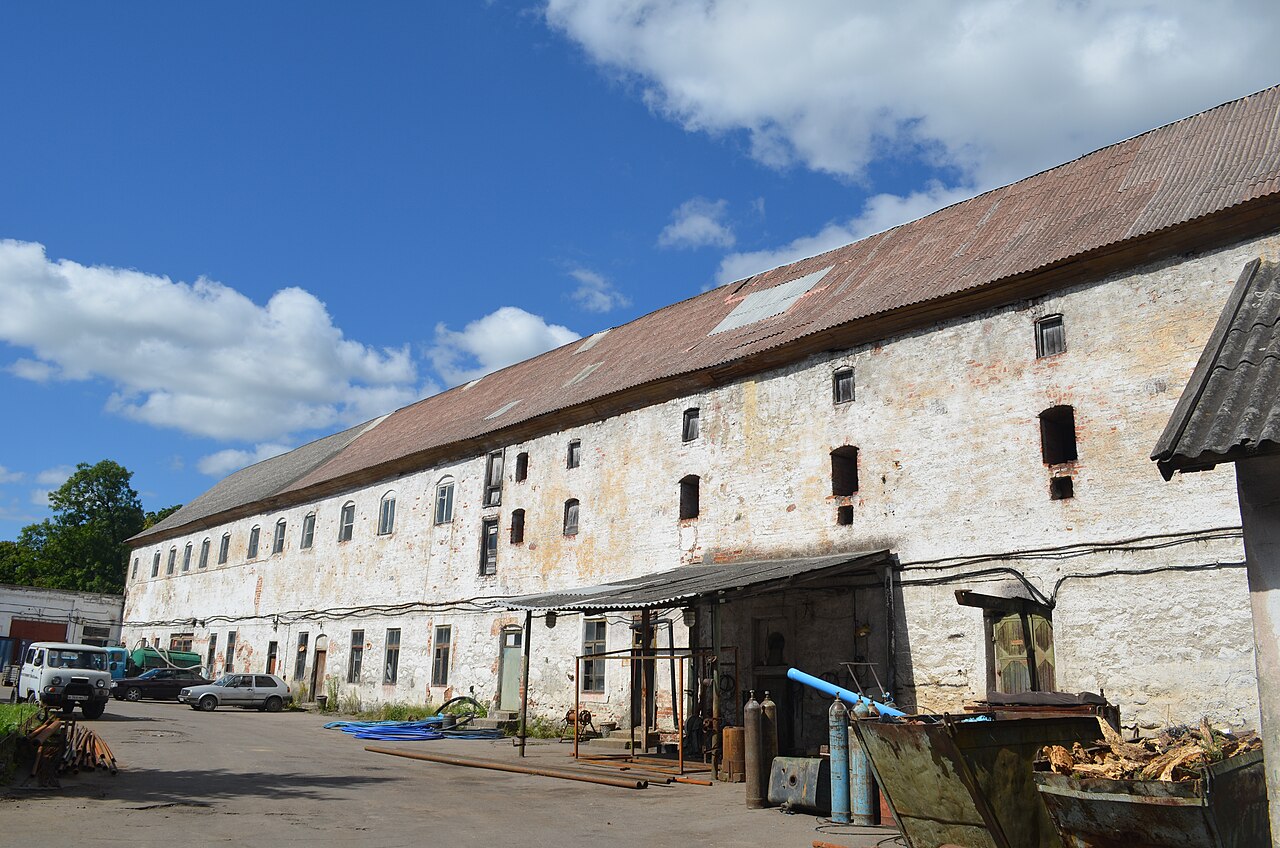
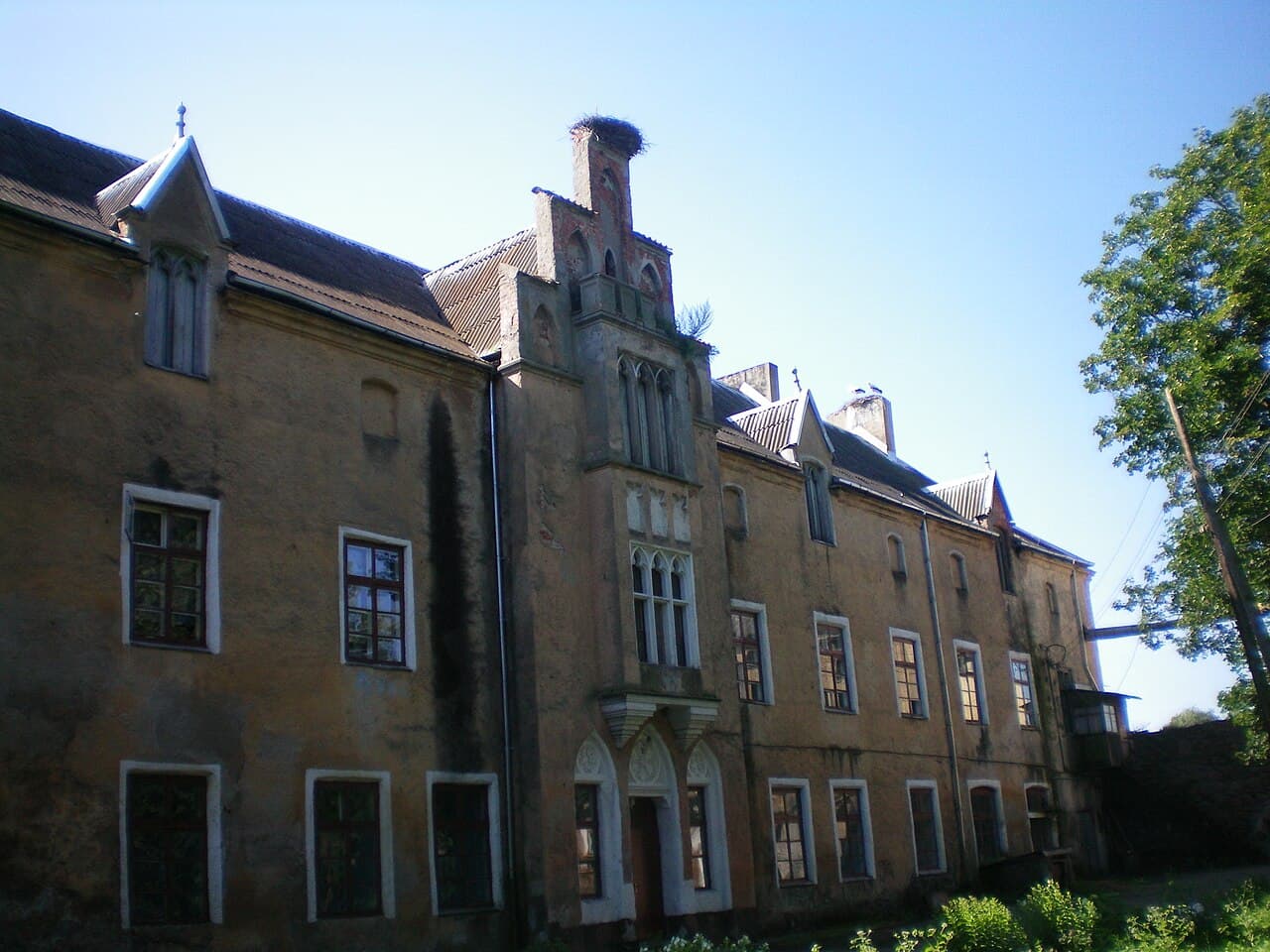
The principal surviving medieval structure is a three-story brick building on the southeast side, about 57 meters long and nearly 12 meters wide. This Gothic-style edifice rests on a fieldstone basement. Its upper floor was designed for defense, featuring small dormer windows and segmental-arched embrasures that allowed defenders to monitor and fire upon the surrounding fields and courtyard.
Architectural details include narrow vertical projections resembling risalits on the north and south sides of the main wing, adorned with 19th-century neo-Gothic decorative elements, reflecting later aesthetic enhancements.
The southwest wing, dating from the 16th century, is a rectangular block with a hipped roof. It also received neo-Gothic ornamental features in the 19th century. Earlier depictions show it once had two Baroque dormers facing the courtyard, illustrating the castle’s evolving architectural styles over centuries.
To the north of the main building is a narrow brick structure with a vaulted cellar that historically housed essential domestic functions including the kitchen, brewery, and bakehouse, underscoring the castle’s self-sufficiency.
Originally, a multi-story gate tower stood before the northwest curtain wall, serving as a fortified entrance. Although this tower no longer exists, an 18th-century drawing provides valuable insight into the castle’s former defensive layout.
Significant alterations in the 19th century included partial dismantling of the ring wall on the northwest and northeast sides to accommodate interior renovations linked to the castle’s educational role. Additionally, a pond adjacent to the castle was drained in 1861, expanding agricultural land around the property.
The castle’s left wing has been restored and now functions as a museum presenting Waldau’s history and the region’s cultural heritage. The medieval well, a crucial water source before World War II, was thoroughly cleaned and conserved during recent restoration efforts.
While the main building remains partially ruined and was assessed as structurally unsafe in 2007 due to risks of roof collapse, other parts, including the restored left wing and well, remain accessible, preserving key elements of the castle’s enduring legacy.
Frequently asked questions (FAQ)
- What is the historical significance of Waldau Castle?
- Waldau Castle, built in the late 18th century, is an important example of neoclassical architecture in Russia. It served as a residence for nobility and played a role in local governance, reflecting the socio-political dynamics of its time.
- When was Waldau Castle constructed?
- Waldau Castle was constructed between 1776 and 1782. Its construction marked a significant period in Russian architecture, showcasing the influence of European styles during that era.
- How do I get to Waldau Castle?
- Waldau Castle is accessible by public transportation, with several bus routes connecting it to nearby cities. Additionally, visitors can reach the castle by car, as it is located just off the main highway.
- What are the opening hours for Waldau Castle?
- Waldau Castle is open to visitors from 10 AM to 6 PM, Tuesday through Sunday. It is closed on Mondays for maintenance and restoration work.
- Can I take guided tours of Waldau Castle?
- Yes, guided tours are available for visitors interested in learning more about the castle's history and architecture. These tours are conducted in multiple languages and can be booked in advance for larger groups.
- Is it possible to host events at Waldau Castle?
- Yes, Waldau Castle offers facilities for hosting private events, including weddings and corporate gatherings. Interested parties should contact the castle administration for more information on availability and services.
- What is the best time to visit Waldau Castle?
- The best time to visit Waldau Castle is during the spring and early autumn when the weather is mild and pleasant. Additionally, these seasons often feature fewer tourists, allowing for a more intimate experience.
- What are the ticket prices for Waldau Castle?
- Tickets to Waldau Castle are priced at approximately 500 rubles for adults and 250 rubles for children. Discounts may be available for students and senior citizens, so it's advisable to check the official website for updated prices.
- Are there nearby attractions to visit along with Waldau Castle?
- Yes, there are several attractions near Waldau Castle, including beautiful parks and museums that showcase the region's rich history. Visitors can also explore local markets and cafes for a taste of traditional Russian culture.
Photo gallery

Information
Loading map...
Visitor reviews
No reviews yet. Been here? Write the first review and help other travelers!
Write the first reviewVisited this castle? Share your experience
Your review helps other travelers and adds first-hand knowledge to our encyclopedia.