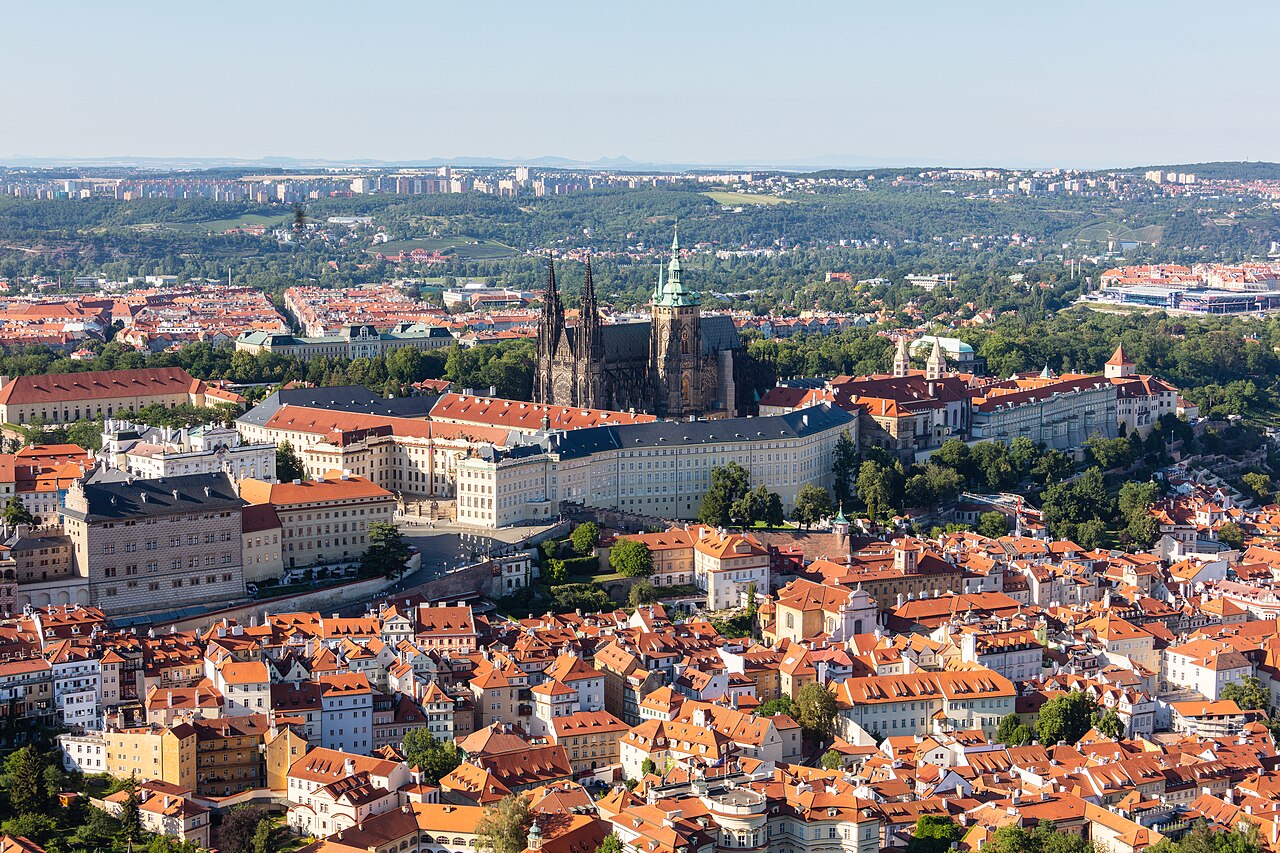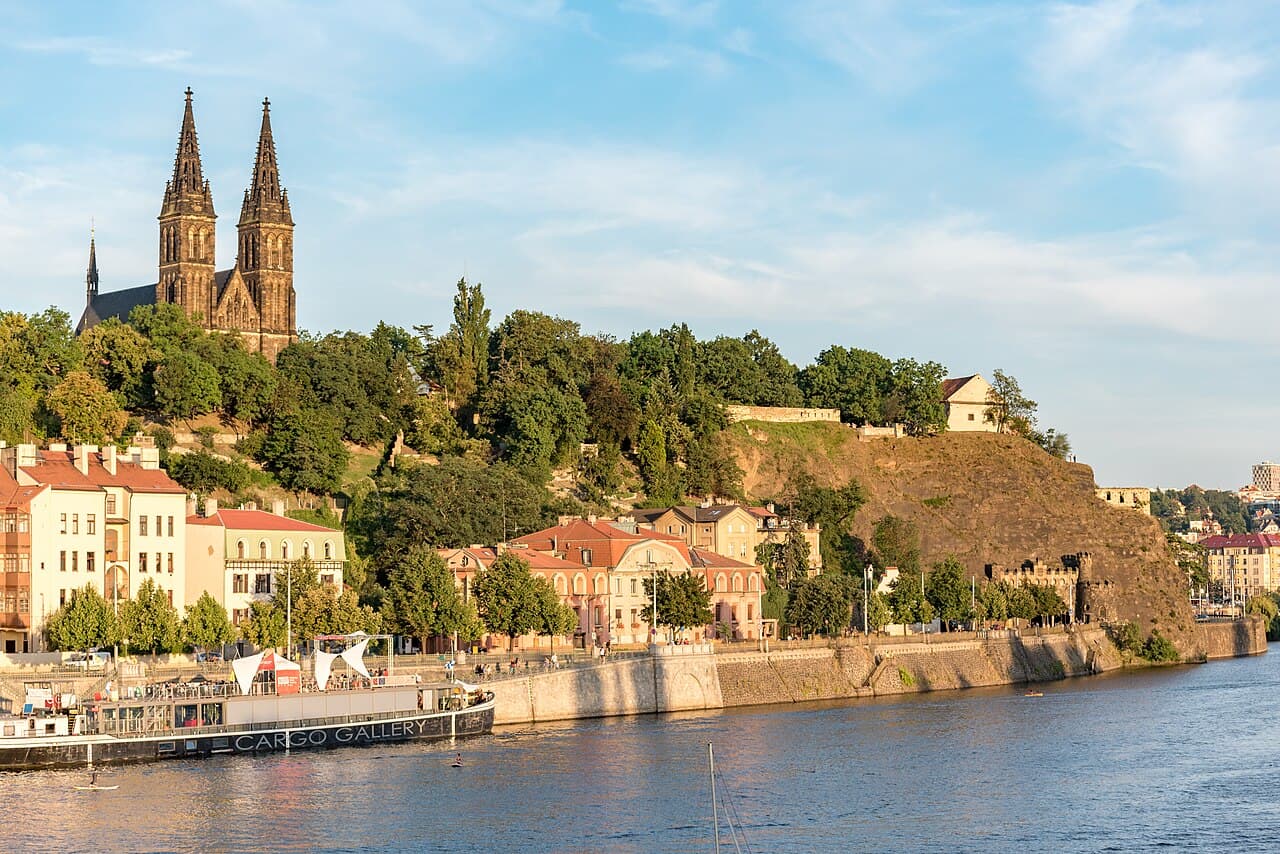
Vyšehrad — Czech Republic castle

Vyšehrad

Vyšehrad castle in Prague, Czechia
Early Medieval (5th–10th c.)
Well Preserved

Vyšehrad, known in German as Wyschehrad and historically referred to as the Prager Hochburg or "upper castle," is a significant historic fortification located in Prague, Czech Republic. Situated on a rocky hill over 3 kilometers southeast of the more famous Prague Castle, it overlooks the east bank of the Vltava River. Its strategic position provided commanding views over the river and the surrounding landscape, making it a vital defensive and administrative center during the Early Medieval period.

The fortification of Vyšehrad is believed to have been established in the 10th century, marking it as one of the earliest known strongholds in the region. It played a crucial role in the early formation of Prague as a political and cultural hub. Unlike many purely military castles, Vyšehrad developed into a complex site combining fortifications with religious and cultural structures, reflecting its evolving role through centuries.

Historical significance and early origins

Vyšehrad's origins trace back to the early medieval period when the Přemyslid dynasty sought to consolidate power in Bohemia. Although the exact date of its founding remains uncertain, archaeological evidence supports a 10th-century establishment. The fortress was initially constructed as a defensive bastioned fortress, a style characterized by angled bastions designed to withstand attacks and provide overlapping fields of fire.

Throughout the Middle Ages, Vyšehrad served as a royal residence and a defensive fortification. It was often overshadowed by the nearby Prague Castle but retained its importance as a refuge and administrative center. The site also holds legendary status in Czech history and folklore, associated with the mythical founders of Prague and various royal legends.

Architectural features and key structures

Bastioned fortress design

The castle's fortifications exemplify the bastioned fortress style, which was adapted and expanded over centuries to meet changing military technologies and threats. The thick walls, bastions, and ramparts were designed to resist artillery fire and sieges, reflecting Renaissance military architecture influences that were integrated into the original medieval structures.

Religious buildings within the fort

Within Vyšehrad's walls stand several important religious monuments. The Basilica of St. Peter and St. Paul is a prominent landmark, showcasing architectural styles spanning from Gothic to Neo-Gothic renovations. It serves as a spiritual center and a repository of Czech religious art and history.

Another notable structure is the Rotunda of St. Martin, the oldest surviving Romanesque building in Prague, dating to the 11th century. This small rotunda is a rare example of early medieval ecclesiastical architecture and provides insight into the religious life of the fortress's earliest inhabitants.

Vyšehrad cemetery and cultural legacy

The Vyšehrad Cemetery is one of the most famous cemeteries in the Czech Republic. It is the final resting place of many of the nation's most celebrated figures, including composers Antonín Dvořák and Bedřich Smetana, writer Karel Čapek, and artist Alphonse Mucha. The cemetery thus serves as a cultural monument, reflecting the rich artistic and intellectual heritage of the Czech people.

Preservation and visitor experience

Today, Vyšehrad is a well-preserved historic site open to the public. Its fortifications, religious buildings, and cemetery attract visitors interested in history, architecture, and Czech culture. The site offers panoramic views of Prague and the Vltava River, making it a popular destination for both tourists and locals.

Walking paths within the fortress allow visitors to explore the bastioned walls, the basilica, and the rotunda, while the cemetery provides a reflective space honoring Czech luminaries. Vyšehrad's blend of military, religious, and cultural elements makes it a unique example of a multifunctional medieval fortress that evolved over centuries.

Frequently asked questions (FAQ)

What is the historical significance of Vyšehrad?
Vyšehrad is a historic fort located in Prague, Czechia, believed to be the original site of the city's founding. It holds great cultural importance as it was once the residence of Czech kings and features the stunning Basilica of St. Peter and St. Paul, showcasing the country's medieval heritage.
When was Vyšehrad built?
Vyšehrad was founded in the 10th century, making it one of the oldest fortifications in Prague. Its construction marked the beginning of Prague's extensive fortification system, and it played a crucial role in the city's defense throughout the centuries.
What are the opening hours for Vyšehrad?
Vyšehrad is open to visitors year-round, with the grounds accessible 24 hours a day. However, specific attractions within the complex, such as the Basilica and the Vyšehrad Cemetery, have varying opening hours, typically from 9 AM to 5 PM.
Can I visit Vyšehrad with children?
Yes, Vyšehrad is a family-friendly destination with plenty of open spaces and educational opportunities. Children can enjoy exploring the castle grounds, climbing the ramparts, and visiting the beautiful gardens, making it an enjoyable outing for all ages.
Is it possible to access Vyšehrad using public transportation?
Absolutely! Vyšehrad is well-connected by public transportation, including trams and metro lines. The Vyšehrad metro station is just a short walk from the castle, making it easy for visitors to reach the site without a car.
What is the best time to visit Vyšehrad?
The best time to visit Vyšehrad is during the spring and early autumn when the weather is mild and the gardens are in full bloom. Additionally, visiting on weekdays can help you avoid the crowds that typically gather during weekends.
What are the ticket prices for Vyšehrad?
Access to the grounds of Vyšehrad is free, allowing visitors to explore the park and enjoy the views of the Vltava River. However, there may be a small fee for entry to specific attractions within the complex, such as the Basilica of St. Peter and St. Paul.
What nearby attractions should I visit while at Vyšehrad?
While visiting Vyšehrad, you can also explore the nearby Vyšehrad Cemetery, the National Cultural Monument, and the beautiful gardens surrounding the castle. Additionally, the views of Prague from the ramparts offer a stunning perspective of the city, making it a fantastic photo opportunity.

Photo gallery

Vyšehrad
Click to view

Photo by Tilman2007•CC BY-SA 4.0

1 photo • Click any image to view in full screen

Information

Bastioned Fortress

Loading map...

Visitor reviews

No reviews yet. Been here? Write the first review and help other travelers!

Write the first review

Visited this castle? Share your experience

Your review helps other travelers and adds first-hand knowledge to our encyclopedia.
Write a review

(5/5)

0/2000 characters

Your review will be visible after admin approval

Nearby castles

2.7 km
King’s Court in Prague — Czech Republic castle

King’s Court in Prague

Czechia, Czech Republic

The King’s Court in Prague (Králův dvůr) was a significant royal residence and political hub in the heart of Bohemia during the late medieval period. Located in what is today the Old Town of Prague, this complex served as the main seat of the Bohemian monarchy from the late 14th century until the late 15th century. Its historical importance is underscored by its role as the residence of several key monarchs and as the site of important royal ceremonies and legal functions. Originally, the estate belonged to the Koldic lords and featured a palace, adjacent houses for courtiers, extensive gardens, baths, and a lion house symbolizing royal prestige. Around 1383, King Wenceslaus IV relocated his residence here from Prague Castle, reportedly due to tensions with the queen dowager. He officially secured ownership after 1386, establishing the King’s Court as the primary royal residence for himself and his successors. The king’s court as a royal residence and political center The King’s Court was home to several notable rulers of Bohemia, including Sigismund of Luxembourg, brother of Wenceslaus IV and later Holy Roman Emperor; Albert II of Habsburg, Sigismund’s son-in-law; Ladislaus the Posthumous, who died within the palace walls; and George of Poděbrady, a significant 15th-century monarch who also passed away here. The court was the official royal seat from 1383 to 1485, a period marked by political turbulence and important historical events. The tradition of royal coronation processions beginning at the King’s Court was established after Sigismund’s death, with four documented processions in the 15th century (1438, 1453, 1458, and 1471). The site also witnessed the departure of funeral processions for Ladislaus the Posthumous in 1457 and George of Poděbrady in 1471, emphasizing its ceremonial significance. Legal and administrative functions From the early 15th century until 1512, the Bohemian Land Tables (Zemské desky)—the kingdom’s key legal records—were stored at the King’s Court. These documents were essential for the administration of justice and governance. Unfortunately, the Land Tables were destroyed in the great fire of 1541 after being moved back to Prague Castle in 1515. Architectural layout and features of the king’s court Archaeological investigations have revealed that the King’s Court was arranged in a triangular layout covering a substantial area in Prague’s Old Town. The complex was anchored by a tower palace in the southwest wing, which housed a large hall used for royal assemblies and official functions. Surrounding this were gardens and residential buildings for servants and courtiers, reflecting the multifaceted nature of the court’s daily life. The palace was strategically located near the Nicholas Gate (historically called the Mountain Gate and today known as the Powder Gate), an important access point on the route connecting Prague to the mining town of Kutná Hora. Within the court grounds, specialized structures included baths for hygiene and a lion house (lvinec), likely used to keep lions or other exotic animals symbolizing royal power and prestige. The queen’s court and adjacent properties Across what is now Celetná Street stood the Queen’s Court (Dvůr králové), a neighboring property with a distinct history. Formerly owned by families such as the Velfl, it was used by King Wenceslaus IV and later by Queen Johanna, the spouse of George of Poděbrady. This proximity highlights the interconnected nature of royal residences and their role in courtly life. Later history and transformations of the site After the decline of the King’s Court as a royal residence following 1485, parts of the palace were pawned and came under the ownership of the Lobkowicz family. In 1631, Cardinal Ernst Adalbert of Harrach purchased the property and established a priestly seminary there in 1636. The complex suffered a fire in 1689 but was rebuilt and enhanced with the addition of the Baroque Church of St. Adalbert, designed by the architect Jean Baptiste Mathey and consecrated in 1705. The seminary was closed after the suppression of the Jesuit order in 1773, and the church itself was later closed due to the Josephine reforms. Between 1869 and 1900, the site housed a military cadet school. Ultimately, the original medieval buildings were demolished in 1902–1903 to make way for the present-day Municipal House (Obecní dům), a prominent civic building in Prague. Today, a commemorative bronze plaque on the Municipal House honors George of Poděbrady and his residence here from 1454 to 1471, underscoring the site’s enduring historical and cultural significance as a center of political and religious life in medieval Bohemia. Archaeological remains and heritage commemoration Excavations have uncovered foundational walls and other remnants of the original palace complex, providing valuable insights into its construction techniques and spatial organization. These remains are preserved underground, as no above-ground structures from the medieval King’s Court survive today. The Baroque Church of St. Adalbert, once a prominent feature of the site, no longer stands, but its historical presence is documented through visual sources and architectural records. The street name Králodvorská commemorates the medieval court, replacing the former name Benediktská, which referred to the now-demolished Church of St. Benedict. Historical illustrations from the mid-18th century depict the King’s Court alongside the Church of St. Adalbert, offering a glimpse into the layered architectural and cultural history of this important site in Prague’s Old Town. Significance in Prague’s urban and cultural landscape The King’s Court played a crucial role in shaping the medieval urban fabric of Prague’s Old Town. Its location near major city gates and thoroughfares connected it to important trade and communication routes, including the road to Kutná Hora, a vital mining center. The court’s function as a royal residence, legal archive, and ceremonial site made it a focal point of Bohemian political power and cultural life. Although the physical structures of the King’s Court no longer stand, its legacy endures through archaeological remains, commemorative plaques, and the continued recognition of its historical importance in Prague’s heritage. The site’s transformation over centuries—from royal palace to seminary to military school and finally to a civic building—reflects the dynamic history of Prague itself.

Details
3.1 km
Prague Castle — Czech Republic castle

Prague Castle

Prague, Czech Republic

Prague Castle (Czech: Pražský hrad) stands as a monumental symbol of Czech history, culture, and statehood. Founded around 870 AD by Prince Bořivoj of the House of Přemysl, it is one of the oldest and largest castle complexes in the world, occupying nearly 70,000 square meters. Strategically perched on a rocky promontory overlooking the Vltava River in the heart of Prague, this hill castle has served as the seat of Czech princes, kings, Holy Roman emperors, and today, the president of the Czech Republic. The castle complex is an architectural palimpsest reflecting over a millennium of European styles and historical epochs. It encompasses buildings and structures from the Romanesque, Gothic, Renaissance, and Baroque periods, alongside modern interventions that blend seamlessly into its historic fabric. The castle’s layered history is visible in its religious, defensive, and residential architecture, making it a unique repository of Bohemian heritage. Early history and foundation The origins of Prague Castle trace back to the late 9th century when early Slavic inhabitants established a fortified settlement known as a hradiště. Archaeological excavations have uncovered evidence of even earlier Neolithic settlements and a richly furnished warrior’s burial from the late 9th century, indicating the site’s long-standing strategic and cultural importance. Prince Bořivoj I, the first historically documented ruler of Bohemia from the Přemyslid dynasty, is credited with founding the castle around 870 AD. The earliest stone building within the castle precinct was the Church of the Virgin Mary, although only fragments remain today. During the 10th century, significant religious structures were established, including the Basilica of St. George and the St. Vitus Rotunda, the latter eventually replaced by the grand St. Vitus Cathedral. Medieval expansion and gothic grandeur From the 10th century onward, Prague Castle became the political and ecclesiastical center of Bohemia. It served as the seat of the Bohemian princes and kings and was also the site of the bishopric. The castle’s fortifications and palatial buildings evolved significantly during the High and Late Middle Ages. The reign of Charles IV (1346-1378), King of Bohemia and Holy Roman Emperor, marked one of the castle’s most illustrious periods. Under his patronage, the Royal Palace was rebuilt, the fortifications strengthened, and construction began on the St. Vitus Cathedral, inspired by the great French Gothic cathedrals of the time. This cathedral, with its soaring spires and intricate stained glass, remains the spiritual heart of the complex. The castle also saw the addition of the Vladislav Hall around 1500, a vast vaulted space within the Royal Palace designed by architect Benedikt Rejt. The hall is renowned for its impressive ribbed vaulting without internal supports and the Knight’s Staircase, which allowed horses to enter the hall for ceremonial purposes. Renaissance, baroque transformations and modern history Following a devastating fire in 1541, Prague Castle underwent extensive reconstruction. The Habsburg dynasty introduced Renaissance architectural elements, including the construction of the Belvedere summer palace commissioned by Emperor Ferdinand I for his wife Anne. The castle flourished as a cultural center under Emperor Rudolf II, who established the northern wing and the Spanish Hall, which housed his renowned art collections. The castle was damaged during the Thirty Years’ War and suffered looting during the Swedish invasion in 1648. However, it was restored in the Baroque style in the 18th century, notably under the direction of architect Niccolò Pacassi, who designed the elegant façades of the First Courtyard and other enhancements. In the 20th century, the castle became the official residence of the president of Czechoslovakia and later the Czech Republic. Architect Jože Plečnik played a key role in modernizing the complex, redesigning courtyards, adding monumental colonnades, and creating harmonious connections between historic and modern elements. President Václav Havel further enhanced public access by opening areas such as the Deer Moat and commissioning contemporary architectural projects. Architectural highlights and features Religious buildings The St. Vitus Cathedral dominates the skyline with its soaring spires and richly decorated interiors, including the St. Wenceslas Chapel adorned with semi-precious stones and royal tombs. The Romanesque Basilica of St. George, with its twin white towers, is one of the oldest surviving structures and served as the main church for centuries. Smaller chapels such as the Chapel of the Holy Cross and the Church of All Saints add to the castle’s spiritual dimension. Defensive structures Prague Castle was heavily fortified with multiple towers, gates, and a deep moat. Notable defensive features include the Black Tower, White Tower, Daliborka Tower (later used as a prison), and the Powder Tower (Mihulka), which stored gunpowder. The moat, approximately 30 meters deep and 24 meters wide, provided formidable protection against sieges. Secular and residential spaces The Royal Palace complex includes the Old Royal Palace, the New Royal Palace, and the Ferdinand’s Palace. The Vladislav Hall is a masterpiece of late Gothic architecture and engineering, used for royal ceremonies and banquets. The Golden Lane, a narrow street lined with small houses once inhabited by castle guards and artisans, preserves the atmosphere of medieval life within the fortress. The Royal Garden and the Belvedere summer palace showcase Renaissance and Baroque garden design. The Spanish Hall features lavish gilded stucco decorations and was used for court festivities and exhibitions. Historical events and cultural significance Prague Castle has been the stage for numerous pivotal events in European history. The Second Defenestration of Prague in 1618, when Protestant nobles threw Catholic officials out of a castle window, ignited the Thirty Years’ War, a devastating conflict that reshaped the continent. During World War II, the castle served as the headquarters of Reinhard Heydrich, the Nazi Reich Protector of Bohemia and Moravia. His assassination in 1942 by Czech resistance fighters marked a significant moment in the resistance against Nazi occupation. In the post-war era, the castle became a symbol of democratic change during the Velvet Revolution, with figures like Alexander Dubček and Václav Havel playing key roles in Czechoslovakia’s transition from communism to democracy. Visitor experience and public access Today, Prague Castle is a major tourist attraction, welcoming millions of visitors annually. The complex houses several museums, including the National Gallery collections of Bohemian Baroque and Mannerism art, a Toy Museum, and exhibitions dedicated to Czech history and culture. The Deer Moat (Jelení příkop), once a royal hunting ground and part of the castle’s fortifications, is now a public park featuring shaded paths, lawns, and a pedestrian tunnel designed by architect Josef Pleskot. This tunnel allows visitors to explore the extended castle grounds more easily. Regular cultural events such as the Summer Shakespeare Festival take place in the courtyard of the Burgrave Palace, enhancing the castle’s role as a living cultural center. Prague castle today As the official residence of the Czech president, Prague Castle continues to function as the political heart of the nation. It preserves invaluable cultural treasures, including the Bohemian Crown Jewels kept in a secret chamber, and serves as a symbol of Czech national identity and resilience. The castle’s vast and varied architecture, its historical significance, and its role in Czech and European history make it a unique monument and a must-visit destination for those interested in medieval and modern heritage.

Early Medieval (5th–10th c.)
Details
6.3 km

Nový hrad u Kunratic

Prague, Czech Republic

Nový hrad u Kunratic stands as a remarkable Gothic castle ruin perched on a wooded promontory beside the Kunratice stream in the Prague district of Kunratice, Czech Republic. Constructed in the early 15th century, this fortress embodies the architectural and historical complexities of the late medieval period in Bohemia. Its origins are closely tied to the reign of King Wenceslaus IV, who envisioned the castle as a distinguished summer residence, reflecting the era's royal ambitions and turbulent political climate. The castle's construction began in 1411 under King Wenceslaus IV, who sought to create a retreat that would rival the grandeur of other royal residences like Karlštejn Castle. Although the castle was not fully completed, records indicate that the king occupied it as early as 1412. Wenceslaus IV intended to name it "Wenzelstein" as a personal homage, but this designation never gained widespread acceptance. Instead, the local populace referred to it simply as Nový hrad or Nový hrádek u Kunratic, meaning "New Castle near Kunratice." The castle's historical significance and royal connections Nový hrad is historically significant as the site where King Wenceslaus IV received news of the defenestration of councillors from Prague's New Town in 1419. This violent event, which marked a critical escalation in the tensions leading to the Hussite Wars, deeply affected the king. According to historical accounts, the shock precipitated a severe stroke or heart attack, leading to his death at the castle on August 16, 1419. The king's demise at Nový hrad symbolized a pivotal moment in Bohemian history, coinciding with the onset of religious and political upheaval. Following Wenceslaus IV's death, the castle's fate became entwined with the Hussite revolution. In December 1420, the fortress was besieged by Prague citizens aligned with the Hussite cause. The siege culminated in the castle's capture and subsequent burning on January 27, 1421. After this event, Nový hrad was abandoned and never rebuilt, marking the end of its role as a royal residence and military stronghold. Architectural features and layout The original layout of Nový hrad included two palaces, a rectangular tower, and two gates controlling access to the castle grounds. These elements were enclosed within robust stone fortifications typical of Gothic military architecture of the period. The castle was further protected by an outer bailey, an unfortified courtyard surrounded by an additional defensive wall and a moat that separated it from the main castle area. This design reflects the strategic considerations of the early 15th century, balancing residential comfort with defensive capabilities. Today, only modest fragments of the rectangular palace walls remain, alongside the remnants of what is likely a corner of the tower distinguished by a sharp edge. The outer bailey still bears traces of earthworks from the Hussite siege, providing tangible evidence of the castle's violent conquest. These earthworks serve as an important archaeological and historical record of the castle's military past. Stonework and interior elements Among the surviving architectural details is a stone fireplace cornice, recovered during mid-20th-century archaeological excavations led by the National Museum. This decorative element offers insight into the interior craftsmanship and residential aspects of the castle. The cornice was carefully reconstructed and is now displayed in the museum's Lapidarium, highlighting the blend of defensive and domestic functions within the fortress. Later history and conservation efforts After the castle's destruction and abandonment in the 15th century, the site continued to hold cultural and religious significance. Between 1735 and the late 18th century, a chapel dedicated to St. John of Nepomuk was built within the ruins, reflecting ongoing spiritual reverence. However, this chapel no longer survives above ground. By the late 19th century, the Kunratice estate administration deliberately reduced most of the remaining above-ground walls to cellar level. This demolition aimed to discourage visitors and obscure the once imposing structure. The site also included slate quarries, indicating local industrial activity around the ruins. In the mid-20th century, archaeological research by the National Museum uncovered artifacts such as ceramics, metal tools, arrows, and axes related to the castle's siege and occupation. These findings enriched the historical understanding of the castle's role during the Hussite period. Conservation efforts since 1965 have focused on preserving the ruins as a cultural monument. Between 2012 and 2013, significant restoration work included removing damaging vegetation, partial wall restoration, structural reinforcement, and the construction of a wooden pedestrian bridge over the neck ditch. These measures have improved access and stabilized the remains, ensuring the site's longevity and educational value. Visiting Nový hrad u Kunratic today The ruins are accessible via a marked blue trail, inviting visitors to explore the remaining stone structures and earthworks firsthand. The site offers a unique opportunity to engage with a castle that played a crucial role in Bohemian history, from royal residence to battlefield. The combination of surviving architectural fragments and landscape features provides a vivid connection to the past. Visitors can appreciate the castle's Gothic architectural elements, the strategic layout of its fortifications, and the historical narratives embedded in its walls and surrounding terrain. The wooden bridge over the neck ditch highlights one of the key defensive features of the castle, while the visible earthworks tell the story of the Hussite siege. Nový hrad u Kunratic remains an evocative site for those interested in medieval architecture, Bohemian history, and the dramatic events of the early 15th century. Its preservation as a cultural monument ensures that this significant heritage site continues to educate and inspire future generations.

Late Medieval (14th–15th c.)
Details