King’s Court in Prague
The King’s Court in Prague (Králův dvůr) was a significant royal residence and political hub in the heart of Bohemia during the late medieval period. Located in what is today the Old Town of Prague, this complex served as the main seat of the Bohemian monarchy from the late 14th century until the late 15th century. Its historical importance is underscored by its role as the residence of several key monarchs and as the site of important royal ceremonies and legal functions.
Originally, the estate belonged to the Koldic lords and featured a palace, adjacent houses for courtiers, extensive gardens, baths, and a lion house symbolizing royal prestige. Around 1383, King Wenceslaus IV relocated his residence here from Prague Castle, reportedly due to tensions with the queen dowager. He officially secured ownership after 1386, establishing the King’s Court as the primary royal residence for himself and his successors.
The king’s court as a royal residence and political center
The King’s Court was home to several notable rulers of Bohemia, including Sigismund of Luxembourg, brother of Wenceslaus IV and later Holy Roman Emperor; Albert II of Habsburg, Sigismund’s son-in-law; Ladislaus the Posthumous, who died within the palace walls; and George of Poděbrady, a significant 15th-century monarch who also passed away here. The court was the official royal seat from 1383 to 1485, a period marked by political turbulence and important historical events.
The tradition of royal coronation processions beginning at the King’s Court was established after Sigismund’s death, with four documented processions in the 15th century (1438, 1453, 1458, and 1471). The site also witnessed the departure of funeral processions for Ladislaus the Posthumous in 1457 and George of Poděbrady in 1471, emphasizing its ceremonial significance.
Legal and administrative functions
From the early 15th century until 1512, the Bohemian Land Tables (Zemské desky)—the kingdom’s key legal records—were stored at the King’s Court. These documents were essential for the administration of justice and governance. Unfortunately, the Land Tables were destroyed in the great fire of 1541 after being moved back to Prague Castle in 1515.
Architectural layout and features of the king’s court
Archaeological investigations have revealed that the King’s Court was arranged in a triangular layout covering a substantial area in Prague’s Old Town. The complex was anchored by a tower palace in the southwest wing, which housed a large hall used for royal assemblies and official functions. Surrounding this were gardens and residential buildings for servants and courtiers, reflecting the multifaceted nature of the court’s daily life.
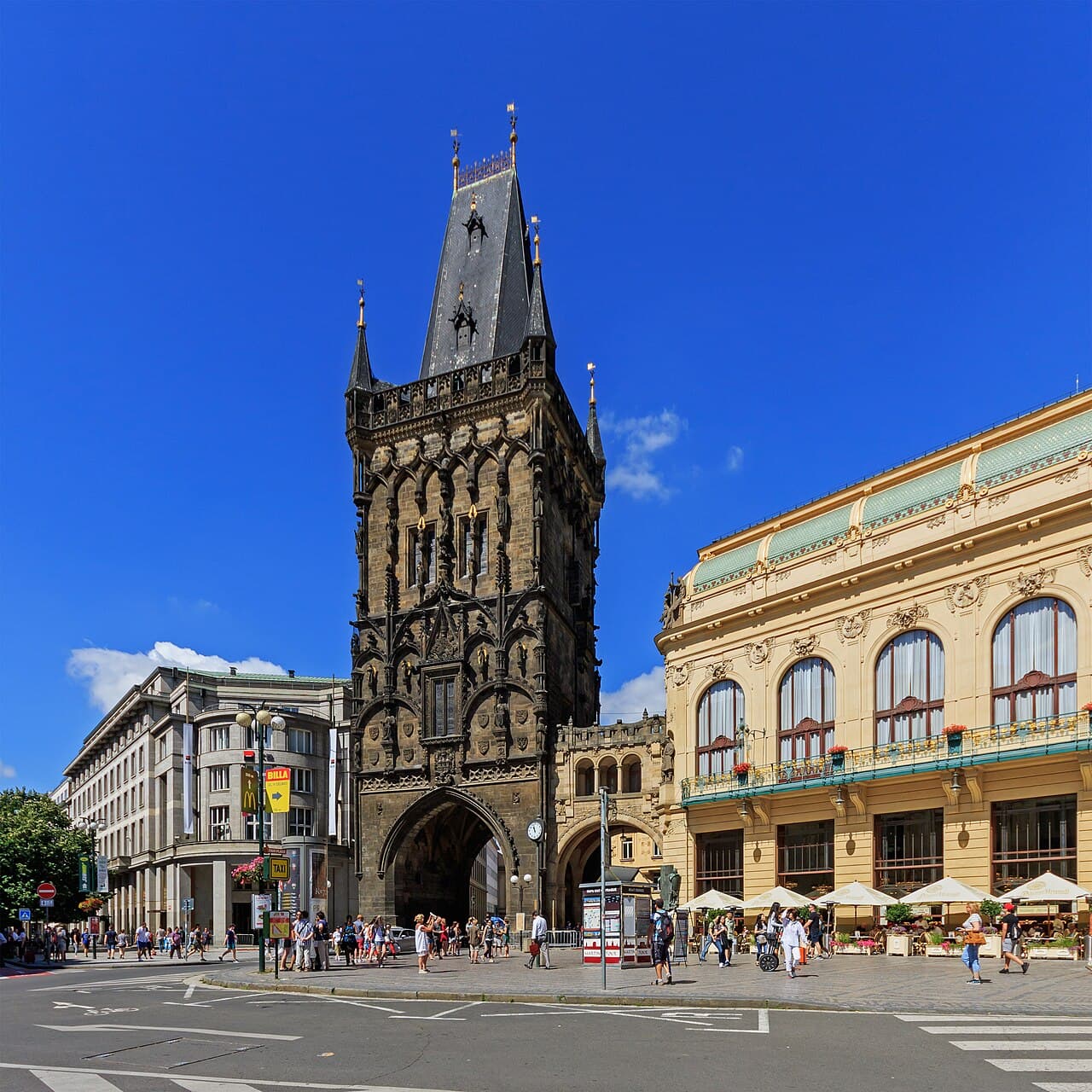
The palace was strategically located near the Nicholas Gate (historically called the Mountain Gate and today known as the Powder Gate), an important access point on the route connecting Prague to the mining town of Kutná Hora. Within the court grounds, specialized structures included baths for hygiene and a lion house (lvinec), likely used to keep lions or other exotic animals symbolizing royal power and prestige.
The queen’s court and adjacent properties
Across what is now Celetná Street stood the Queen’s Court (Dvůr králové), a neighboring property with a distinct history. Formerly owned by families such as the Velfl, it was used by King Wenceslaus IV and later by Queen Johanna, the spouse of George of Poděbrady. This proximity highlights the interconnected nature of royal residences and their role in courtly life.
Later history and transformations of the site
After the decline of the King’s Court as a royal residence following 1485, parts of the palace were pawned and came under the ownership of the Lobkowicz family. In 1631, Cardinal Ernst Adalbert of Harrach purchased the property and established a priestly seminary there in 1636. The complex suffered a fire in 1689 but was rebuilt and enhanced with the addition of the Baroque Church of St. Adalbert, designed by the architect Jean Baptiste Mathey and consecrated in 1705.
The seminary was closed after the suppression of the Jesuit order in 1773, and the church itself was later closed due to the Josephine reforms. Between 1869 and 1900, the site housed a military cadet school. Ultimately, the original medieval buildings were demolished in 1902–1903 to make way for the present-day Municipal House (Obecní dům), a prominent civic building in Prague.
Today, a commemorative bronze plaque on the Municipal House honors George of Poděbrady and his residence here from 1454 to 1471, underscoring the site’s enduring historical and cultural significance as a center of political and religious life in medieval Bohemia.
Archaeological remains and heritage commemoration
Excavations have uncovered foundational walls and other remnants of the original palace complex, providing valuable insights into its construction techniques and spatial organization. These remains are preserved underground, as no above-ground structures from the medieval King’s Court survive today.
The Baroque Church of St. Adalbert, once a prominent feature of the site, no longer stands, but its historical presence is documented through visual sources and architectural records. The street name Králodvorská commemorates the medieval court, replacing the former name Benediktská, which referred to the now-demolished Church of St. Benedict.
Historical illustrations from the mid-18th century depict the King’s Court alongside the Church of St. Adalbert, offering a glimpse into the layered architectural and cultural history of this important site in Prague’s Old Town.
Significance in Prague’s urban and cultural landscape
The King’s Court played a crucial role in shaping the medieval urban fabric of Prague’s Old Town. Its location near major city gates and thoroughfares connected it to important trade and communication routes, including the road to Kutná Hora, a vital mining center. The court’s function as a royal residence, legal archive, and ceremonial site made it a focal point of Bohemian political power and cultural life.
Although the physical structures of the King’s Court no longer stand, its legacy endures through archaeological remains, commemorative plaques, and the continued recognition of its historical importance in Prague’s heritage. The site’s transformation over centuries—from royal palace to seminary to military school and finally to a civic building—reflects the dynamic history of Prague itself.
Frequently asked questions (FAQ)
- How do I get to King’s Court in Prague?
- King’s Court is conveniently located in the heart of Prague, making it easily accessible by public transportation. You can take a tram or metro to the nearest stations, and it's just a short walk from there. If you prefer to explore on foot, the castle is well-signposted and offers beautiful views along the way.
- What is the historical significance of King’s Court?
- King’s Court has been a pivotal site in Czech history, serving as the royal residence and a center of political power. Established in the 14th century, it played a key role during the reign of Charles IV and has witnessed numerous historical events. Today, it stands as a testament to the rich heritage and cultural evolution of Prague.
- When was King’s Court built?
- King’s Court was originally constructed in the 14th century, during the reign of Charles IV, who sought to establish Prague as a significant European capital. Over the centuries, the castle has undergone various renovations and expansions, reflecting different architectural styles. This blend of history and architecture makes it a fascinating site for visitors.
- Can I take guided tours of King’s Court?
- Yes, guided tours of King’s Court are available, offering an in-depth exploration of its history and architecture. These tours typically include access to key areas of the castle and are led by knowledgeable guides. It's advisable to book your tour in advance, especially during peak tourist seasons.
- Why is King’s Court considered an architectural gem?
- King’s Court is renowned for its stunning Gothic and Renaissance architecture, showcasing intricate details and impressive structures. The castle features elaborate facades, beautiful frescoes, and remarkable interior designs that reflect the artistic styles of its time. This architectural diversity attracts many visitors and photography enthusiasts.
- Is it possible to visit King’s Court with children?
- Absolutely! King’s Court is family-friendly and offers various activities for children, including interactive exhibits and guided tours designed for younger audiences. The vast grounds provide ample space for exploration, making it an enjoyable experience for the whole family.
- What are the opening hours for King’s Court?
- King’s Court is typically open to visitors from 9 AM to 5 PM, but it's best to check the official website for any seasonal changes or special events. Extended hours may apply during peak tourist seasons. Planning your visit accordingly can help you avoid crowds and enjoy a more relaxed experience.
- What are the ticket prices for King’s Court?
- Ticket prices for King’s Court vary depending on the type of tour and access level you choose. General admission tickets are reasonably priced, and discounts are often available for students and seniors. It's recommended to purchase tickets online in advance to secure your spot and potentially save on fees.
- What are some nearby attractions to visit while at King’s Court?
- Nearby attractions include the iconic Prague Castle, St. Vitus Cathedral, and the charming Malá Strana district. These sites are within walking distance and offer a rich blend of culture, history, and stunning views. Exploring these attractions can enhance your visit to King’s Court and provide a comprehensive experience of Prague.

Information
Website
Visit websiteSources & official resources
Verify the information above using these authoritative references.
Loading map...
Visitor reviews
No reviews yet. Been here? Write the first review and help other travelers!
Write the first reviewVisited this castle? Share your experience
Your review helps other travelers and adds first-hand knowledge to our encyclopedia.